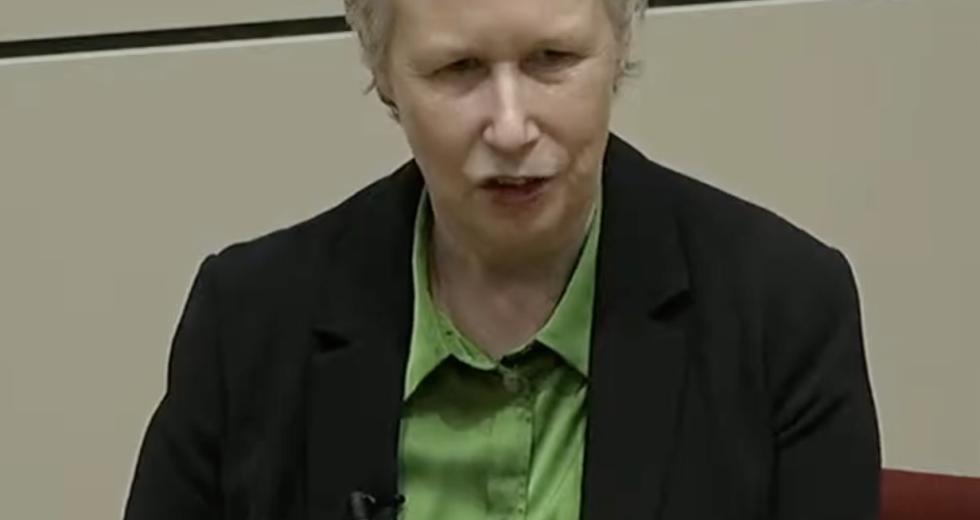
Michelle Haslem is the recently appointed Director General of the Homeland Security Group (HSG) in the Home Office. This makes her one of the most senior spies in British intelligence. She has risen almost without trace, as we saw in Part 1 of this investigation. In the second and final part of this investigation, we ask how her earlier training in literary theory has informed her covert career in MI6. After that, we look at the history of the Homeland Security Group. We reveal that every single former Director General of the HSG has apparently been in MI6. We put this together with the new Fusion Doctrine adopted by British intelligence in 2018 and suggest that rather than contain the deep corruption and lies exhibited by MI6 during the Iraq war, the evidence of the HSG suggests that MI6 has effectively spread its influence throughout British intelligence and on to the ‘whole of government’.
Passionate Commitments to EDI?In her biographical note on the University of Nottingham’s website, Michelle Haslem states that she “is a passionate advocate for EDI, and is actively engaged in initiatives to ensure that the FCDO is more representative of the country we serve”.
EDI — Equality, Diversity, and Inclusion — is perhaps an odd interest for a covert MI6 officer, given that for the entire period of her ‘service’ with British intelligence, the whole direction of UK foreign policy and the history of MI6 operations have been deeply racist. However, a professed interest in EDI is perhaps not surprising, given that she studied English Literature and has participated in gender studies. Her PhD acknowledgments noted:
I would also like to thank Chester College for a grant which has supported me for the duration of this project, and my friends and colleagues at Chester, especially the members of the gender studies seminar, for their comments and advice.
It is worth, therefore, reflecting on the contents of her PhD thesis to see if the theories and commitments rehearsed in it help us to make sense of the apparent thread of similar commitments from gender studies to EDI over a quarter of a century.
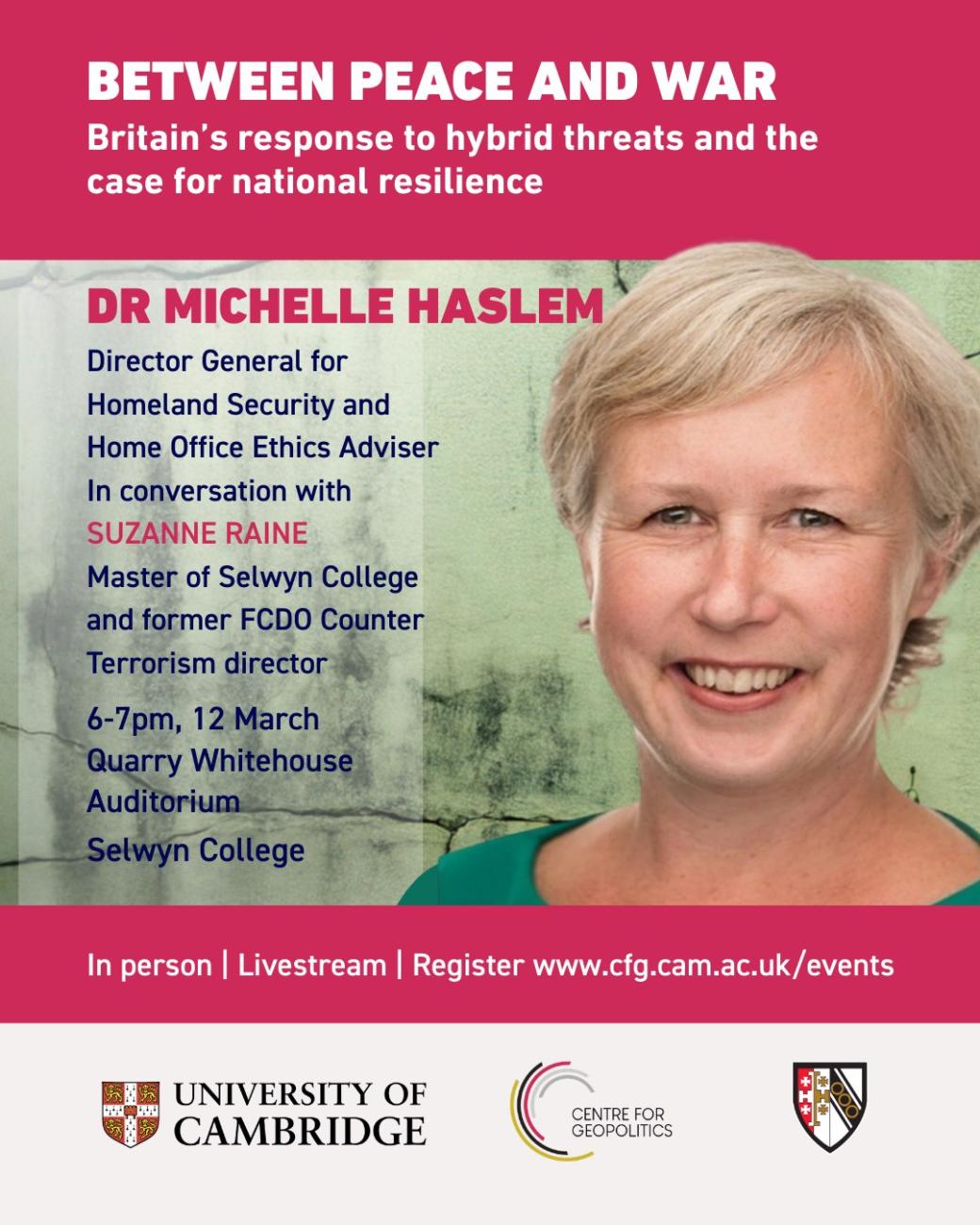
March 2026: Advertising the first public talk by Michelle Haslem in a quarter of a century
Michelle Haslem’s PhD thesis, titled Familial Politics and the Stuart Court Masque, was submitted in August 1999, by which time it appears she had already joined MI6. Was her subsequent career a radical break from her interests in gender studies and literary theory? Or are there things we can learn from reading it in the light of her subsequent leading role in the abuses and terror inflicted by MI6 in the quarter-century after 1998?
Her thesis challenges monarch-centred theories of power by examining the Stuart Court. These were advanced in the so-called ‘New Historicist’ readings of Stuart Court masques (performances put on for the monarch) and Shakespeare’s The Tempest by highlighting how familial politics and other voices disrupt, rather than solely support, the sovereign's power. By focusing on agency within performances at Court, it argues that power is a contested, non-monolithic force, effectively employing post-structuralist and gender-focused perspectives to show how marginalised figures like Queen Anne challenge patriarchal authority and create openings for audience resistance.
The New Historicism, which Haslem criticised, is totalising in its view of power. Heavily influenced by French philosopher and anti-Marxist Michel Foucault's model of power, it treats power not as a top-down authority, but as a pervasive, inescapable network that dictates all knowledge and social practice. Haslem criticises New Historicists like Stephen Greenblatt (she never cites Foucault) who are said to argue that any apparent act of subversion, rebellion, or resistance within a text or culture has actually been pre-authorised and ‘contained’ by the dominant power structure to reinforce its own stability. This means true political agency or exteriority to power is virtually impossible. Haslem’s thesis attacks this, but she does not break from Foucauldian notions of power. The thesis pushes back against a specific strain of that framework. It uses post-structuralist tools to critique a specific Foucauldian trap within New Historicism. It argues that power is a messy, multi-sided negotiation, rather than a one-way street dominated by the monarch.
When you look at this through the lens of a senior British intelligence operative in counter-terrorism (MI6) who claims to be a “passionate advocate” for EDI while steering institutional Islamophobia, the 1999 thesis reads almost like a blueprint for the exact brand of neocolonial counter-insurgency and statecraft that has defined the last three decades.
The intersection of Haslem’s academic argument, her state power, and her internal contradictions reveals four distinct connections, which are summarised below.
1. EDI as the New Court Masque
In her thesis, Haslem notes how King James used the court masque to “aestheticise his power as a beneficent and creative act” in order to hide real violence, such as the colonisation of Ireland. It should be noted, however, that this former Catholic grammar schoolgirl of Irish heritage never refers directly to the colonisation of Ireland in the thesis. In her MI6 career, EDI is her modern-day court masque. Advancing women or championing gender equality within the intelligence apparatus functions as a cosmetic ‘mystification’ of state power. It wraps an inherently violent, surveillance-heavy, and Islamophobic state agency in the progressive language of liberation.
2. The Weaponisation of Imperial Feminism
Haslem’s thesis focuses heavily on how Queen Anne used her female body and performance to challenge the king. This mirrors the logic of imperial feminism. In British counter-terrorism, gender equality is weaponised to justify aggressive foreign and domestic security policies. This helps create the ideological justification to target Muslim communities. The framework paints Islamic cultures as uniquely backward, patriarchal, or dangerous, thereby legitimising structural Islamophobia and MI6's surveillance state under the guise of ‘protection’.
3. Co-opting ‘Other Voices’ for Surveillance and Propaganda
The thesis champions the idea of an uncontrollable, active audience. When the author writes about The Tempest’s “banquet of harpies” failing to make the sinners feel remorse, she explicitly states:
… spectacles, even those produced by the state, could be interpreted in any of a number of ways. Even when stagecraft and statecraft are in collusion, the creator, be it King or masque-writer, cannot control the response of the audience.
This is a textbook expression of the ‘active audience’ theory popular in literary theory, media, and cultural studies in the 1990s and beyond. She is arguing that the audience has the power to decode, resist, and re/misinterpret state propaganda. She uses this ‘active audience’ concept to escape Foucault's trap of total state control.
In theory, Haslem’s thesis celebrates the ‘active audience’ and ‘other voices’ of women, such as Queen Anne, or colonial subjects like Caliban — the indigenous central character in Shakespeare’s The Tempest — as sites of freedom and democratisation that the monarch cannot control. “My own project”, she writes, “constitutes an attempt to [develop] a model which finds room for oppositional forces”.
In practice, in her MI6 career, Haslem recognises that audiences and marginalised groups, which are ‘active’ and uncontrollable, pose a direct threat to the state. Therefore, counter-terrorism policy (like Prevent, of which she is now in charge as Director General of the Homeland Security Group) cannot rely on simple, top-down propaganda. The state must step in to map, monitor, and manage those ‘active’ responses. This is, of course, precisely what the covert propaganda unit in the Home Office’s Research, Information and Communications Unit (RICU) does, as I have shown. She is presently commanding that unit, which sits beneath Prevent in the Home Office hierarchy. We can also note the irony that Haslem advertises that she is the Home Office Ethics Adviser while simultaneously overseeing what is probably the least ethical part of the Home Office.
In British counter-terrorism policy (specifically frameworks like Prevent), ‘listening to other voices’ within Muslim communities was never about democratisation. It was a targeted intelligence-gathering and subversion strategy. By mapping out the internal factions, ‘familial politics’, and distinct elements within the community, the state learns exactly who can be co-opted — to become the state’s favourite Muslims — and who must be neutralised.
4. Directing the ‘Spectacle’ of the Enemy
If power is not an abstract, inescapable web, then it is an intentional, targeted mechanism wielded by specific actors. In her thesis, Haslem shows understanding that the “creator ... cannot control the response of the audience”. Therefore, intelligence operatives do not try to project a flawless image of absolute power. Instead, they engineer controlled friction. They allow, or better cultivate, anti-Muslim rhetoric, fearmongering, and securitised ‘crisis’ narratives to circulate in the public space. This intentionally shapes public anxieties and helps keep the population dependent on the security state.
While the brutal reality of Michelle Haslem’s trajectory cannot be predicted directly from her thesis, it is perhaps appropriate to note that ‘freedom from the monarch’ becomes effectively an interrogation of how a ruling class survives when its authority is challenged. She took the lessons of the Jacobean court — that raw autocracy fails, and that you must manage diversity, absorb factions, and perform benevolence — and successfully applied them to the preservation of the modern British security state.
As I have been arguing for over a quarter of a century, the ‘active audience’ theory is an illusion. Audience response is not some magical, free-floating space of resistance. In the real world, ‘active responses’ are heavily conditioned by material conditions, media ownership, class, and state intervention, including most notably propaganda.
From believing in the ‘active audience’ during her academic years, Haslem apparently became highly attuned to the fact that the state must actively manage how people interpret events. When she transitioned into British intelligence, she did not leave ‘other voices’ alone to be free; she has used the state's immense resources to police, surveil, and structure those voices so they could never mount a real defence against anti-Muslim policies.
The thesis claims the audience is free; her career is, and has been, dedicated to making sure they never could be.
EDI and the Neutering of Anti-racismHaslem’s commitment to EDI is a mark of how far the EDI discourse has contaminated and neutered genuine anti-racist struggles. Here is a very senior spook claiming to be a “passionate advocate” of EDI who at the same time waxes lyrical in her interview with Civil Service World about how touched she was to witness the struggle of the Ukrainian regime: “I’m really proud of what the UK Government is doing in Ukraine”. She notes she has visited Kyiv and has heard from “Ukrainian counterparts” — specifically the Banderite, Nazi-aligned Ukrainian intelligence services — which “was a high point of my career, humbling and moving”.
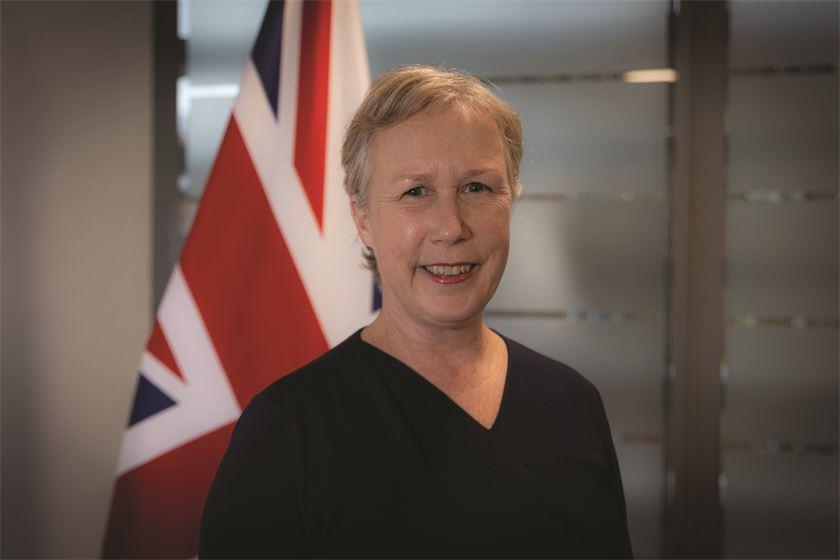
Haslem's official portrait, supplied to Civil Service World in April 2026. Note the Union flag, which is not necessarily always displayed in Birkenhead in preference to the Irish Tricolour
In the same interview, she happily trades in Islamophobic slurs, such as the term ‘Islamist’. Given her history, it is also clear that she has been a leading figure in the deeply racist counter-terrorism activities of the British state. She even gives an EDI gloss to participation in MI6, in a passage where she talks about her “brilliant” career — surely a matter for others to judge? On barriers to women becoming spooks, she says:
There are stereotypes and perceptions that might put women off. I think part of my role is to demystify and to debunk those myths — so national security careers do not equal being James Bond. There are tons of jobs in national security that are being done really successfully by women — and by men who don’t want to be James Bond either, who have families and caring commitments.
In other words, you do not need to be a testosterone-fuelled assassin to take part in the crimes and abuses of the British state. She goes on:
So for me, this is not just a question about women. This is about making national security careers really attractive to the diverse talent we have in this country so that nobody feels that a job in national security isn’t for them.
No British citizen should feel a job in national security is not for them — just so long as they are comfortable participating in war crimes and racist oppression, not forgetting direct participation in the genocide in Gaza and the decades-long subversion of the Islamic Republic of Iran.
Appointment in the Homeland Security GroupHaslem’s predecessor Chloe Squires was listed as earning between £155,000 and £159,999 as of 31 December 2024. Like her predecessors in the role, this is an appointment at SCS3 level — the second highest in the Senior Civil Service. In subsequent disclosures in March and June 2025, though the post number is disclosed (HO407), neither Squires’ name, job title, unit in the Home Office or salary are disclosed. All is withheld for national security reasons — the only member of the Home Office at SCS3 or above to be withheld. One imagines that when the first data on Haslem is disclosed, the same will apply. It would appear that these redactions were in part a consequence of a marked reorganisation of the Homeland Security Group. This is evidenced by the significant cuts in the large salary budget of those staff reporting directly to the DG (Squires) from £2,056,997 (31 December 2024) to £397,142 (31 March 2025). This was accompanied by new structures underneath Squires of four SCS2 level Directors in charge of Counter-terrorism, State Threats/Cyber, and Economic Crime (plus a central directorate position), to whom the staff salaries of those reporting to them were allocated. This would appear to have been done in preparation for the appointment of a new DG of HSG: Michelle Haslem.
What Is the Homeland Security Group?The Homeland Security Group, formerly known as the Office for Security and Counter-Terrorism (OSCT), looks like a sort of MI5 fiefdom, given that it operates in the Home Office, which is MI5’s home turf. In its early years, however, its propaganda group, the RICU, was funded by and run with staff from the FCO and DCLG. The Home Office took full control of it in 2011 when the Prevent strategy was revised. It is responsible, as we have noted, for counter-terrorism, state threats (including cyber threats), and economic crime. Its counter-terrorism brief gives it primary responsibility for “the operational relationship with MI5”.
However, the appointment of Haslem is not the first time that an MI6 officer has been at the helm in the HSG. The inaugural DG of the OSCT was Charles Farr (June 2007–December 2015). At the time of his appointment, The Sunday Times reported that “the Home Office said Farr was a ‘diplomat’ who had served at British embassies in South Africa and Jordan”. But as the paper noted, “security insiders” confirmed that he had reportedly been a career MI6 officer.
He was followed by another career MI6 officer, Tom Hurd (April 2016–March 2021), the nepo baby son of the former Tory Home Secretary Douglas Hurd. Unlike Haslem, Hurd had previously operated in the open, with undercover titles at postings including at the Warsaw embassy in 1995, at the same time as the future whistleblower Craig Murray. Indeed, they had the same job title, but only one was a spook. He was named as an MI6 operative on the famous 1999 leaked list of operatives. His identity as MI6 was further confirmed in a 2023 memoir, Leadership: Lessons from a Life in Diplomacy, by the former Permanent Secretary of the FCO, Simon McDonald.
The third DG was Chloe Squires (1 April 2021 to August 2025) who had evidently been a career intelligence officer, possibly in MI5, but given her earlier roles in the FCDO and in setting up the National Cyber Security Centre which is part of GCHQ (also Foreign Office based), more likely in MI6.
According to the description given by Tom Hurd, the role of DG at HSG is pivotal to and has oversight of all domestic British intelligence operations:
As Head of the UK’s Office of Security and Counter-Terrorism for the last five years, Thomas Hurd was the most senior official in the UK government responsible for Homeland Security, leading cross-government work countering state threats, cyber crime and security, disinformation, money laundering, online harms, child sexual exploitation and terrorism. He also oversaw the domestic operations of the intelligence agencies, CT Police and the National Crime Agency and played a leading role internationally on domestic security issues, especially within the Five Eyes community.
In other words, the HSG has a key role which in the words of the Home Office “sits at the heart of the UK’s national security system, setting strategic direction and playing a crucial enabling role in national security and law enforcement operations”. Given that all of its Directors General since creation in 2007 appear to have been MI6 officers, it would seem to be an MI6 fiefdom.
Does MI6 now run all of British intelligence, or indeed the British Government?
Fusion DoctrineAmong the reasons for suspecting that MI6 now has an outsized role in both the intelligence worlds, and indeed in the entire machinery of government, is the adoption — formally in 2018 — of the so-called ‘Fusion Doctrine’.
Here is how the UK Government explains and justifies it. In the March 2018 inaugural statement of the policy, it is referred to as a “whole-of-government” approach to intelligence. Speaking to the Defence Select Committee in May 2018, the architect of the policy Sir Mark Sedwill described the Fusion Doctrine as a means of ensuring the UK is “deploying the full set of our national security, economic and influence capabilities ... against the full set of our national security, economic and influence goals”. Sedwill personally symbolised the intelligence takeover of the whole of government by unprecedentedly simultaneously holding the positions of National Security Adviser (an intelligence position) and Cabinet Secretary (the most senior civil servant).
Speaking to Civil Service World, Sedwill reflected:
… the doctrine has grown from government’s response to the Chilcot report, and is designed to ensure there is not only proper rigour and process when strategy is set and decisions are made, but that there are effective mechanisms to deliver those decisions using all of government’s capabilities as well as its ‘catalytic’ ability to get other partners involved in reaching strategic aims.
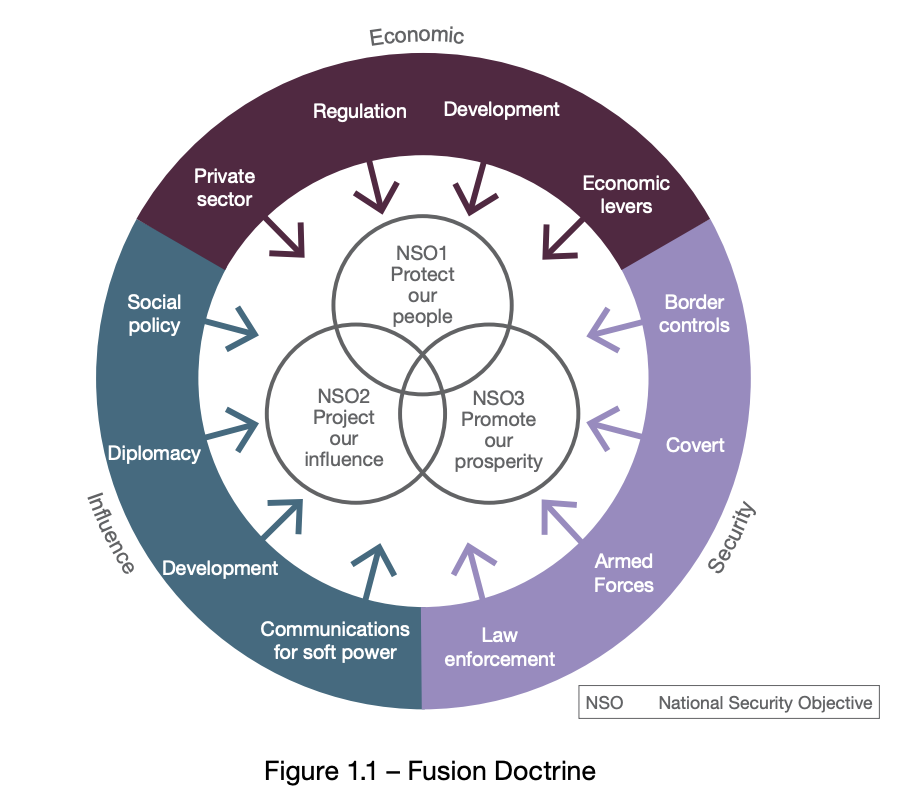
The all-encompassing Fusion Doctrine as illustrated by Military Strategic Effects, a British military propaganda unit
Let’s translate this into more straightforward English. MI6 and other British intelligence agencies were involved in a systematic propaganda campaign on the threats allegedly posed by Saddam Hussein — including on WMD and the ‘45-minute claim’. The lies were investigated by the Iraq Inquiry. The inquiry determined they were not lies exactly, but rather the product of silos and groupthink. This, it was suggested, needed to be smashed by creating a National Security Council to bring all the intelligence agencies together to find unity in assessments as opposed to allowing MI6 to drive things. This approach was further developed by the introduction in 2018 of the Fusion Doctrine. This was supposed to finally smash intel or ministerial fiefdoms, silos, and groupthink.
But it had another fundamental aspect which actually counteracts and dramatically escalates the power of the intelligence agencies, including MI6 specifically. This is the so-called ‘whole of government’ approach. To the extent that this is confined to testing intelligence assessments across the whole of government, it is arguably within the realm of a Whitehall solution to an identified problem. In reality, however, it is not confined to that. Instead, it dramatically leverages the power of the intelligence agencies allowing them to pull on the full range of governance levers — intelligence, economic, and influence (aka propaganda) — to direct government, as opposed to informing it of intelligence assessments. Thus, we have the Chilcot findings being subverted. Far from containing MI6, it resulted in MI6 effectively taking over the intelligence agencies and indeed having a key role in the ‘whole of government’.
It is no surprise, therefore, to see career MI6 officers in charge of intelligence operations across Whitehall, including domestic intelligence operations like counter-terrorism, which are supposed to be the preserve of the police and MI5. Michelle Haslem may be an anomaly in being of Irish Catholic heritage and coming from ‘Up North’, but as part of the barnstorming colonisation of government by MI6, she is very much on brand.