From 1998, for 25 years, Michelle Haslem was a covert MI6 operative. Her name never appeared in public in English, and no photos of her appeared anywhere online. It was only in late 2022 that her existence was acknowledged in public sources in an obscure minute of a Council meeting at the University of Nottingham. Shortly thereafter, in 2025, she was appointed one of the most senior spies in British intelligence as Director General of the Homeland Security Group in the Home Office. Where had she been for a quarter of a century? The answer is: we don’t know. But in order to piece together something of her story, we need to go back to her childhood, examine her education, and how she was recruited into MI6. This will help us work out what she has been up to since then.
It is said that the tap on the shoulder at an Oxbridge college is a declining part of the recruitment process for the British intelligence agencies. This would appear to be illustrated in the case of Michelle Haslem. Born to parents of Irish origin in March 1974 in Birkenhead, her parents, Michael Haslem (born 1946) and Kathleen Mullarky (to use her maiden name, born in 1948, also in Birkenhead) had married in the town in 1970. Her younger brother Jonathan was born three years after Michelle in 1977. Back in the 1840s, Birkenhead was a magnet for Irish people fleeing the British-imposed Famine of 1845-1851. By 1851, “a quarter of the town’s population was Irish born; the highest proportion of any British town at the time”. Michelle’s father Michael passed away in June 2025 at 78 in Greasby, just outside Birkenhead.
Haslem was a Catholic Grammar School girl, attending Upton Hall Convent School in Birkenhead. In the summer, after she left school at age 18, just before she went off to Nottingham University in September 1992, Haslem appears to have been involved in a serious road accident. According to the Market Rasen Weekly Mail on 10 July 1992:
Shortly before midnight on Saturday, a Vauxhall Cavalier with six people in it veered off the A46 Caistor bypass down an embankment. Four of the people were thrown from the vehicle and two others had to be cut free by fire-fighters. The driver, Michelle Haslem from Grimsby, was taken to hospital with serious injuries along with one other passenger, Josephine Morley, who was also seriously injured. The other four passengers suffered minor injuries.
Public records do not disclose another Michelle Haslem of that age, whether born or living in Grimsby or elsewhere. Perhaps ‘Grimsby’ was a misheard rendering of Greasby where Haslem did live. We can note that a Vauxhall Cavalier did not have six seats. Having to be cut free and sustaining serious injuries while driving an overloaded car must have had significant effects on an 18-year-old, assuming it was her.
Haslem’s early achievements included being awarded a Gold Duke of Edinburgh Award at a Buckingham Palace Garden Party in July 1993, just a year later. Her qualifying voluntary work included helping on a sick people’s pilgrimage to Lourdes organised by her local Catholic Diocese.
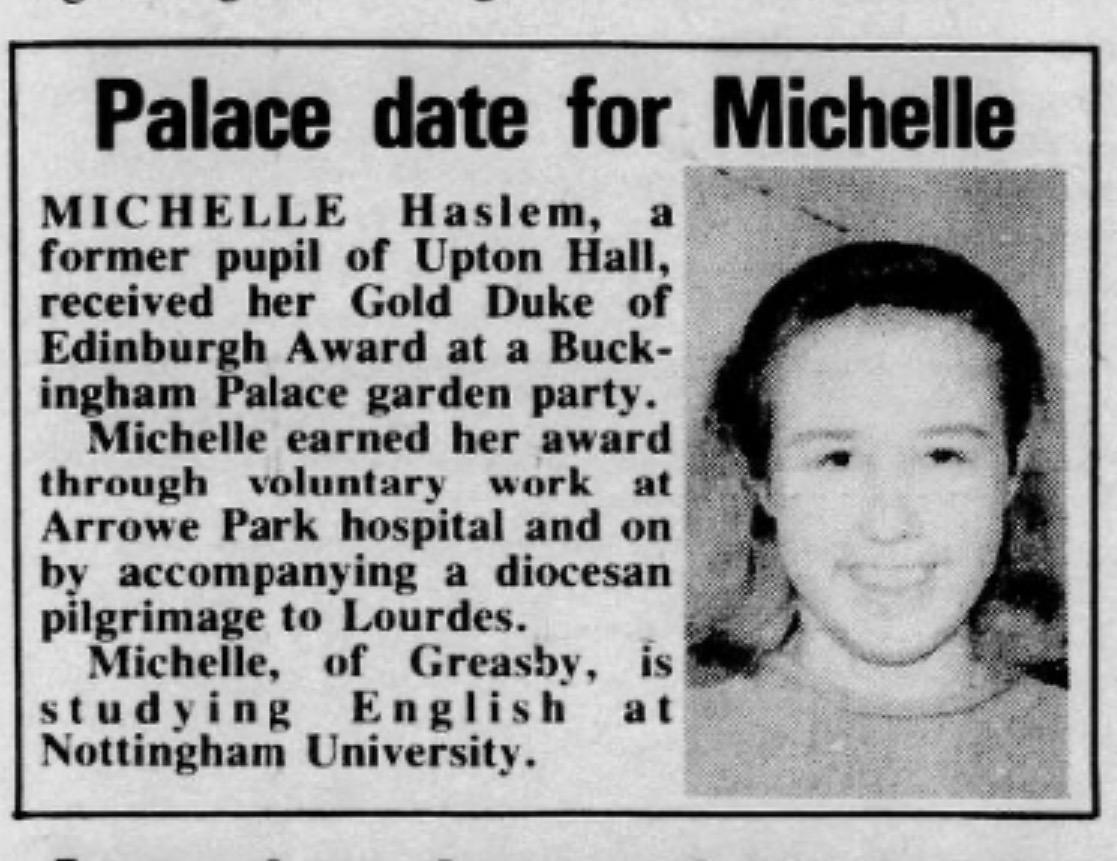
Hoylake & West Kirby News, 14 July 1993
She graduated in English in 1995 at the age of 21. She later studied for a PhD at the University of Liverpool in English Literature. She was awarded her PhD in 1999. In April 1998, she won a Festival prize for ‘Vocal Ensemble’ at the 50th Anniversary Golden Jubilee of the Bromborough Festival. She was 24, and within months would be an MI6 officer.
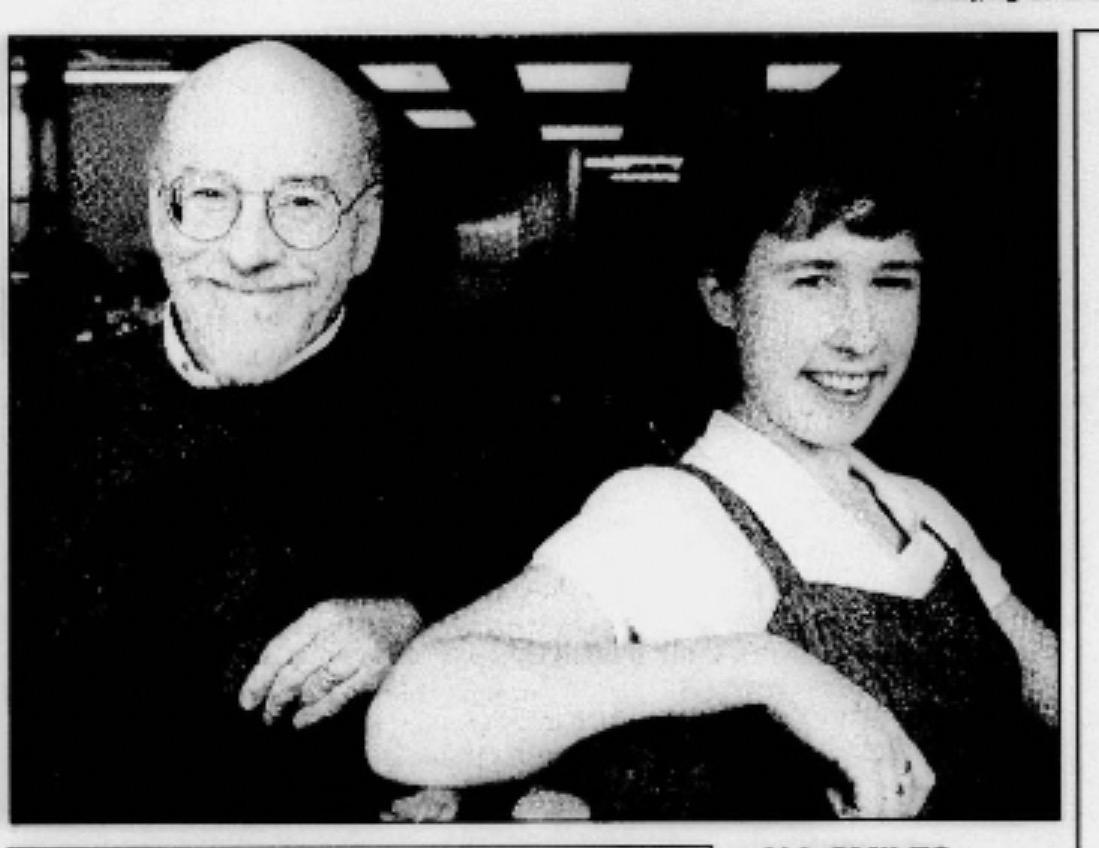
Original caption: ALL SMILES: Francis Nance, of Wallasey and Michelle Haslem of Greasby at the festival. — At the 1998 Bromborough Festival. Chester Chronicle, 3 April 1998
She appears to have joined MI6 in 1998, presumably after the completion of the first draft of her PhD, though her final draft was submitted in August 1999.
Michelle Haslem’s career in MI6 has been under deep covert cover. Not for her, with one exception we will come to later, the occasional appearance on the Diplomatic List as ‘Second Secretary (Political)’ at a middling British Embassy. No, she appears to have spent almost her entire career in MI6 as a covert operative in MI6 stations in various parts of the world and in the UK, public knowledge of which is fragmentary at best.
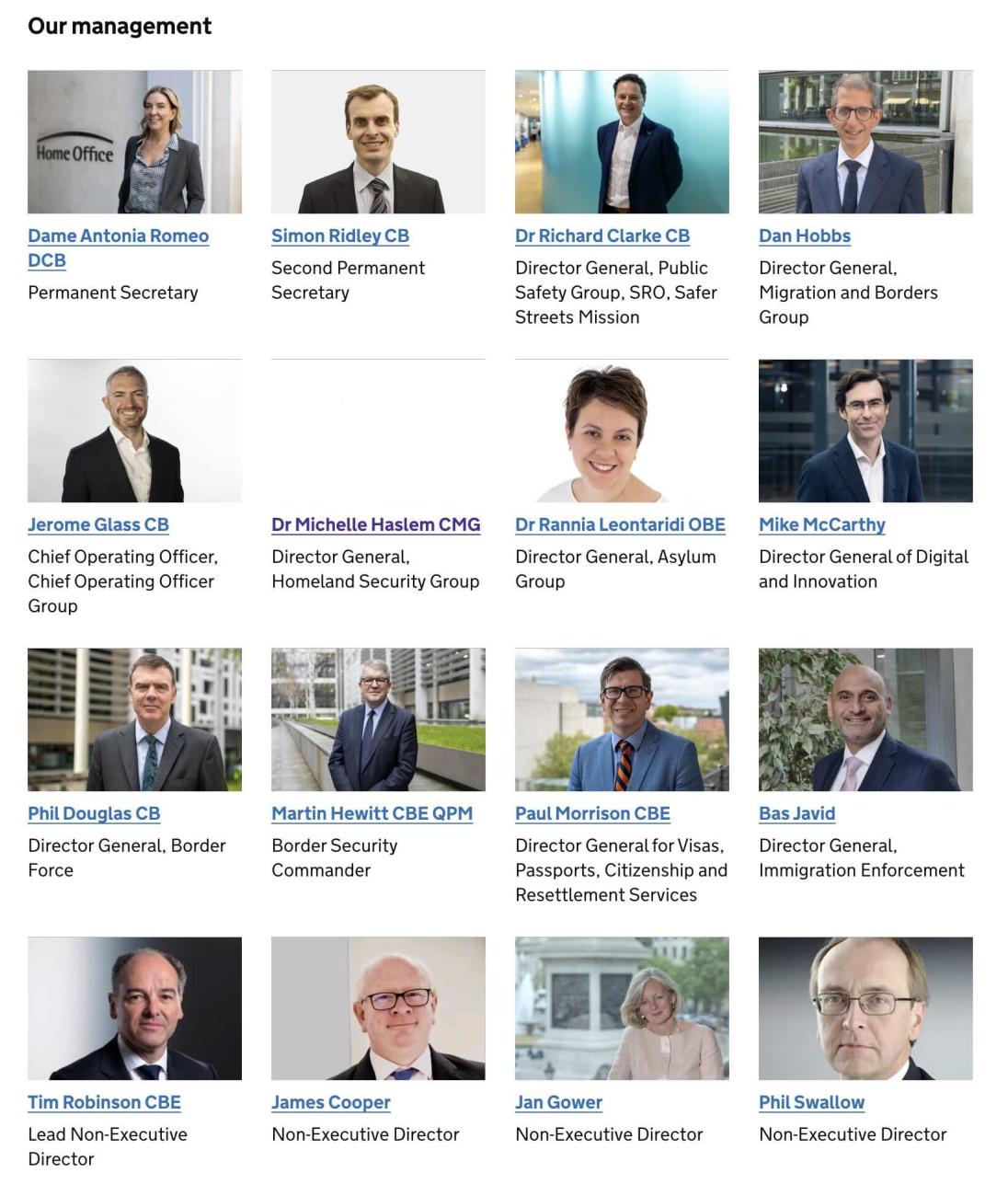
But now she has slipped into the public world as the Director General of Homeland Security in the Home Office. I say ‘slipped’ because, unlike previous heads of the Homeland Security Group (HSG), and indeed all other members of the current Home Office management, there is no photograph of Ms Haslem on its website. Why the Home Office — or more likely MI6 — has taken this decision is an open question. But, it is all of a piece with the entire rest of the internet. You will scour in vain for a photographic likeness of one of the UK’s top spies until early in 2026.
MI6 ensures cover for its officers through various methods, including via carefully constructed false identities, backed by specialist support teams. One can distinguish four main types of cover:
- Public Official Cover: A common method involves officers taking on official, seemingly legitimate roles, such as diplomatic staff within a British embassy, or working for other government departments or trade delegations abroad. This provides a plausible reason for their presence in a foreign country and offers a protection under diplomatic immunity.
- Non-public official cover: In this case, the MI6 officer is acknowledged or “avowed” to the host government's intelligence or security services but not publicly listed as a diplomat. They may be assigned a generic role within the embassy (eg, “administrative assistant” or “attaché”) and their true role is a known secret between the respective intelligence communities, but not a matter of public record.
- Non-Official Cover: In other cases, officers may operate under “non-official cover” to conceal any government affiliation. They might pose as business people, journalists, civil society workers, students, or other professionals. This requires them to build and maintain a convincing backstory, or “legend”, that can withstand scrutiny.
- Deep Cover (“Illegals”): Some operatives are in “deep cover” using entirely false names and nationalities. Sometimes dubbed “illegals”, they operate without the protections of diplomatic immunity, making their cover more vital to their operational security.
Harry Ferguson, a former MI6 intelligence officer, described this in 2014:
A good operational officer has a number of different cover stories. Let's assume that you are based in your home capital. You could get called out anywhere and your target could be anyone. So a good operational officer will have six or seven, possibly more, covers and there are specialist departments within those intelligence services whose job it is to maintain those covers. In my day, however, you could simply print a passport, hop on a plane and arrive. Now advances in technology mean maintaining people's covers has become a specialist area and it is a much more sophisticated operation.
The MI6 website admits that the agency has dedicated internal teams whose specific job is to create, maintain, and advise on covers:
To help keep our operations and the identities of our agents secret, we keep the identities of our staff secret too. We have a team dedicated to help us keep cover, advise us on what to say when people ask, and how to navigate difficult conversations.
Officers undergo rigorous training to ensure they can maintain their cover identity convincingly under pressure. This includes training in anti-surveillance techniques and role-play scenarios designed to replicate real-world operational challenges.
The identities of MI6 staff are kept strictly confidential. New recruits are warned not to discuss their application with anyone other than a close British family member or partner, and never on social media. This high level of secrecy extends to all aspects of their work and personal lives to minimise risk to themselves and their operations.
The goal of these methods is to ensure that officers can gather intelligence covertly while minimising the risk to their safety and the success of their mission.
Michelle Haslem was clearly not in the first category. It seems likely that, of the other three categories, she was an “avowed” intelligence officer, but this is not clear. The first public mention of her name in English in a quarter of a century was in November 2022 when the minutes of a University Council meeting at the University of Nottingham announced that “following a recruitment process the Nominations Committee had recommended” that she should be appointed a member of Council for a period of four years from 1 January 2023. Then in June 2023, she was awarded a CMG, the third class ‘Companion’ of the Order of Saint Michael and Saint George. She was listed in the Gazette as follows: “Dr. Michelle HASLEM Director General, Foreign, Commonwealth and Development Office” and the award was for the opaquely general “services to British Foreign Policy”. This specific phrasing is standard diplomatic cover for senior intelligence officers who cannot have their real operational ‘achievements’ publicised.
The announcement also gives a further clue — it refers to her as a “Director General” in the FCDO. A Director General (DG) is a position in the Senior Civil Service (SCS). The SCS has four pay bands, given the name SCS1, SCS2, SCS3 or SCS4, where SCS4 is the highest. A Director General is the second highest of these — SCS3 — heading up a large directorate and reporting directly to the Permanent Secretary with a salary range of £125,000 to £208,100.
But when was she in the DG position? In October, a new biographical page on her was posted on the GOV.UK site which stated she had been a DG between 2019 and 2025, and in a disclosure in a conflict of interest statement at Nottingham, she states the role started in September 2019. However, if we consult FCDO disclosures on the senior management of the department for this period (January 2024) featuring all DG level appointments and senior appointments below that level (see below) we find that her name is not present, a clear sign that she was in a covert role in MI6. In other words, the appointment has been effectively described as civilian cover in order to ease her into the public realm.
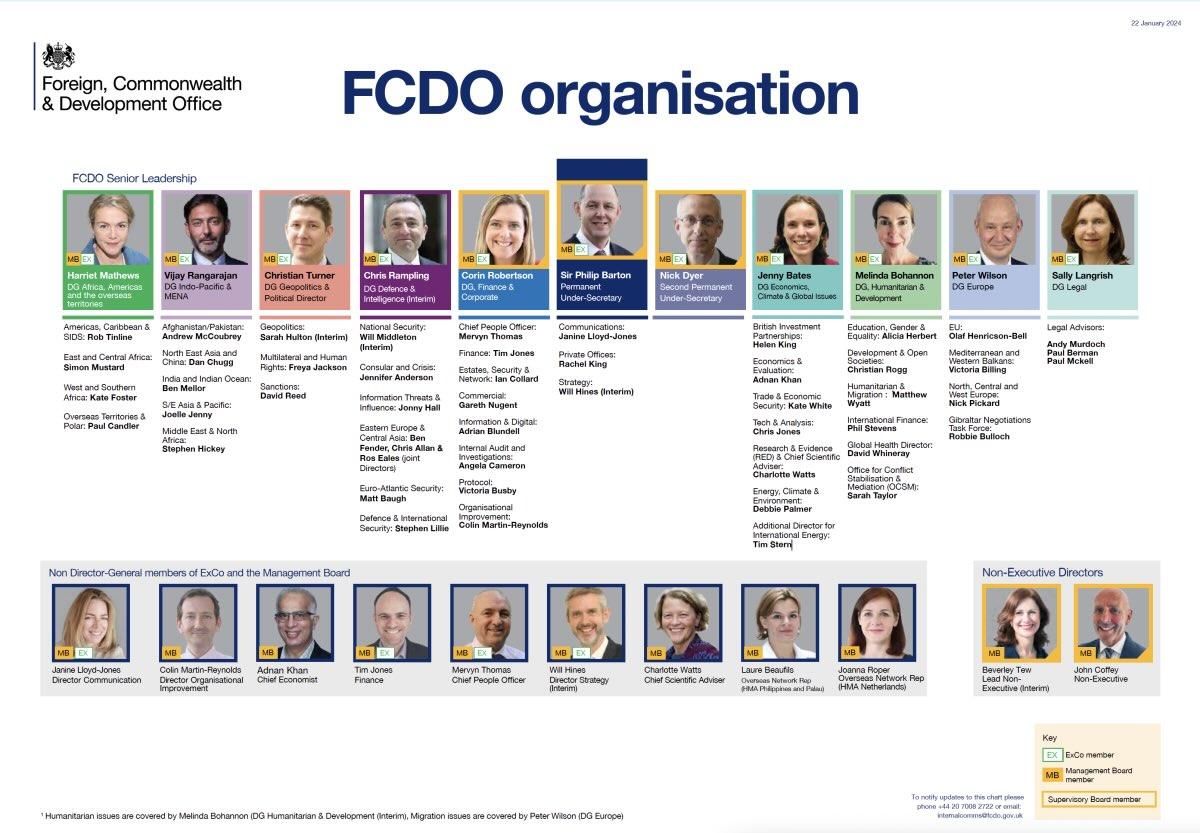
No mention of Michelle Haslem in the FCDO organisation chart — a sure sign of a covert role
The Route to a Covert Career
We know very little about her activities after she joined MI6 in 1998, which was around a year into the first Tony Blair administration and nearly five years before the illegal invasion of Iraq.
Prior to her appointment as a DG in the FCO, her official biography states that she had been a “national security professional with 27 years’ experience gained from roles in the UK, Asia, the Middle East and Europe”. But where? In March this year, Haslem appeared in public for what appears to be the first time in 25 years. She gave a talk on hybrid threats at Selwyn College, Cambridge, chaired by an academic — Suzanne Raine — who also appears to have been a career MI6 operative. In the talk, Haslem let slip that among her FCDO postings were “Southeast Asia”, and “Paris and Bucharest”. She didn’t say "Middle East”. We can get some further clues by looking back at her milieu during her student years and the first part of her MI6 career.
The Move to LondonOne thread upon which we can pull is that in the acknowledgements to her PhD, she thanks “Andrew”: “Last but not least I would like to thank my friends and family, especially Andrew, who has been with me every step of the way”. This would appear to be Andrew J. Cawley, who we may surmise was her boyfriend or partner since at least the beginning of her PhD in 1995, but probably back to the time they were both Nottingham undergraduates between 1992-1995.
Later, in 2002, he was on the electoral roll with Haslem as the only other person registered at a flat at 129, Henry Doulton Drive, London, SW17 6DF. Cawley was not registered on the electoral roll at Haslem’s next known address in East Dulwich, London, SE22 in 2005 (precise address withheld for confidentiality). Records at the Land Registry show that Haslem bought the leasehold of this flat in June 2001 for £110,000. She was 27 years old at the time. The flat is still registered in her name today. Electoral roll records suggest that the flat has been rented out to a changing cast of tenants at least between 2002 and 2017, when it would appear she returned to London.
Cawley and Haslem were also registered at Ground Floor Flat, 44, Canonbie Road, London, SE23 in 2006. Historic Land Registry documents show the flat was bought by the pair for £207,000 in June 2005 and sold for £455,000 in October 2016. In the 2010s, Cawley pursued his career in a couple of jobs in Thailand, but I have not been able to determine if this was the country in South East Asia to which Haslem was posted.
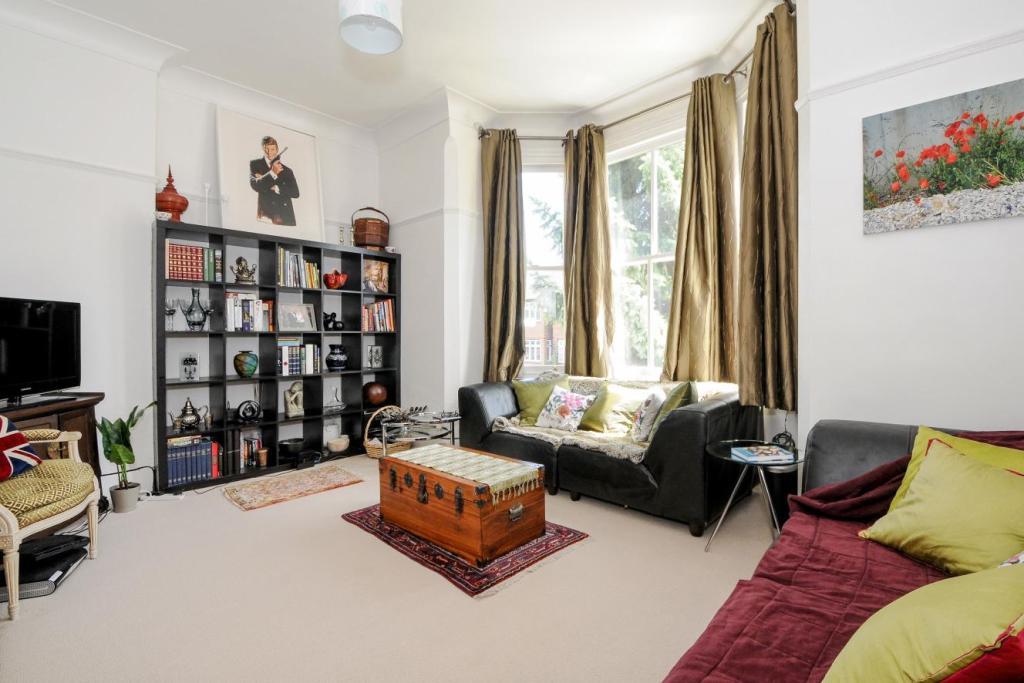
Rather fetching portrait of Roger Moore as James Bond, an MI6 assassin, glamourised in a long-running series of movies — and a tasteful Union Jack pillow! The flat at Canonbie Road owned Michelle Haslem up for sale in 2016. By this time she was some 18 years into her MI6 career.
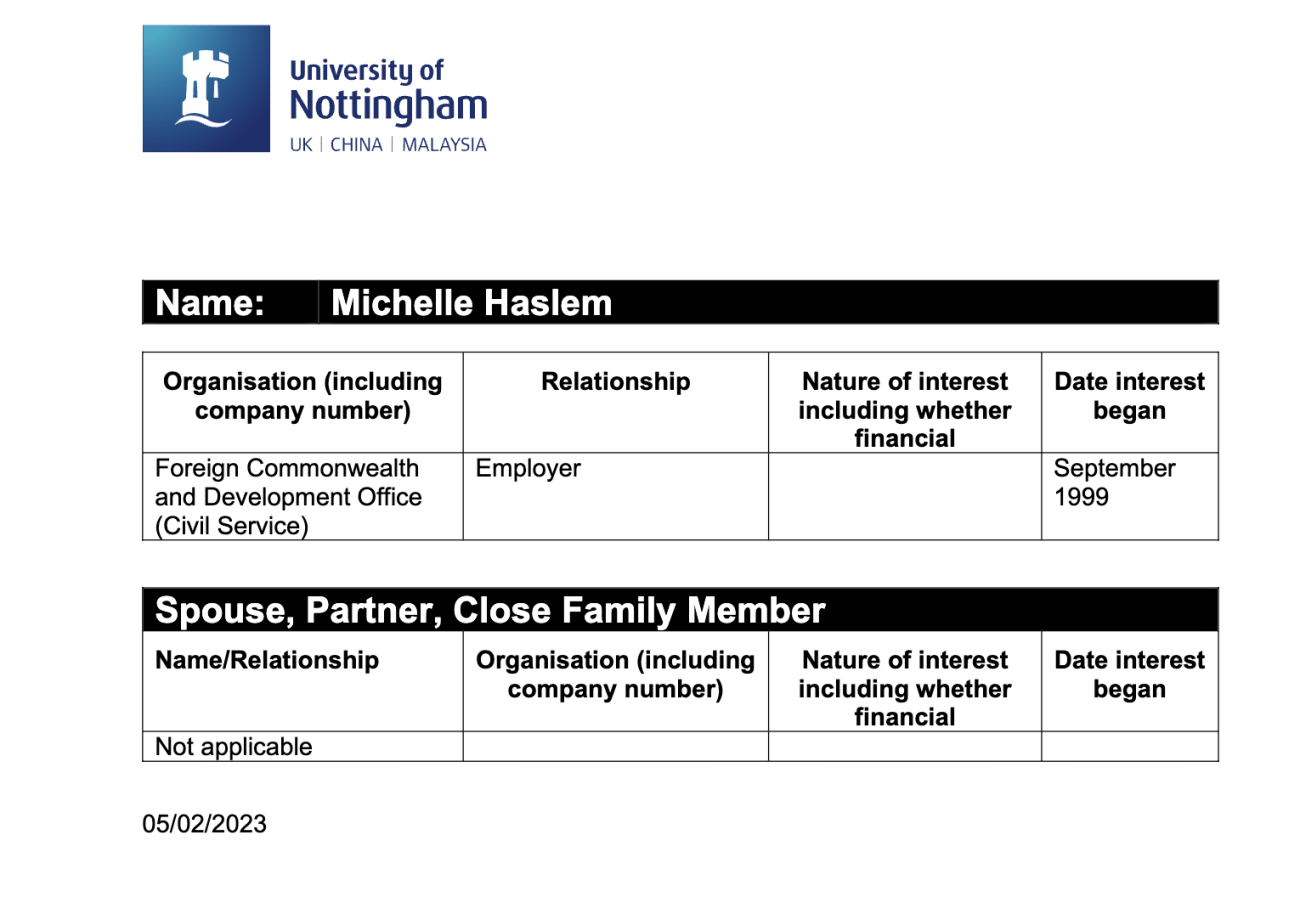
Haslem’s conflict of interest disclosure at Nottingham
Between 1998 and 2012, Haslem was posted overseas for at least six years. There is scant further information about most of those postings, including in South East Asia, the Middle East, and Paris. During these years, British intelligence officers were intimately involved in very serious crimes and abuses.
Rendition, Torture, and AbuseBased on findings from the UK Parliament Intelligence and Security Committee (ISC) and legal challenges, MI6 was complicit in torture and mistreatment. The agency routinely capitalised on torture inflicted by foreign allies. MI6 proactively assisted the US Central Intelligence Agency (CIA) in abducting terrorism suspects and flying them to secret prisons or countries known for brutal interrogation practices.
The ‘James Bond Clause’ and Domestic LawbreakingDuring this era, MI6 routinely relied on this specific legal loophole, which permits the Foreign Secretary to give written authorisations protecting MI6 officers from UK prosecution for crimes committed abroad — including bribery, murder, kidnap, or torture. A later tribunal investigation revealed that MI6 had unilaterally assumed secret policies permitting its covert agents to run operations involving serious criminality within the UK, without adequate transparency or proper ministerial oversight.
The Ultimate War Crime: IraqThe primary justification used by the UK and US Governments for the 2003 invasion of Iraq was the imminent threat of Iraqi Weapons of Mass Destruction (WMDs). This argument claimed that Saddam Hussein possessed active biological, chemical, and nuclear programmes capable of devastating international peace. As is well-known, subsequent independent inquiries — most notably the Chilcot Report (2016) — comprehensively proved that this justification was built on heavily manipulated, unverified, and flawed intelligence provided by MI6 and partner agencies.
Given Michelle Haslem’s role in national security and counterterrorism — and specifically in South East Asia, the Middle East, and London — it is highly likely that she has been directly and personally complicit in at least some of these crimes and abuses.
MI6 Station, BucharestThere is a further detail worth mentioning which is that, perhaps as part of easing into public view, Haslem appears to have created a Facebook page. It is anonymous-looking, with no profile picture and has only 110 friends at the time of writing, but it does state her school and university attendance and mentions being a DG at the FCDO. There is an additional detail stating she was living in Bucharest, Romania. So that supports her admission that she was posted to the Bucharest Embassy. In fact, official Romanian Government records note her role as a ‘Political Counsellor’ (Consilier politic) there from 21 May 2012 to at least March 2016, most probably as MI6 Station Chief.
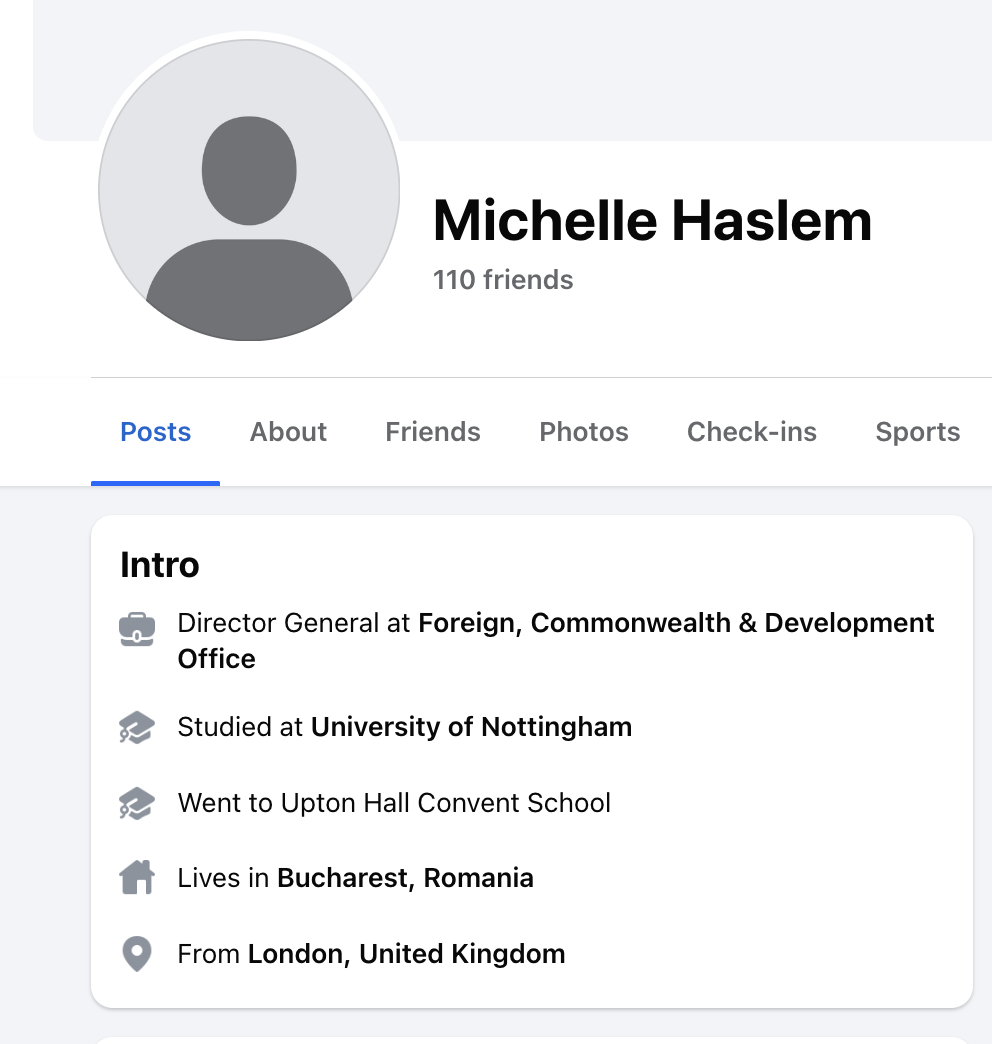
Facebook: She lives in Bucharest, Romania
Haslem’s term in Bucharest appears to have coincided with a scandal in which a former Director of MI6, John Scarlett, was implicated in gathering intelligence in Romania using ex-spies for a client in a legal case. The client was Alexander Adamescu, who, in June 2016, was arrested in London on foot of a Romanian European Arrest Warrant over alleged 2013 judge bribery offences. Adamescu’s defence team formally retained Sir John Scarlett’s corporate intelligence firm, SC Strategy Ltd. Their operatives — former spies — deployed to Bucharest to build a counter-intelligence file showing that the Romanian National Anti-Corruption Directorate (DNA) was running a politically motivated prosecution. SC Strategy packaged its findings from 10 confidential Bucharest assets (Sources A–J) into a highly sensitive, formal ‘Expert Report’. It was, however, ruled inadmissible by British courts.
Scarlett’s company, SC Strategy, was set up by him after he stepped down from MI6. His co-director was the fanatical Zionist and former ‘independent’ Reviewer of Terrorism Legislation Alex Carlile (Lord Carlile of Berriew).
It is likely that Scarlett or his operatives, and whoever was the head of the MI6 station in Bucharest, would have had informal contact at this time for so-called ‘deconfliction’ purposes. This would have been conducted strictly under standard, deniable protocols.
The Counsellor in the British Embassy in Bucharest is usually the third highest-ranking official, sitting directly underneath the Deputy Head of Mission. In that position, she was likely at the top of the civil service ranks or on the first rung of the FCDO Senior Management Structure. Her posting to Bucharest as Political Counsellor likely served as a bridge from a senior operational lead via Grade D7, into the top tiers of intelligence management in Whitehall (SMS1/SCS1).
Into the Whitehall Intelligence Machine?Though the official descriptions of her career are very circumspectly written, they do, nevertheless, give some clues that after Bucharest she was recalled to London into a promoted role, presumably at SCS2 as a prelude to her further promotion to SCS3 in 2019 in her role as DG in the FCDO. Her bio on the Nottingham University website notes: “She is known for her collaborative approach to solving complex problems across departmental boundaries. She has specific expertise in managing national security risks, and in leading crisis response including to terrorist incidents”.
These skills and experiences suggest that her role in 2016-2019 was in intelligence coordination. The most likely location for such a role is in the Cabinet Office, where since 2010, the National Security Secretariat has been responsible for intelligence co-ordination and attempting to break down ‘silos’ and ‘groupthink’ which were said in the Chilcot Report on the Iraq war to be behind the intelligence ‘failings’ in that period.
Haslem gives further clues in an interview with Civil Service World in April this year. This seems to have been only the second time that a photo of her had been published. Asked if she could share a challenging time in her career, she talked about “one job that was totally outside of my comfort zone”, a technology programme, which “was one of the most difficult but also most developmental jobs I’ve done.” She went on:
I thought I had to learn and understand all of the technology and to learn and understand all about projects and programmes and agile and waterfall — and I did all of that, and it was really helpful. But fundamentally, I was trying to bring together people from different organisations to do technology in a different way. And ultimately, it wasn’t about the technology. All of the objections were very human.
This kind of job in cross coordination between intelligence agencies (and other government departments) is very much the role of the Cabinet Office intelligence machinery, and further suggests that in 2016-2019, she was seconded to the National Security Secretariat. It is a mark of how deep undercover she was that no reference to any such role has been published. This is in contrast with other officials who are seconded to the NSS (or the Joint Intelligence Organisation, the other key Cabinet Office intelligence grouping) whose particular roles are sometimes publicly acknowledged.
Among her friends on Facebook are the former head of MI6, Richard Moore, whose own page appears not to have been updated since 2019 shortly before he was appointed as the head of MI6. This suggests that it was prior to 2019 that Haslem connected with him on the platform. Moore, like Haslem, has Irish heritage. Indeed, it has been reported that his grandfather, Jack Buckley, was an Irish Republican Army Volunteer in Cork between 1916 and 1922. This little detail was revealed by the former Sinn Féin Director of Publicity, Danny Morrison.
Two of the most senior British intelligence operatives came from backgrounds that would previously have precluded their recruitment and progression through the service. What does it say that two people of Irish Catholic background, one of them with a grandfather who literally fought British colonialism, could end up as such senior figures?
Great power can incorporate and co-opt the descendants of former enemies. Is it a kind of ancestral betrayal, or a sign of how times change?
Certainly, it would appear that there are no doubts in Whitehall about the loyalty of Michelle Haslem, since, in late 2025, she was appointed as Director General of the Homeland Security Group. This gives her responsibility for intelligence oversight of all the UK Government’s counterterrorism activities as well as responsibility for economic crime and for so-called state threats (that is, targeting Russia, China, and Iran).
In the next part of this investigation, we examine how the Catholic Grammar Schoolgirl from Up North, with a PhD in English Literature, has adapted to the world of British intelligence and has come to play a key role in the barnstorming takeover of the whole of the British intelligence apparatus by MI6.