
This is Part 5 of a six-part series on the effects of Covid lockdowns on children, young people, and education. Part 1 and Part 2 summarised the so-called ‘science’ of lockdowns. Part 3 set out children's and parents' feelings and experiences, and Part 4 set out the educators' feelings and experiences. Part 5 presents the effect that the Covid era imposed on higher education and examines the efficacy of the UK Government’s decision to close educational institutions.
The purposes of this series are to:
- Present the evidence of what has been done to our children and young people — a compendium to remind people of the damage inflicted on a generation and for which no one has been held accountable
- Reject lockdowns as a valid public health strategy
- Reflect on the experiences, words, and feelings of the children and those trying to educate and care for them, and
- Highlight that, in the words of Professor Ian Brighthope, “They knew. They did it anyway”.
The reasons given for closing universities, thereby isolating students, were to protect students’ lives and to prevent them from transmitting a so-called deadly virus to their families. But did the risks to university-age students justify the Draconian Covid lockdown measures? The answer is an unequivocal no.
It is essential to remember that HM Government posted in March 2020: “As of 19 March 2020, COVID-19 is no longer considered to be an HCID [High Consequence Infectious Disease] in the UK”. The Government locked up the country a few days later. University classes immediately ‘shifted online’ with no preparation or advance warning for the lecturers and students who would be so profoundly impacted.
According to the Government’s own data from the Office for National Statistics, more people under age 25 died from road accidents than died ‘from Covid’ on average over a typical 16-week period. As Professors Norman Fenton and Martin Neill stated in their comprehensive evidence and data-driven rebuttal of the Covid narrative and policies, Fighting Goliath: Exposing the Flawed Science and Statistics behind the COVID-19 Event, “only 3 deaths in total of people under 20 were in people without at least one major underlying comorbidity … it was certainly no more deadly than flu”.
Freedom of Information requests revealed that the youngest person to die ‘of Covid’ in Northern Ireland was 38. In Scotland, only 13 people under 30 were recorded as having died ‘of Covid’ in 2022. The age-related Covid mortality rate for Western countries — only seemingly applicable for adults aged 40 and up — is shown below in the chart.
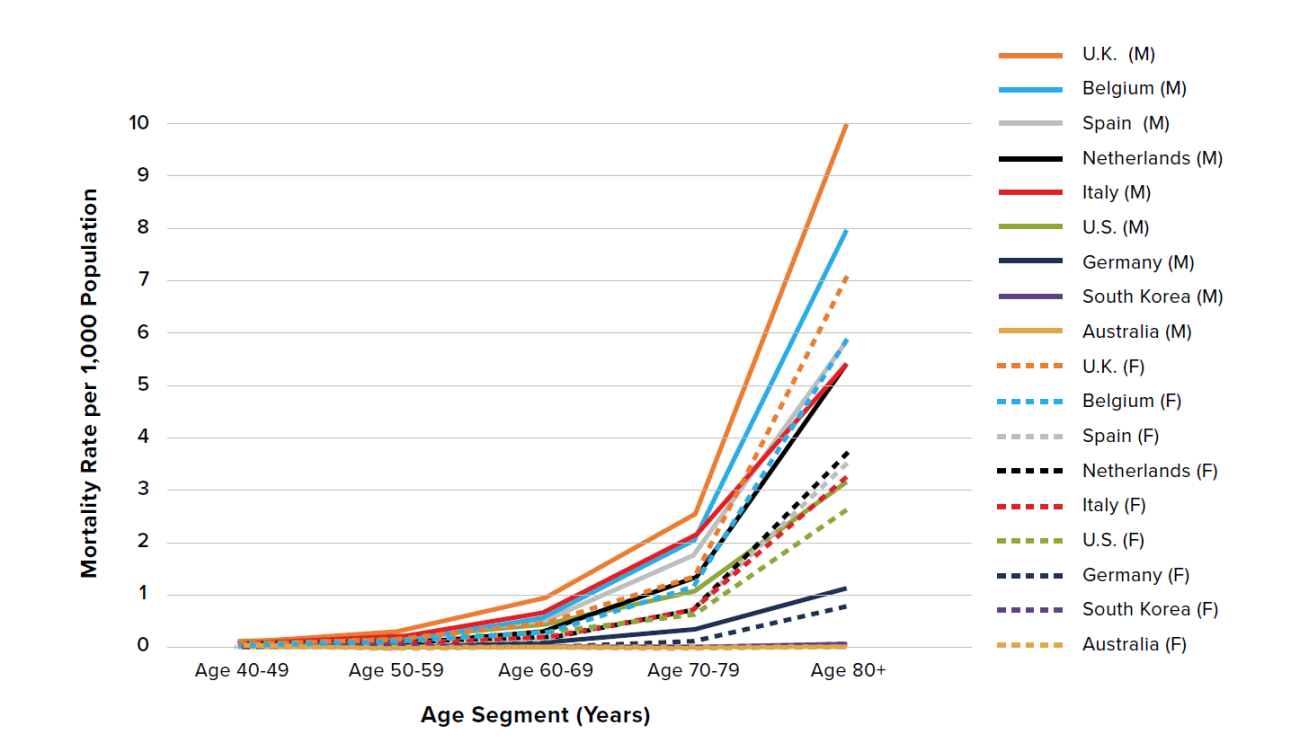
Covid mortality rates per 1,000 population by age and gender in adults aged 40 years and older. Source: RGA Reinsurance Company
Covid’s median Infection Mortality Rate (IFR) was 0.0003% at 0–19 years of age and 0.002% at 20–29 years of age. And, consistent with the very low IFR estimates in the non-elderly, excess death calculations showed no excess deaths among children and adolescents during the Covid era in any country with highly reliable death registration data.
Regarding transmission, Public Health England reported in September 2020:
How Did Covid Lockdowns Affect University Research?We found very few infections and transmission events in 131 educational settings during the 4-6 week summer half-term from 1 June to mid-July 2020. Where a SARS-CoV-2 positive case was identified, we did not find any additional cases within the household, class bubble or wider education setting when tested.
Dr Gerry A. Quinn, a scientist at the Centre for Molecular Biosciences at Ulster University, who has written about the effects of ‘public health policies’ on Covid, supplied this statement in response to a request from UK Column regarding Covid’s effect on laboratories:
I continued my research in a microbiology lab during the Covid period until lockdown was declared. The original data on the severity of the ‘new’ disease did not seem to be very clear or consistent, but I assumed that the public health authorities would soon get on top of it and let us know what was happening. As it was, the authorities were releasing some data from a very limited set of the population and then constructing models based on these very high infection fatality rates. For some reason, there seemed to be a great deal of shuffling of the definitions of cases and deaths, which made it very difficult to assess the actual threats posed. From my previous work in a laboratory which routinely handled multiresistant microorganisms and HIV, I knew that there were certain precautions that could be taken to prevent infection in a specially designed containment lab, level 2 or 3. However, the difference here was that Covid-19 was now in the community and was an airborne virus.
The initial public health instructions to the general population seemed to be quite contradictory as a whole. I generally ignored these because it seemed like politicians had been tinkering with the process and had their pet projects firmly embedded in the public health instructions.
Indeed, none of this affected me to any great extent until we were no longer allowed to enter the microbiology lab. I was very disappointed with this decision because it is an environment which is specifically designed to deal with pathogenic hazards. However, at the time, I assumed that this was a very temporary measure, perhaps a matter of a week or two. Indeed, I already guessed that many of the health policies being promoted were just attempts to be seen to do something and made little sense from a public health point of view, but I assumed that the people making local decisions went along with the administrators or local politicians rather than getting into a dispute.
Later, with colleagues in other institutions, I began to write a series of articles which disputed some of the logic behind the major public health policies coming from governments. At this time, it was almost impossible to have any scientific manuscript which disagreed with government health narratives published in the usual manner. Instead, many of these manuscripts faced immediate editorial desktop rejection or were ‘slow-walked’ so that they lost their relevance or even impact on policies. For instance, one of our manuscripts which simply said that seasonality was more responsible for the rises and falls of cases and deaths attributed to Covid-19 than any government measures or pharmaceuticals. This took two years, five journal submissions, and 12 reviewers until it was eventually published! It almost seemed like there was an undeclared, secret policy of not giving any scientist who expressed dissenting views any airtime. Indeed, many of the authors of our papers who objected to government measures such as lockdowns were also given similar treatment by scientific publishers.
There is a summary of this long, drawn-out process early in the Covid period by Simon Wood, who detailed his trials and tribulations in getting his scientific research published. All he was trying to say was that the number of cases/deaths was already falling before the introduction of any government measures, but this process took more than a year to see the light of day!
Looking back at this period, I get the feeling that orders came from very high up and people either had to accept these ‘health policies’ or face the consequences, which for some brave people included loss of their careers, reputations, and any means of making any money.
Even today, doctors who are demonstrably correct face sanctions from medical boards around the world. If we do not learn from our mistakes, how can public health move on?
A general distrust of ‘science’ seems to have arisen in certain people and groups since ‘the science’ of Covid. This is not entirely unwarranted. As Dr Randall Bock wrote on his Substack in February 2026:
How Did Covid Lockdowns Affect Students?Power is an intoxicant. What begins as an inversion of a discredited scientific hierarchy can, absent methodological discipline, devolve into the subversion of science itself: replacing evidence and contestation with proclamations enforced by status rather than proof.
University is indeed about much more than passing exams; it is about developing personally, individuating as an adult, developing leadership skills, and fostering meaningful relationships. In addition to considering what the lockdowns did to students, another question should be: did the authorities think that young people who may have been reluctant learners before leaving school would suddenly develop the focus and motivation needed to study at university level whilst staying inside their bedroom at home, or even more alone in a residence hall bedroom?
Olivia, a 19-year-old university student in 2021, said the following:
Every day is the same, and no matter how hard I squint, I simply cannot see a future on the horizon … I sometimes take the Xanax, too, when the fear settles in my chest and causes my heart to jump around. And it’s not lost on me that taking half the bottle could bring quick and relatively painless relief from this ‘new normal’ … I cry in the shower every day — at least on the days I can bring myself to take a shower … There will come a point when continuing to live in this much pain is no longer a viable option.
Lynn recalled her daughter's experience at the University of Dublin:
She lived under conditions that were genuinely dystopian: first-years confined to their tiny apartment groups, forbidden to visit friends even across the corridor. She was 17 years old, far from home, and she has never fully recovered her confidence since.
Watching the impact of the lockdowns on the students was difficult for those who observed it directly. Dr Zenobia Storah, a child and adolescent clinical psychologist who currently serves as Clinical Lead at the Knowsley Neurodevelopmental Pathway in Liverpool, shared her recollections:
How Did Covid Lockdowns Affect Lecturers?In November 2020, during the second national lockdown, I watched students at Manchester University tearing down barriers that had been erected, apparently to ‘keep them in’. The important thing was that young people were actually effectively being barricaded in their place of residence by the university authorities, in the name of public health. I watched those students in the grainy images taken on mobile phones and wondered anew what life must be like for these young people, locked up in their Halls of Residence, newly away from home, many with vulnerabilities. They were deprived of most of the normal experiences of university life and were now navigating such extraordinary social circumstances. I thought about the psychological difficulties experienced by my young adult clients. What would it actually be like to be locked in halls with stressed people you hardly knew, with no outlet and no idea of when this would end? It seemed to me that these students had been placed in an intolerable position, but that few in Government, the media, and society seemed to care much. These students provide unique insights into the world that emerged when students were ‘stuck in our rooms all day with no outlet’. Imagine being 18 years old, living in flats or on corridors with people you hadn’t chosen to live with and were just getting to know, but ‘all of a sudden you were with them every moment of the day’, with no escape.
What quickly developed was a deeply cliquey and reactive social life where you would panic if you weren’t invited to every single little thing. Everyone’s lives were so restricted, so enclosed, and so comparable. You could hear the parties. You knew who was hanging out with whom. This was a world in which it was ‘all the normal uni stuff, but … extreme’, a world of ‘destructive social dynamics’. You don’t have to be a psychologist to recognise the utter toxicity of this environment and to imagine the mechanisms by which many young people’s mental health deteriorated. You just have to remember what it is like to be 18 and apply a little empathic imagination.
There is now an entirely predictable plethora of evidence about the deterioration of young people’s mental health during the pandemic, including specifically students. In 2020, eight students’ lives were lost in the UK during the first month of the autumn term through suicide or drug-related deaths. In the words of the father of 19-year-old University of Manchester student Finn Kitson, who died in student halls in October 2020, 'If you lock down young people because of COVID-19 with little support, then you should expect that they suffer severe anxiety'.
Extensive evidence has demonstrated that educational closures negatively impacted learning and teaching. During the closures, the narrative that online learning was an adequate substitute for in-person teaching was promoted by governments worldwide and was used to justify extending the closures to the public.
Good teaching utilises varied strategies to engage students’ different learning needs. Overall, however, teaching requires verbal and non-verbal interaction to assess whether students understand the material. During Covid, it was frequently impossible for lecturers to know whether students understood lecture content, or whether they were even listening to lectures or participating in tutorials because students switched off their microphones and cameras during the Zoom, Teams, or Google Meet ‘classes’. Online learning platforms demonstrated that lecturers’ pre-recorded lecture videos were infrequently viewed. Universities instructed lecturers and exam boards to pass students who completed substandard assignments and exams because of Covid’s apparent impact on students’ ability to learn, and demonstrate their learning, to the usual high standard expected at university level. Marginally passable exams in 2020 (which were taken at home rather than in a proctored exam room) likely would not have met the requirements to pass in 2019.
Professor Diane Rasmussen, now UK Column’s Commissioning Editor for Written Content, was a senior lecturer at a Scottish university in 2020. She recalls the impact of the lockdowns vividly:
March 2020 changed everything about teaching and learning. I have a remarkable amount of experience with online teaching and learning, having taken postgraduate classes in either an entirely online or a ‘blended’ (a combination of online and face-to-face) format between 2000-2004 for my master’s and PhD, and teaching online from 2003 onwards. For all those years, I was adamant that online teaching, while beneficial in some aspects, does not replace face-to-face contact. I still maintain that position in 2026.
Despite my experience, I worked more hours during the Covid lockdowns than I did when I was on campus daily before March 2020. It simply takes more time and effort to communicate effectively with students through electronic communication, especially when explaining complex or technical concepts, compared to sitting together in a dedicated learning environment, or even over a cup of coffee. I developed mental and physical health problems, including a painful corneal abrasion which caused damage to my eye that continues to the present day, caused by staring at a computer monitor for too many hours every day.
It is impossible to imagine how difficult the ‘shift’ to online teaching and learning was for educators at all levels who had no experience doing it, but regardless, online learning was expected to magically happen instantly across the education sector, with no advance planning, and no consideration for the impact on us. My university told lecturers who didn’t own lecture recording equipment — many of them still used desktop computers in their campus offices rather than a laptop — to record lectures on their phones if that was the only camera they had available to them!
Students struggled academically and emotionally. University students living in residence halls and student flats were trapped in their own bedrooms, and were not ‘allowed’ to socialise with flatmates. Some lost their motivation to focus on their studies, and even worse, some became clinically depressed or indeed suicidal. Lectures broadcast live on Zoom or Teams, or pre-recorded from their lecturers’ homes using poor equipment such as their phones, allowed limited options for social and intellectual interaction with lecturers and fellow students.
The stress of the students’ circumstances passed down to us lecturers. As a programme director at the time — with pastoral responsibility to a cohort of students — if students reported depressive symptoms or suicidal ideation to me, all I could do was give them an email address to contact the student counselling service. Before 2020, I could refer them to the service with their phone number or their campus office location, meaning immediate direct contact and faster professional help.
It was difficult to believe that students paid full tuition fees for this university ‘experience’. They had no access to basic campus services, such as the student union, the libraries, the laboratories, or counselling services. Yet, lecturers received no pay rises, despite the increase in hours and workload. Where did the money go? I have to think the university administrators kept it. At the same time, the administrators were entirely unfamiliar with the reality that the on-the-ground teaching staff experienced. When my university’s principal announced during the lockdown era that he was going to give us Fridays off to ‘rest and recover’, it actually increased our stress levels because we were still doing more work than we were pre-2020, but given less time in which to do it.
Reflecting on it, even now, I have to believe the stress it created for us was entirely intentional.
Professor Richard Ennos, a retired professor of evolutionary biology at Edinburgh University, Chair of Common Knowledge Edinburgh, and a UK Column contributor, recently wrote this about his recollections at UK Column’s request:
A Sobering Thought: 2020’s School Pupils Are 2030’s University StudentsOn 11 May 2020, seven weeks into the Covid lockdown, I emailed approximately 35 colleagues and research students in my department of Evolutionary Biology at Edinburgh University. By that time, it was clear that we were not dealing with a deadly virus, and that there was no reason to quarantine the young and ruin their education and future prospects. I argued that the UK and Scottish Governments’ response to the Covid crisis was being developed not through rational analysis of the evidence, but through irrational fear engendered by the flawed scientific advice that they have been given by Imperial College London. Naively, I invited colleagues to use their sceptical and critical thinking skills to weigh up the evidence and come together to provide a clear statement that the science did not support the actions being taken.
Far from being critical thinkers, the academic community proved to be almost universally craven and bought into the Government narrative. Of the 35 recipients of the email, I received a supportive reply from only one member of staff, one postdoctoral researcher, and two PhD students. One professor of evolutionary biology took exception to the email, informing me that the death rate from Covid was 15%.
Convinced that they were doing the ‘right thing’, the university staff, switched seamlessly from face-to-face learning to remote teaching, and bizarrely this including the organisation of a virtual field course. When faculty returned, it was with masks, limitations on room occupancy, and warning signs everywhere. Young healthy students were encouraged by the university to take up the untested Covid vaccines that any critically thinking university biologist would have known were inherently dangerous — instructing their bodies to manufacture foreign proteins in multiple tissues for an uncontrolled length of time. And this came with a large helping of infantilisation for the students, organising walks in nature with the faculty to look after their mental health.
Universities were once seats of learning where critical thinking, free speech, and a passion for deeper understanding of the world were fostered. Covid has ruthlessly exposed what they have become. They are lackeys of the power brokers who provide the grants that keep them afloat. Their role is to manufacture the academic gloss to legitimise the false narratives that serve the purposes of those power brokers, and to embed those false narratives in the minds of the young. Where there should be diversity of thought and rational discussion, there is only imposed uniformity and conformity. If it is intellectual development you are after, steer well clear of universities.
Although the focus of this article is higher education, it is worthwhile reviewing the substantial evidence that measurable decreases in child development and educational attainment have occurred since 2020; after all, today’s schoolchildren are tomorrow’s university students.
A UCL study on the outcomes of the UK Government’s restrictions on children in 2020-2022 reiterated this, saying, “will have detrimental consequences for children and young people in the short and long-term, with many not yet visible” and added that there will be “negative impacts on young people’s professional life trajectories, healthy lifestyles, mental wellbeing, educational opportunities, and self-confidence”.
In 2023, the OECD’s Programme for International Student Assessment (PISA), which compares educational attainment among 15-year-olds around the world, showed UK schoolchildren achieved their lowest scores in mathematics and science since 2006, the first year of comparable data. Reading results were also down, close to the previous minimum in 2009. GCSE results mirrored these falls, with English and maths GCSE passes slumping to a historic low.
Other European countries had even greater attainment declines, and America’s Nation’s Report Card attributed its decline to school closures and the “era of virtual learning and social distancing”. Overall, worldwide results indicate significant educational and developmental setbacks whose long-term effects may not be fully understood for many years.
The National Foundation for Educational Research reported that Covid’s negative impact on reading progress, greatest among four- and five-year-olds, is of “particular concern as early reading plays a key part in children’s later achievement”. Reading progress is a concern even in normal times, yet reading standards are not systematically assessed across the UK, making it difficult to identify and support children who are falling behind.
More published research on lockdown’s negative effects on children and their education is available, for example, from the Education Endowment Foundation, the Royal College of Speech and Language Therapists, the UK’s Department of Education, The Daily Sceptic, and UK Column.
Only time will tell how the lockdowns will impact the children who were very young during the Covid era once they reach university; however, educational institutions have already reported reduced learning readiness among children who were still developing during the lockdowns.
Did Covid-era Online Learning Work in Universities?Back to the universities: was online learning successful during Covid for university students? The evidence is mixed. Although the efficacy of online learning is a separate concern, with little evidence supporting its pedagogy, the instantaneous ‘shift’ expected to implement the online teaching that was demanded of lecturers is the core issue, at least in relation to this article series. A September 2020 article in the academic journal Interactive Learning Environments encapsulated this vital concern: “the crisis-response migration methods of universities”. The authors stated, “it is evident that online learning is different from emergency remote teaching”. As discussed above, with no support, preparation or planning in place for the ‘shift’, lecturers were indeed thrown into crisis mode, with nothing available to help them. This crisis operation would, of course, trickle down to the students.
A reason typically mentioned in favour of online learning, by those who enjoy online learning as well as universities (including Harvard) selling online classes, almost always includes convenience for motivated students. After all, who wouldn’t want to earn a higher education qualification on one’s own schedule, wearing their dressing gown? Although some students had a positive attitude toward online learning over 20 years ago, they also expressed concerns, including their own technical proficiency and the reliability of online course delivery methods.
Years later, as technological advances moved forward, students’ computer literacy increased, and online learning became more commonplace, these were insufficient to overcome the Covid era’s contextual challenges. Canadian researchers concluded in a study published by Computers in Human Behavior Reports in 2021:
Our analysis shows that the specific context of the pandemic disrupted more than normal teaching and learning activities. Whereas students generally responded positively to the transition, their reluctance to continue learning online and the added stress and workload show the limits of this large scale social experiment. In addition to the technical and pedagogical dimensions, successfully supporting students in online learning environments will require that teachers and educational technologists attend to the social and affective dimensions of online learning as well.
The assumption that everything could be done online in 2020, from teaching and learning to buying food to speaking with family, presented particular difficulties for those who did not have access to an internet-ready device and reliable internet access. A 2020 article in the Journal of Pedagogical Sociology and Psychology presented Pakistani university students’ negative views in relation to the more readily obvious concerns about online learning:
… online learning cannot produce desired results in underdeveloped countries like Pakistan, where a vast majority of students are unable to access the internet due to technical as well as monetary issues. The lack of face-to-face interaction with the instructor, response time and absence of traditional classroom socialization were among some other issues highlighted by higher education students.
In summation, here, it is unreliable to look at the efficacy of university online learning during Covid without looking at the separate issues: (1) online teaching and learning itself and (2) the unprecedented conditions surrounding the Covid lockdowns. There are too many confounding variables.
What Happened at the Universities?Online teaching and learning was launched into an unprepared university system, untrained lecturers, and indeed into an unprepared student population. No reliable sources for deploying pedagogy online were widely available — if they existed at all. No assistance existed for lecturers regarding how to teach practical subjects online, how to moderate classroom discussions, how to design group assignments, or how to conduct scientific research with no university laboratory access. Campus services closed, leaving students without vital access to the many services and social opportunities which come with attending university.
Where did the student fees go if they weren’t being used on campus offerings or staff salary increases? We may never know. But it is worth noting that US tech stocks have skyrocketed by 187% since the end of 2019, whereas US non-tech stocks have gained just 59%. Computer sales in the UK saw a massive, immediate spike around March 2020. Total PC shipments to the UK grew to 12.15 million units in 2020, up 32.3% year-on-year from 2019. Zoom's global revenue grew from $0.62 billion in 2019 to $4.39 billion in 2022.
It seems corporate shareholders won during the Covid era, but university students and lecturers lost.

Hugh McCarthy
Hugh McCarthy recently retired as a head teacher after 23 years' service in that role. He has served as a director on two of Northern Ireland’s major education councils.

Professor Diane Rasmussen
Professor Diane Rasmussen is UK Column's Commissioning Editor for Written Content. Her reporting includes historic institutional child abuse, education, Western culture, and globalist policy. Before joining UK Column full-time in February 2025, she was a librarian and a professor of social informatics.