
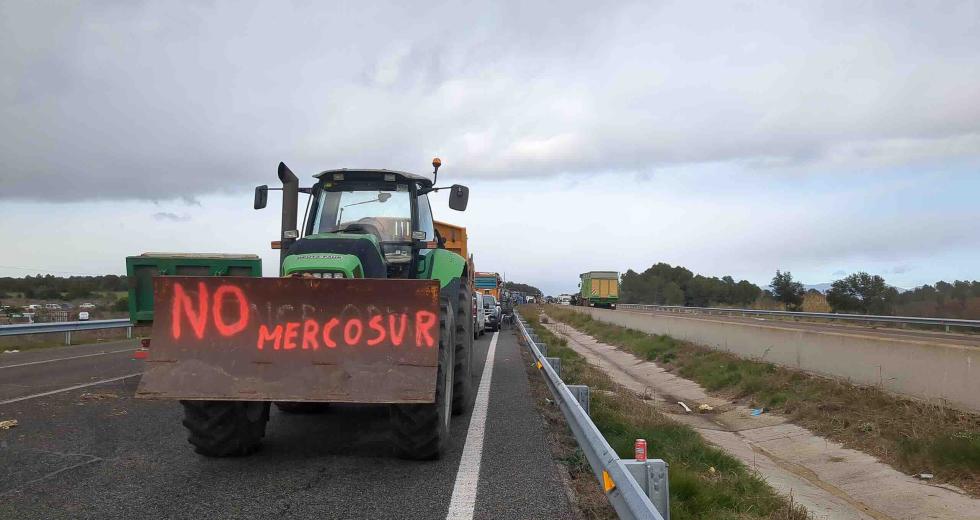
On Thursday, 8 January 2026, French farmers converged on the centre of Paris, installing armchairs under the Arc de Triomphe, surrounded the Eiffel Tower with their tractors and go-slowed down the Champs Élysée and the Périphérique. Similar protests occurred throughout France, with French farmers and their tractors blocking roads, motorways, and border crossings across the country. And this happened despite a Prefectural Decree initiated a couple of days earlier rendering the protests banned. The police were brought out in force to enforce the decree, but the farmers got through the barricades in a number of ways. Some police actually defied orders and let the farmers through. Some barricades were forced back by the tractors, and in other cases, farmers simply took to the fields and drove around them. Prior to this day of national protests, the farmers announced that they didn’t care if they were locked up; they were defending their livelihoods and their futures. Some farmers were indeed arrested and locked up. The main autoroute between France and Spain was also blocked by farmers just south of Perpignan by French farmers, and to the south of the border on the same autoroute, Spanish farmers had also blocked the road. Indeed, similar farmers protests have occurred across Europe, including in Spain, Belgium, Greece, Poland, Ireland, and Italy. They all have one major theme in common: they are all protesting against the EU-Mercosur Agreement.
That same evening, I watched the French evening news with my wife to see how the French mainstream media were covering the event. Despite the scale of the civil disobedience and disruption, huge traffic jams in Paris, police disobeying government instructions, and farmers’ protests around the country with autoroutes blocked, there wasn’t a mention of it at all.
Foreign media and cynics may well consider that French farmers are always protesting and are always complaining about something. But, in the case of Mercosur, they aren’t alone. Around the EU, farmers are making their discontent known in large numbers, and have already held massive joint protests in front of the EU Parliament in Brussels. Even if the mainstream media in France are instructed to ignore the most important news of the day, they could possibly consider the EU wide farming protests, but they didn’t do that either. The subject is obviously taboo.
But, what is this Mercosur deal? It’s the conclusion of over a quarter of a century of negotiations. Let’s now look at the Mercosur deal and why the issues involved don’t just affect the EU, but Europe as a whole, including the UK, and why this deal offers up an insight into far more profound changes to the way Europe will be controlled.
Mercosur (or Mercosul in Portuguese) is a South American free trade association, established along similar lines to the European Common Market. It came into being at the Treaty of Asunción in 1991. Its full members are Argentina, Brazil, Paraguay, Uruguay, and Bolivia, with Venezuela having been suspended for human rights’ misdemeanours. There are six associate members, including Chile, Colombia, and Ecuador.
Only eight years after its founding, in 1999, talks began to create a wide-ranging free trade arrangement between the EU and Mercosur. Fully 20 years later, the general principles were agreed upon, and the free trade agreement, which was formally called the EU-Mercosur Free Trade Agreement, was signed on 17 January 2026 in the Bank of Paraguay by EU and Mercosur representatives after a delay. In France, this free trade agreement is known simply as Mercosur. When ratified, the agreement will reduce duties on over 91% of exported goods between the two countries. In the most simple terms, the EU, mainly Germany, will get to export industrial goods, mainly cars and biochemical goods, while Mercosur will get to export low cost agricultural products, most importantly beef, of which there will be a 99,000 tonne quota and poultry at reduced duties.
EU beef farmers believe that if this deal comes into effect, the consequence will force such a dramatic drop in beef prices that all except for industrial scale beef production will be forced out of business, ending a millennia-long tradition of small-scale beef farming. This imminent threat to the livelihoods of EU’s beef farmers was sufficient to get them to leave their farms and come out in protest. But is there more to this story than just the threat to beef farmers?
In 1999, at the outset of the Mercosur discussions, it was clear that the EU, in particular Germany, had a considerable interest in opening a vast new market for its industrial goods, cars, and the like. The core Mercosur population is around 280 million people, so the interest for the German-driven EU was obvious. What was less obvious was the interest for the Mercosur countries in opening its markets to the EU. Back in 2000, the EU was virtually self-sufficient in terms of agricultural produce, with a small net trade deficit of 0.9% and with a gross agricultural export budget of 68 billion euros. Then, France was an agricultural exporter, ranked second in the world. In 2000, the EU was a net exporter of beef to the tune of 230,000 tons. The number of head of cattle raised in the EU increased steadily up until 2016, when it reached its all-time high. Since then, the number has fallen year-on-year, despite the EU population rising, as long as we take the Brexit skew out of the equation. The tonnage of beef produced in the EU in 2016 was 7.5 million tonnes, whereas in 2024 it was 6.6 million tonnes, a decrease in production of nearly 1 million tonnes. Back in 2016, France was the largest EU producer of beef, producing 1.46 million tonnes. This has fallen to 1.28 million tonnes in 2024. Although figures haven’t yet been finalised for 2025, most sources agree that a further 1.8% fall will have taken place during 2025, with that trend set to accelerate under pressure from the Mercosur deal.
By contrast, the beef imports from Mercosur increased from 130,000 in 2016 tonnes to around 200,000 tonnes in 2025. Once the Mercosur agreement is signed, the current figure of 200,000 tonnes is expected to rise to 299,000 tonnes. The figure may well become significantly higher, but the excess according to the current deal will have import duties applied. So, French domestic beef production has fallen by about 220,000 tonnes of beef between 2016 and 2025, while in the same time period, imports have increased from Mercosur. In a previous article which focused on the deliberate destruction of the UK beef industry by the Government, ‘The Bison and the Bias: Rethinking Methane, Climate Science, and Scientific Integrity’, the Government justified this destruction using fraudulent pseudo-science. But how has the French Government succeeded in decreasing its beef production?
The answer is a complex combination of EU and French national policies, whose results, both directly and indirectly, have reduced beef production from 2016 onwards. So in 2016, the CAP reforms of 2015 came into effect and had an immediate negative impact on beef production. In 2021 and 2022, the CAP Eco schemes’ rollout reduced beef production further still on the fraudulent basis that beef production has a direct impact on man-made global warming, an issue examined in detail and debunked in ‘The Bison and the Bias’. Then in 2023 and 2024, France rolled out a series of French-specific ‘climate change’ policies aimed at reducing beef production.
So, the French SNBC law (National Strategy for Low Carbon), which set carbon reduction targets and emission reduction targets, and the 2019 Climate Law both had indirect negative impacts on French beef production. In addition, economic factors such as the cheap import of beef undermining the local beef production costs, rendered local beef production less viable. Both the EU and French National policies combined to produce a year-on-year reduction in French and EU beef production from 2016 onwards, culminating in the 900,000 tonnes of beef reduced in 10 years, which equates to roughly around 3.6 million fewer bovines being raised in the EU, and 880,000 fewer in France. When we consider the number of beef livestock farms closed in France since 2016, the numbers appear even grimmer, with a total of between 40,000 and 55,000 farms that have stopped operating as beef livestock farms; the exact figure isn’t known because there wasn’t a census carried out in 2016. There are 122,000 beef livestock farms remaining today, so roughly a third of them have disappeared throughout France over the last 10 years or so. This equates to roughly 4 million hectares of land taken out of beef livestock production since 2016, which in turn equates to roughly 5% of the total surface area of France.
The writing is writ large on the walls for French beef livestock farmers. They have seen a decade of sustained attacks on their whole industry, with 1/3 of their number being forced to cease production entirely, and for them, the most important cause is both EU and French policies. All of this reduction in beef production has prepared the market nicely for the import of cheap Mercosur beef.
But yet another factor appeared in 2024 hammering the French farmers even further: the arrival of an unusual skin disease called dermatose nodulaire, or lumpy skin disease (LSD).
The EU’s Animal Health Law, which came into effect in 2021, insists on the complete eradication of a number of diseases, one of which is LSD. The French authorities have chosen to interpret that law as meaning that if one cow in a herd is affected with LSD, then the entire herd must be culled. This has resulted in 2025 alone, according to official figures, of around 3,000 bovines culled, and in some cases, only one animal in the herd was infected. Official figures may be significant underestimates as anecdotal accounts suggest more culling than has been officially announced. The disease itself is a mild skin disease producing wart like nodules, which may cure on their own, scab, and fall off within 2–3 weeks. Once recovered, the animal then becomes naturally immune. All the authorities are absolutely clear, including the World Organisation for Animal Health, there is absolutely no risk to humans when they consume beef from an animal with LSD, nor is there any risk of the disease spreading through contact from bovines to farmers. In other words, it is a mild skin condition, with no impact at all on human health, and can easily heal in time on an otherwise healthy animal. Despite this zero risk to humans, France insists on culling entire herds of healthy animals, because one of them has maybe a few warts on its skin.
For French farmers, this was the last straw, following a decade of sustained attacks on their livelihoods; watching as vets euthanised entire herds, some of which had taken lifetimes to generate, just in order to clear up an issue of a cow with a wart or two. The flash point occurred in 2025 in Savoie and in the Doubs region to the South and North of Switzerland respectively, when farmers began to coordinate action amongst themselves to protect their herds, by blocking access to the farms. Police intervened and none of the herds were saved. The farmers stepped up their mutual cooperation, with increased numbers of protesters, but the police in turn stepped up their levels of force by using tear gas and armoured cars to break up the farmers’ barricades. The most violent confrontation to date was at a farm in the Ariege region on 11 December 2025, when a farm with 207 bovines was identified for total destruction. Many farmers gathered to block access to the farm, and the police used tear gas, several helicopters, and armoured cars to break through. Four people were arrested, the entire herd was killed, and the carcasses were destroyed. The combination of the wanton destruction of entire herds for the sake of a virus which has no human impact at all, coupled with the use of paramilitary force on the farmers on the back of 10 years of attacks on beef farming, only served to inflame the farmers even further. A number of provocative government statements did nothing to help the matter, nor did the filming of a peacefully protesting farmer being manhandled to the ground with a police gun against his head to then be led away in handcuffs. The Confederation Paysanne (CP), colloquially known as the Confederation Rural, became the main focus of French farmers’ protests and began to coordinate farmers’ protest throughout France against EU and National policies which targeted French bovine farmers.
Against this heavily charged backdrop, a number of high-level meetings took place to finalise the Mercosur Agreement, the last of which was held at Foz do Iguaçu on 20 December 2025. However, Italy blocked the approval due to concerns voiced by its agricultural sector. Later, President Macron, under considerable pressure from the French farmers, joined Italy’s position. But this was only token opposition as double-qualified majority voting rules were applied, meaning that at least 55% of member states must approve as well as 65% representing the EU population. On 9 January 2026, the EU voted to ratify the agreement.
As stated previously, the agreement was signed on 17 January 2026. But there’s a ratification process that may take some time and is required by the EU Parliament, and by Mercosur parliaments. Given that, in the end, France, Ireland, Hungary, Austria, and Poland voted against the deal in the EU Commission, significant delays are expected in the implementation of the agreement; goods can actually be imported at low/no duty rates. The EU Parliament therefore took a vote on whether they could actually implement the deal before full ratification took place, wanting to jump the gun, as it were. In a very close vote, the decision was finally made by the parliament to push the decision off onto the European Court of Justice to rule on whether the EU can legally implement the agreement before full ratification. All these legal shenanigans reflect the very high stakes involved in the deal, given the amount of opposition.
The EU Commission is now moving the spotlight and news cycle on to another deal, which they claim to be the ‘mother of all deals’ (their language), between the EU and India, which they are in the early stages of negotiating. It is likely that the effects of this will be to shift attention from the Mercosur Deal and the virulent opposition onto the India Deal, allowing potentially for less opposition to the Mercosur Deal.
So, EU farmers in general, and beef and poultry farmers in particular, will now face reduced tariff, low cost agricultural produce imported duty-free from Mercosur, on top of all their other concerns.
Given that the main policy decisions aimed at reducing EU beef production were based on concerns over global warming, it is a crowning irony that the Mercosur countries are increasing their beef production by cutting down the Amazonian rainforest — the so-called lungs of the planet — and one of its main CO₂ sinks. The deforestation of the Amazon rainforest is at its highest rate for a decade, and cattle farming is responsible for 80% of that deforestation. According to Brazil's National Institute for Space Research (INPE), deforestation in the Brazilian Amazon increased by more than 50% in the first three months of 2020 compared to the same period in 2019.
The very real climatic impact of the Mercosur Agreement hasn’t been lost on the mainstream media and campaign groups. An editorial in The Irish Times stated, “EU countries are committing to achieving net-zero carbon by 2050, but this will prove meaningless if the planet’s greatest carbon sink is destroyed”. In June 2020, five NGOs filed a complaint with the European Ombudsman, criticising the fact that the Agreement didn’t take into account the impact on the climate caused by Amazonian deforestation resulting from the deal, and thus not complying with the 2016 Paris Climate Agreement. Even Financial Times noted that “The EU-Mercosur deal will cancel out climate efforts”.
French and EU beef farming have been deliberately targeted by EU and French national policies on the altar of climate ideology justified by fraudulent science, yet the deal that compensates for the resultant shortfall of beef supply locally will result in a very real destruction of the world’s greatest and most precious rainforest. The hypocrisy is off the charts. The EU brags about planning to be so-called ‘carbon-neutral’ by 2050, when to achieve that goal, they have ensured an increased destruction of the Amazonian rainforest.
Historically, the Amazon Basin has played a significant role as a carbon sink, absorbing approximately 25% of the carbon captured by terrestrial land. A scientific review article published in 2021 indicates that current evidence suggests the Amazon Basin is currently emitting more greenhouse gases than it absorbs overall. This shift is attributed to climate change impacts and human activities in the region, particularly wildfires – which are part of the forest clearing process, current land-use practices, and deforestation.
In ‘The Bison and the Bias’, we examined the science behind the claims that beef farming in the US and UK accounted for any significant climate change, and the objective conclusion was that it did not, because, essentially, the large ruminant populations in the pre-industrial age were equivalent to numbers today. This argument cannot be made for the massive destruction of rain forests however, which have always acted not just as carbon sinks, but as transformers of CO₂ into breathable O₂. In other words, the EU large ruminant industry which has been largely carbon stable for years, thus having no significant impact on the climate, replacing it in part or in whole by South American beef, raised on savannas created from rainforest clearance habitat, then the net damage to the climate is immense. Yet, the EU congratulates itself for acting in favour of the climate, and uses the climate crisis mantra to further the policy of reducing EU-raised beef while importing more beef from elsewhere.
The indigenous peoples of Brazil have also protested against the deal. Dinaman Tuxá, an indigenous leader, has said, “Accords like this only raise the level of violence against indigenous people. We need to tell the EU that signing this free-trade agreement could lead to genocide in Brazil. If they sign this agreement, blood will be spilled”.
If the EU had any serious interest in protecting the world’s climate and ecosystem, they could easily have removed the quota of 99,000 tons of annual beef from Mercosur to the EU, which the Greens, the NGOs, and Brazilian indigenous people cite as being a contributor to Amazonian rainforest destruction. The fact that the EU has not taken these 99,000 tonnes of beef out of the EU-Mercosur Agreement demonstrates that the EU is only concerned about the climate when it suits their purposes. Equally, as farmers around the EU have protested against the Mercosur Agreement while the EU seeks to undercut their prices, it has been revealed that the priority for the EU is no longer maintaining agricultural self-sufficiency. This position today is in stark contrast to the days when the CAP was one of the cornerstones of EU policy, protecting the internal food supply market. The 1962 CAP policy commitment was specifically aimed at creating agricultural self-sufficiency: “the European Economic Community’s Common Agricultural Policy … was based partly on the idea that the EEC should if possible be self-sufficient in food”.
So, to summarise, both the EU and France have, for the last 10 years or so, created policies based mainly on climate crisis ideology which have severely impacted EU farming. In particular, these policies have reduced French beef farming by nearly one million tonnes of production per year, and in the process, closed down at least 40,000 beef farms in France alone, thus creating a need for imported beef. The EU is signing a free trade deal with Mercosur which, amongst other things, guarantees the reduced duty importing of 99,000 tonnes annually of Mercosur beef on top of the already 200,000 tonnes of duty-paid beef. The EU gains by being able to export German industrial and biochemical products duty free to the Mercosur market.
The main winners are German industry, Mercosur beef and poultry producers, trans-Atlantic freight shipping companies, and insurance companies. The main losers are EU farmers, particularly beef and poultry farmers, and the global climate in the form of reduced oxygen generating capacity, increased CO₂ levels, and, of course, a decrease in bio-diversity (in other words, the world’s population). From the EU perspective, French, Greek, Italian, and other EU farmers are being sacrificed on the altar of German industry. This is no secret to the farmers in question. They are well aware that their industry and livelihoods are being sacrificed, which is why they have mobilised massively to protest, carrying placards saying, ‘Mercosur Non!’
One key question remains to be answered, however. President Macron is desperately clinging on to power, having presided over five failed governments, incapable of being able to pass a national budget for two years running, having guided his country into a debt spiral from which there appears no salvation other than default or an external bailout, and with his personal popularity rating verging on the single fingers. Why, indeed, would President Macron, in such a desperate state of affairs, choose to antagonise the powerful French agricultural industry for what would appear to be no gain whatsoever? Admittedly, at the last minute, he voted against the Mercosur deal, in the full knowledge that his vote would carry no weight at all, while at the same time stepping up the culling of French beef herds.
To gain some insight into this vital question, for which there seems to be no obvious answer, we need to take a step back from the relatively narrow subject of beef farming to the European rural situation in general. We have seen in the article on Portuguese wildfires how EU policies have forced nearly half the rural Portuguese population into the cities or to work elsewhere in Europe. We have seen how the wildfires in the Aude department of France how systematic policy-driven destruction of vineyards has driven the rural populations into towns by systematically halving the principal means of agricultural employment, namely wine production. In this article on the destruction of beef farming in the UK, we have seen how the rural economy is being hollowed out by the closure of farms. All these articles describe policy driven change, often justified by fraudulent climate science.
But the key clue is that these policies apply not just to the EU, but also to the UK. In other words, the drivers of these policies are to be found hierarchically above both the governments of the UK and the EU Commission. We are looking at policies created by supranational organisations who dictate policy to national governments, the EU, and more. As we have already seen, the Mercosur free trade deal carries in its DNA lasting and significant damage to the planet, so we must exclude any genuine climate concerns from the reckoning, despite the pretences. In all these cases, we are looking at the hollowing out of the European rural economy, causing a massive movement of populations from the countryside to the towns and cities. Many European major cities have become unrecognisable in the last 30 years because of the massive influx of foreigners. I have been fortunate enough to have been guided and escorted around no-go areas in both Grenoble and Paris by French-Arab friends at night. I have witnessed first-hand how in these areas, immigrant ghettoes have been created where the locals patrol the streets with Kalashnikovs and AK47s, and where the police do not go unless in heavily fortified convoys. In Grenoble, there were ‘guetteurs’ or look-outs posted on all the main road intersections in these areas, who are there to report police and other unwelcome activities.
How many times have we seen basic law enforcement in the UK ignored for fear of upsetting local communities, meaning immigrant communities? Meanwhile, in small towns and villages around Europe, life continues much as it has done for decades and centuries. And it is typically in these places where there remains a strong level of national and cultural identity. And this identity typically refutes mass immigration and policies aimed at destroying traditional cultural identities. In ‘The USA to the Rescue?’, we focused on how the Trump Administration has recognised this Europe-wide loss of traditional identities and intends to fight for them to be restored, preserved, and honoured.
What is happening right under our very noses is a Europe-wide emptying of the countryside forcing people into urban areas, coupled with the implementation of the 15-minute city programme, with the positive aspects explained here by the WEF. In these 15-minute cities, the inhabitants are expected to spend most of their lives within 15 minutes’ walk of their residential units and where populations can easily be controlled by their Global City Mayors and where a social credit system can be most easily applied. The 15-minute city concept was tested out during the French Covid lockdown, when all France was restricted to moving only within a radius of 1km of one’s residence (coincidentally, about 15 minutes’ walk), beyond which travel permits were required. In 15-minute cities, urban residents will have no need for cars, any further travel will be controlled by carbon quota permits, or withheld from people who do not comply with the rules. Smart meters will ensure that electricity can be equally rationed or withheld as power stations are taken offline. Digital money can be removed (or stolen) at the press of an administrator’s button. And let’s not forget the WEF comment coined in 2016, “You will own nothing and you’ll be happy”, exhorted in the essay ‘Welcome to 2030. I own nothing, have no privacy, and life has never been better’.
The Global City Mayors together form the Global Covenant of Mayors for Climate & Energy (GCoM), a global organisation claiming to represent 1.2 billion people, with very specific goals which override national policies. In their 2025 annual report, they state:
The Global Covenant of Mayors for Climate & Energy (GCoM) is the world’s largest alliance for city climate leadership, uniting over 13,800 cities and local governments across 148 countries. More than 1.2 billion people, one in every seven worldwide, live in a city or locality that is committed to GCoM.
As countries prepare enhanced Nationally Determined Contributions (NDCs), cities are stepping forward with Self-Determined Contributions (SDCs): locally led, measurable, and often more ambitious climate commitments. Together, they form the global mutirão, a collective effort of multilevel action, called for by the COP30 Presidency.
The Global Cities Hub website promotes 15-minute cities: “The 15-minute city concept emerged again as a flagship example of integrated, people-centred urban planning”. And they ominously report: “At this moment, when people doubt multilateralism, it is essential to bring Mayors together to find global solutions”. So, Global City Mayors are the self-proclaimed vanguard of the globalist one-world government movement.
The notion of 15-minute cities was invented by a French man, Carlos Moreno, and according to the WEF:
… the most vocal proponent of the concept remains Paris, where the concept originated. Its mayor Anne Hidalgo has been championing the ‘ville du quart d’heure’ [15 minute city] since early 2020, and has embedded it into a broader plan to promote active mobility in lieu of cars: car speed has been limited to 30 kilometres per hour on many streets.
Anne Hidalgo also features heavily in the Global Cities literature and websites.
Naturally, the WEF wants to sell the positive side of 15-minute cities, but there’s a far more sinister side to them and their relationship with Agenda 2030, of which Sandi Adams has made an excellent presentation. Both the EU and France actively promote their 2030 agendas. So, for example, here we see France’s specific 2030 official Agenda, in which, for example, they want the population to abandon their own vehicles (“Pour inciter les automobilistes à abandonner leur voiture individuelle”). There is also a transcript of a meeting between Mme Hidalgo, the French President, and Michael Bloomberg, in which the President applauds Mme Hidalgo’s efforts in the creation of 15-minute cities and saying that the President will do all that he can to help her.
So, throughout Europe, we see a longstanding and slow burning policy of forcing people out of the countryside and into the cities by hollowing out the rural way of life. Rural communities throughout Europe have become the last repository of nations’ cultures and traditions, a form of ‘living national archive’ where ways of life have been passed down from one generation to another for dozens, if not hundreds, of generations. The concerted attack on Europe’s rural communities recalls how in much the same way the US finally defeated the Plains Indians by destroying the buffalo herds that supported their ways of life and had sustained them for thousands of years.
Mass immigration into European cities has ensured that traditional culture there has been transformed into some mongrel form of international culture, which the globalist elites vaunt as multiculturalism. Rural life is being targeted by the globalists, and it must be defended if we want to preserve our traditional cultures and heritage, be we British, French, Italian, or any other European nationality.
Within Europe, active resistance to the hollowing out of the countryside which will inevitably affect all of us relies mainly on the farmers and their determination to protect their livelihoods. From outside of Europe, the Trump Administration has also joined in the struggle while much of Europe’s population sleepwalks into 15-minute open prisons.
Cover image: Wikimedia Commons


Neil Harrison
Neil Harrison achieved a degree in Pure and Applied Physics at Salford University, UK, and went on to work in the space industry for Marconi Space and the German Space Operations Centre near Munich, working on various satellite and NASA space shuttle programmes.