
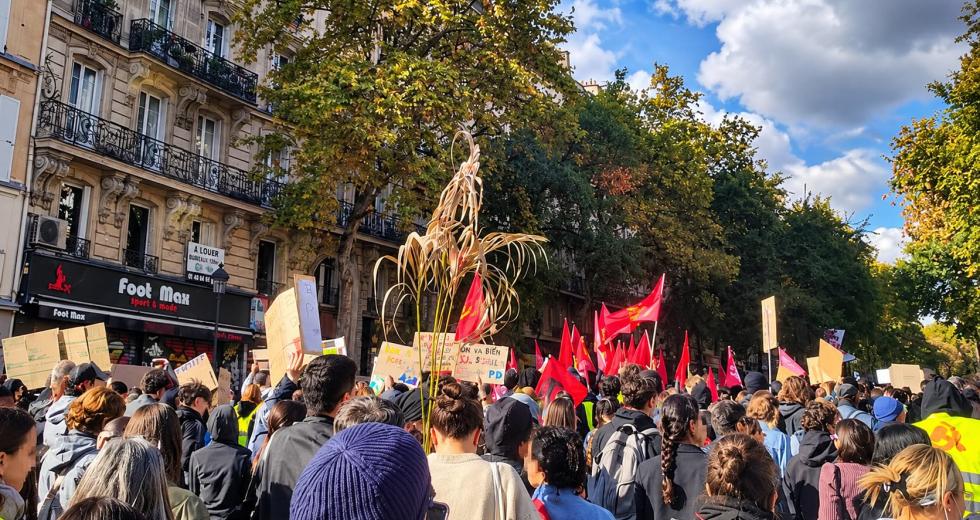
France is caught between a rock and a hard place. On the one hand, its national finances are catastrophic, resulting in multiple warnings from the ECB and the IMF as well as pressure to make €50 billion worth of economies in the current budget negotiations. On the other hand, there is a rapidly escalating series of protests across multiple sectors that are demanding more money. This crisis has been years in the making, and it looks now to be entering the final denouement.
By all measures, France’s economic situation is dire. It has €3.595 trillion of national debt. It also has a budget deficit of over 5.4%. This is fully 2.4% above its allowed deficit ceiling, and it is expected to hit 5.7% next year. This is a debt-to-GDP ratio of 121%, according to the ECB, even though the French media use 119% based on an overrated GDP estimate. And now, 10-year bond yields recently hit 5%. If France’s sovereign debt were transformed into €1 coins, and then were piled on top of one another, they would reach the moon. But it wouldn’t be just one such pile; there would be 20 such piles! Such is the almost unimaginable scale of the national debt in France.
The spread with the German Bund also recently hit 160 basis points over the past few days. GDP growth has been downgraded to 0.4%; this is by far the lowest in the eurozone. The managing director of the IMF, Kristalina Georgieva, has just issued the third warning this year to France: “get your house in order … France must reduce its deficit in order to reassure the bond markets, as to its credibility”. National debt repayment costs are taking up an increasing amount of the annual budget.
That budget is currently under parliamentary scrutiny, and for the third year running, it looks like the budget is not achieving parliamentary approval. In 2026, interest repayments alone exceed €65 billion, or over 2.6% of GDP. These interest payments come out at over €7.4 million per hour! Since its inception, the euro has lurched from crisis to crisis, as the EU attempted to harmonise economies with polar differences such as Cyprus and Germany under one currency and one set of interest rates. During the last major crisis, there was much finger-pointing at the ‘Club Med’ countries which were blamed for financial irresponsibility, and were sneeringly labelled the PIIGS (Portugal, Ireland, Italy, Greece, and Spain) countries.
Today, France is in a far worse condition than those Club Med countries, which it mocked 14 years ago, and it has been labelled FROGS (French Oversized Government and Social Security). It is a well-earned nickname, as France is the top country worldwide for state spending. Even the CAC 40 has fallen by 3.3% this year; in comparison, for example, to the NASDAQ at +16% or even the FTSE at +8%. The rapidly degenerating situation in France is starting to spread, dragging the euro down, which has lost around 10% against the US dollar this year, dropping from $1.17 at the end of August to $1.12 today in a sharp and continuing downward trend.
For years, the degenerating situation in France was kept away from the media spotlight, but the situation has become so critical that it has even reached the mainstream media. Next year, there are supposed to be French presidential elections (which could yet be cancelled), and according to the polls, the final run-off election is predicted to be between Marine Le Pen of Rassemblement National (a rebranding of the old National Front) and Jean-Luc Mélenchon, a one-time Trotskyist (La France Insoumise, or LFI). Mélenchon has already come out publicly in declaring that he will order a partial sovereign default, to reduce the national debt. His current plan is to default on €600 billion of debt.
Lenders, who are increasingly wary of French sovereign debt and demand very high returns, see this as a warning sign. They think that France is no longer a safe investment. Christine Lagarde of the ECB sent a furious public message to Mélenchon declaring that his behaviour wouldn’t be tolerated, and the Governor of the Banque de France declared Mélenchon’s statement as a de facto sovereign default.
Whether France can be kept afloat financially until the presidential elections remains to be seen, as French bonds have been on a vertiginous climb over the past couple of months, and the value of pre-existing French bonds has fallen on the secondary markets.
In addition, long-term investors in French national debt are selling up. One of the biggest examples is Mitsui, which has sold off on the secondary market all of its French debt holdings at a loss. Chase Manhattan and Goldman Sachs are now offering instruments betting on a French default.
The Gulf States, once cash rich, invested heavily in French debt. But with virtually no oil sales, they are desperately searching for liquidity, and are not only refraining from buying new French debt but also selling off old French debt. Increasingly, it is the hedge funds looking for a quick short-term return who are buying up French debt with 5% returns. And the Banque de France has warned that whereas in the past it was long-term investors motivated by the continued well-being of France who bought French debt, now the central bank is worried that too much of French debt is held by speculators who could ditch it at the first signs of an imminent default.
Public debate is already invoking the possibility of a state raid on savings, similar to Merkel’s haircut for the Cypriots, known also as a bail-in.
It is in this apocalyptic atmosphere that the current prime minister announced his plans to try to cut €50 billion from the budget to try to pacify the IMF and lenders. But his government doesn’t command a majority, and for reasons that will become clear, it looks unlikely to cobble together a majority final vote for his budget. This leaves President Macron with two legalistic ways of passing his budget by avoiding Parliament altogether, one of which involves establishing the budget by presidential decree. We will have to wait until the parliamentary vote on the budget in November before learning what Macron has in store. And even if the government can realise those €50 billion savings, it still leaves France with a deficit of above 5%, a figure still unacceptable to the IMF and the ECB.
At the same time as France’s budget negotiations, the EU is also negotiating its budgetary needs with member states, demanding an eye-watering €2 trillion. This massive increase is intended mainly to fund the planned militarisation of the EU in its war against Russia and to repay loans made during the Covid crisis. As part of this, the EU is demanding an increased French contribution from €26 billion to €36 billion per year, which is an increase of 38%.
However, Marine Le Pen, the current frontrunner by a significant margin for next spring’s presidential election, plans to cut France’s EU contribution down to €5 billion per year. In this scenario, the already fractious relationship with the EU could become an all-out confrontation. So if Le Pen wins that election, France will massively underfund the EU, whereas if Mélenchon wins the election, France will default on its sovereign debt.
Meanwhile, France’s long-term socio-economic woes have been hitting the population, provoking widespread strikes and unrest. Hospitals are closing, schools (the famous French lycées) are suffering from long-term deprivation of funds, with most complaining of non-functioning toilets, classrooms with no teachers, and disintegrating infrastructure in general. France, which was once the EU’s chief agricultural producer, has now become a net importer of food, thanks to a combination of French and EU policies, including Mercosur and deliberately ripping up vineyards in the name of Net Zero.
Energy prices are soaring. France is unable to reap the benefits of its affordable nuclear energy because of EU policy on harmonising energy prices across the EU, forcing the price of domestically produced nuclear energy to rise far above its production costs. In addition, after the West’s blowing up of the Nord Stream pipelines, access to cheap Russian gas is banned by EU sanctions. Diesel now costs above €2.5/litre and continues to climb, all of which contributes to increased prices across the board from truck deliveries to farm produce. This is further increasing inflation, which is rising fast, and making it impossible for those already financially struggling to remain solvent.
The fuel price hikes and the cost-of-living issues that we see today in France were the initial cause of the original gilets jaunes (yellow vests) protests, which began in November 2018 and lasted until 2020. Back in 2018, there were around 1.3 million protesters, numbers which declined as police brutality stepped up. When the movement fizzled out after three years, their grievances weren’t met, and according to the protesters themselves, they became too afraid of police violence to risk their lives by continuing to protest. These original unresolved grievances remain but are exacerbated today, as the underlying causes are much worse and most of the original protesters are still around. Back then, two protesters were killed by the police, 25 protesters lost an eye, five protesters lost a hand, and at least 2,495 others were hospitalised. It was back then that the Black Bloc agents provocateurs were first deployed.
Initially, it was generally believed that these Black Blocs were the same as those US anarchist Black Block militants in the US. But the reason for their appearance during the gilets jaunes protests was far more obscure. Although they were obviously organised and sometimes appeared at the start of the protests in groups of up to 100, they never had explicit demands, unlike the gilets jaunes. They made no public statements, had no disclosed affiliation or funding, and there was no published organisational chart. They appeared totally covered in black clothing with black cagoules. They dispersed themselves within the protesters and almost immediately began damaging property and attacking the police. Once the violence began, they melted away, and the media was filled with images of burning, looting, injured police officers, with little attention given to the grievances of the gilets jaunes. The violence became the chief subject. Pressure accumulated on the government as protesters were killed and maimed, and there was a threat of forcing President Macron to resign; however, he received support from the opposition Rassemblement National, which called for a strengthening of security forces and tougher police tactics.
Meanwhile, the allegiance of the Black Blocs was coming under scrutiny from the police themselves in the shape of the police union. For example, Philippe Capon, head of the Police Union in Paris, made a statement complaining that during the 18 March 2019 protests, the police could easily have prevented most of the destruction if they had been allowed to intercept the arrival of a large group of Black Blocs, which they’d been monitoring. The police were refused authorisation to intervene, and so the Black Blocs joined the demonstration and caused mayhem and police injuries. When quizzed about what would motivate the order not to intervene, Capon replied that they would have to ask the authorities.
A second such incident occurred when another police union representative complained to the press that they had been instructed not to interfere with the Black Blocs. When quizzed on whether she was sure, she replied that she was a first-hand witness to their arrival and the orders to not stop the Black Blocs from doing their work. Subsequently, she was threatened with dismissal for going to the press with that statement.
The French satirical newspaper Le Canard enchaîné also explored the official mysterious laissez-faire attitude towards the Black Blocs. In it, they described following a Black Bloc militant for most of the day, who, while being constantly monitored by the police, went on a day-long rampage of arson and destruction. When the Canard reporter asked the police why they weren’t stopping the man, the reply was, “It would be a shame to deprive the TV audiences of such a spectacle”.
Despite all this attention at the time, there was still no explanation for the motivation or allegiance of the French Black Blocs. A French MP, Bernard Carayon, from the Tarn district publicly identified their funding by NGOs who were in turn funded by the EU. It became increasingly clear that the Black Blocs were agents provocateurs used by the state to transform peaceful protests into violent protests and thus to sway public opinion away from the gilets jaunes and in favour of the state.
At the height of the gilets jaunes movement in 2018, they had over 80% of public support, with some polls indicating 84%. After one year, that figure had fallen to just 54%. By September 2020, that figure had fallen again to just 44%. One set of Parisian protests in late 2018 that turned particularly violent and was well-televised did a lot to destroy the reputation of the gilets jaunes, and the increasing violence became one of the core reasons why they lost public support. Deploying Black Bloc militants had been a spectacular success, turning a movement with near-total French popular support to becoming a movement tarnished by violence. The state portrayed itself as the public protector, rather than the cause of the protests in the first place. At one point in December 2018, President Macron and the Elysée Palace were nearly taken, but Macron won out in the end and reinforced his political base. His draconian policing policies continue to this day.
At the time of writing, on the day after the 18 October 2026 national protests, when 800,000 French took to the streets, the Black Blocs are back in operation. Yesterday, the town hall in Marseilles was sacked. Limoges’s elegant, spired town hall was burnt to the ground. Entire streets in Paris were systematically destroyed. Countless cars were burnt across France, and the catalogue of injuries increased. In this recent round of protests, two young protesters have had their hands blown off by police grenades, and a protestor was killed in Paris yesterday, although there has not yet been an official verdict on who was responsible.
The French police find themselves in the spotlight because of their brutality and also from the state because they are expected to handle the massive scale of the protests. Yesterday, a police spokesman said, “Today again, in every corner of France, our colleagues are being used as punching bags. Pelted with stones, injured, trapped in real ambushes … Let everyone take responsibility: this cannot go on indefinitely. The rope is stretched to its maximum”. But the protesters view the police actions differently: “Protesters said most people had marched peacefully, and put much of the violence down to troublemakers who had set out to cause damage and clash with the police”. The French banking federation stated on 20 October that over 200 banks were broken into. And on 19 October, Prime Minister Lecornu stated that around 3,000 shops had been broken into or set on fire across France.
The French have not forgotten the suspicions on the deployment of the Black Blocs from 2018-2020, and so there has been increased on-the-day focus on them. On 19 October, UK Column News showed a scene where Black Bloc operatives were cooperating closely with police. BFMTV, usually a state mouthpiece TV channel, produced an investigation stating that between 4,000 and 5,000 of them have been brought in to the protests. BFMTV journalists revealed that most of them spoke English, Dutch, or German, reinforcing the French MP Carayon’s earlier statement that there was EU-wide involvement in the organisation of the Black Blocs.
Multiple mayors across France, including the Mayor of Marseilles, have complained that the police stood down when the Black Blocs rampaged and took possession of the town hall and destroyed many shops, yet when the peaceful marches came past, the police — without provocation — kettled them and used tear gas. The mayor says that he has video evidence of this, including the sacking of the town hall, and that when this evidence is released, it will have major political consequences.
The same scenes were repeated in major cities throughout France. Overwhelming evidence from 17 October shows that the Black Blocs were enabled by the police to destroy wantonly, while the police attacked the peaceful marches, with tear gas, water cannons, stun grenades, and charges. One interesting characteristic of the Black Blocs which doesn’t get much media attention is that they tend not to deliberately injure people, but rather concentrate on material damage. As before in 2018-2020, they don’t deploy on their own except for pre-existing protests.
Being in France right now, I have observed the media, both print and televised, obsessing about the violence and the chaos and demanding a restoration of peace and order. Indeed, we have been requested to join counter-protests organised by our local town halls to demonstrate solidarity with the state and the Republic. The President of El Salvador, Nayib Bukele, described the 17 October events as ‘controlled demolition’. Many in France agree with him.
But a far more sinister consequence is emerging from all this Black Bloc-initiated violence, and there is debate in the media whether President Macron is preparing to invoke Article 16 of the constitution, the French equivalent of martial law. The Mayor of Orleans appealed directly to President Macron in a public address calling for Article 16 to be invoked. Other members of the government such as Gabriel Attal are calling for emergency powers to control the media, including the internet. And just two days after the protests, the government announced curfews in the major cities, including Paris, Lyon, Lille, Nice, and Bordeaux.
French MP Alexis Corbière explained during a 17 October interview how the violence spread rapidly based on his first-hand experience of the recent protests. He described arriving at a protest in Paris with an orchestra playing and everyone behaving peacefully, even good-naturedly, when the police suddenly kettled the protesters. Then, without warning, the kettled crowd was tear-gassed, spreading panic and alarm. They even targeted the orchestra.
Corbière’s view, which has been echoed in many interviews with protesters posted on social media, is that for years, the same grievances have been voiced, and each time the government of whatever stripe fails to listen, leading the population to lose faith in the French democratic process and peaceful demonstrations. In this context, he says, it isn’t surprising that large parts of the population are resorting to violence as the only avenue left to being taken seriously.
Article 16 can be invoked if the President deems that there is an imminent threat to the state and the institutions. It gives the President extraordinary emergency powers within the first 30 days of declaring it. For example, he could easily stop French repayment of bond yields to investors. He could seize private and corporate savings if he thought it necessary. He could authorise systematic use of lethal force against protesters. He could exercise total control over all forms of media, broadcast, and print. He could, like his friend Zelensky, cancel next year’s presidential elections to remain in absolute power.
Eight years on from the original gilets jaunes grassroots protests, which were neither centrally organised nor funded, the gilets jaunes are back again. But this time, the grievances are multi-sectoral. France’s five main trade unions are involved in the organisation, lending infrastructure, organisational assistance, and personnel to the protesters, including the students. The students alone are demanding €10 billion in extra financing immediately to pay for all the investments that they deem their lycées require.
This flies in the face of the €50 billion economies that President Macron is intending to save in the current budget. Self-employed nurses are demanding an extra €300 million per year and the public sector an extra €1.3 billion, while farmers are demanding an emergency €2 billion. The firefighters haven’t yet put their bill on the table, but they are currently demanding that the state and local authorities employ an extra 21,000 firefighters. More trades are joining the protests right now, although they haven’t formally formulated their demands. These include the civil service, which is demanding increased salaries and better conditions. The gilets jaunes are demanding a reduction in fuel costs, which will reduce tax income, and so also negatively affect the budget. As these protests spread horizontally across sectors, the current demands of €14 billion in extra funding are more likely to grow than to shrink. The next nationwide protests are planned, ironically, for Bonfire Night, and given the increased trade unions’ participation, the expectation is that the scale of the protests will be higher still than yesterday’s. There are also smaller protests planned for the weekend of 30 October.
Meanwhile, budget negotiations go on in Parliament with the preliminary vote originally scheduled for 20 October, but postponed until 3 November. The final budget vote must be taken in Parliament by the end of the year. If that vote fails, then the government can force through a budget despite Parliament’s opposition. But this in turn automatically initiates a vote of no confidence in the government.
The unions are calling this an ‘austerity budget’, and last week, the CGT published a statement saying that the next generation of workers must not bear the burden of paying off the national debt. They want that debt wiped clean. Although not formally allied with Mélenchon’s LFI party, they too are advocating a sovereign default.
During all this, the ECB, the IMF, and potential buyers of French debt are watching closely. Even if the planned budget were to succeed, which as of today appears unlikely, it would only mean that France maintains a 5% deficit, which is still 2% beyond the level it is allowed, according to Maastricht rules from 1992. The same rules impose a debt limit of 60% of GDP, which France has exploded twice over with its 121% debt-to-GDP ratio. With no budget, the deficit would be around 5.7% and growing, or even more if the protesters succeed in their claims. In all cases, France will still need to go cap in hand to the markets to borrow money. The ECB, well aware of the dangers of lending money to France, has been winding down its holding of French debt over the year, and this is expected to continue. Germany has already stated on multiple occasions that it refuses to mutualise French debt, aligning itself with the IMF, saying that France must get its house in order.
It’s difficult to imagine how any scenario will not end in tears. The investors and the central banks are demanding that France reduces its deficit and gets its finances under control. Even the most optimistic of French budgets doesn’t do that. But even if that budget is forced through against the will of the French Parliament, it will make no one happy at all. The unions are dead set against the ‘austerity budget’ and have sworn to oppose it; all the currently protesting groups are demanding massive budgetary increases, not the slashing of budgets. From their point of view, an ‘austerity budget’ will simply increase their drive and militancy. And the public is already affected by crippling taxes and the cost of living. And in addition, they face the threat of having all their savings raided by a state which can’t even balance its budget.
France has 2,437 metric tonnes of gold reserves, the fourth-largest of all sovereign gold reserves worldwide, with a current market value of a little over €125 billion. Even if France were to sell off its entire gold reserves, this would only make a tiny 3.47% dent in the overall national debt, and even then, would not start to address the underlying chronic problems that led France into its current state of chaos.
The dire consequences of France’s debt situation are spreading to the wider eurozone. Germany, once considered to be the most fiscally responsible country in the EU, has seen its own 10-year Bund yields rise startlingly. Over the past few days, the 10-year Bund has itself breached 3.6%, a level not seen since the eurozone financial crisis in 2009. Some consider the Bund spread to be an indicator of imminent crisis, but the Bunds too are rising, making the spread in and of itself a misleading indicator. Fear is spreading across the EU bond markets. Even the UK cannot consider itself safe, with 10-year gilts at levels not seen since the global financial crash in 2007, and UK institutions still holding substantial amounts of French sovereign debt. The question facing EU central banks is less ‘can we save France?’ and more ‘can we save the eurozone and the EU?’
It may not be long before the poor Maghreb slums in all the main cities which have been bubbling with hatred and resentment for years explode again, adding to the chaos. Even back in 2022, during the Arab protests, I was given a tour around Arab ghettoes by an Arab friend under his protection. They felt like a war zone, with armoured cars parked on the streets, no police visible outside their protected cars, and Arab ‘guetteurs’ (spotters) placed on the main street intersections.
All these issues have been increasing in gravity over many years, but it appears in the closing months of 2026 that they are all coming to a head at the same time. Meanwhile, as the main French cities erupt in flames, investors will be considering whether it is really worth pouring more money into the French debt.
Cover image: Demonstration in Paris, 17 October 2026. Silanoc, CC BY-SA 4.0, via Wikimedia Commons


Neil Harrison
Neil Harrison achieved a degree in Pure and Applied Physics at Salford University, UK, and went on to work in the space industry for Marconi Space and the German Space Operations Centre near Munich, working on various satellite and NASA space shuttle programmes.