Secure homeownership is becoming ever more elusive in the US, the UK, and across much of continental Europe, at a time when the very idea of truly ‘owning’ anything, anywhere, has become a distant concept.
Even a cursory look at the housing situation reveals that owning a home — unless you’re a trust-funder, part of the peerage, a sundry oligarch, or some other species of secure or established wealth — is increasingly difficult and could soon become all but impossible on a practical level.
This UK Column writer, it’s worth briefly mentioning, ‘owns’ two properties. The catch is that they were purchased and paid off back when there was significantly more sanity in the system — which in the US generally means before the so-called ‘Great Recession’ of 2007-2009, a watershed failure that’s also been called ‘the housing crash’.
After that ‘save-the-banks, screw-the-public’ debacle concluded, US banking and lending rules were rewritten, largely through the 2010 Dodd-Frank Act. Although this bill erected some reasonable guardrails to discourage predatory loan practices, it ultimately did not pack enough punch to do the job.
The things that — according to conventional wisdom — caused that crash, including the pushing of adjustable-rate mortgages that started with low interest rates but soon spiked, and predatory equity stripping, where greedy brokers repeatedly refinanced homeowners and drained away their equity, are merely symptoms of the debt-based monetary system that pushes people into such false alternatives in the first place.
And although the Dodd-Frank Act was sold partly on the premise that things would improve because borrowers now had to prove they had the income and wherewithal to buy a home, getting a mortgage became impersonal, mechanistic, and simply more difficult.
Gone were the iconic days of being approved for a loan with sufficient ease on affordable terms and based, to a significant degree, on your local banker knowing you personally and acting on good faith.
All of that was predicated on a sense of concord, wherein people looked out for each other — and secured agreements with little more than a handshake — as depicted in the 80-year-old classic Frank Capra movie It’s a Wonderful Life starring Jimmy Stewart as George Bailey.
Bailey, recall, was a local banker who (he must have been mad!) put the welfare of his customers ahead of profits for the sake of profits to help his customers achieve and maintain homeownership and other needs.
However, Bailey was foiled by ‘Mr. Potter,’ the ruthless new breed of banker played by Lionel Barrymore. He sought to destroy George Bailey for being George Bailey.
Bailey represented a quaint community banking philosophy that simply had to be destroyed to make way for the beastly modern banking system, for which greed and self-preservation were the new and everlasting credo — a kind of anti-Christ force that would drive Christian morals out of economics, countering the action of Christ Himself when he drove the moneychangers out of the temple, as recorded in all four canonical books of the New Testament.
A Closer Look
Broad brushstrokes aside, let us more closely examine the housing situation.
For starters, it’s important to stress that, if you’re not careful, your home will own you if you have a mortgage with too high of a payment and/or your property tax in the US (or council tax, in the UK) is too high.
An American tradition is to get approved for a home that has an ‘on the edge’ mortgage payment, which still happens despite Dodd-Frank, meaning that it’s ‘affordable’ as long as there are no sudden job losses, medical issues, or other impactful setbacks.
Regarding the UK, an article posted by MPAmag.com on 30 May 2025, entitled ‘More UK homeowners facing high mortgage debt,’ cites Financial Conduct Authority (FCA) data which reveals: “A rising number of borrowers owe over £300,000 as affordability pressures mount.”
That article takes note of a Financial Lives Survey by the FCA, which is a UK regulatory agency. According to that survey, “The share of homeowners with more than £300,000 left on their mortgage … increased from 5% in 2017 to 9% in 2024. In London … that figure jumped from 17% to 28% over the same period.”
The survey also found that 14% of homeowners had mortgage debt amounting to at least four times their annual income — up from 11% in 2017, though slightly below the 16% recorded in both 2020 and 2022.
Moreover, among UK adults currently purchasing a home with a mortgage or using “shared ownership schemes”, 10% admitted for the survey that even modest increases in monthly mortgage repayments would be difficult to manage and could push them to, or over, the edge of a financial cliff.
The survey clarified: “This includes 3% who would struggle with a £1 to £49 increase, and 7% who said the same for a £50 to £99 rise. In other words, an increase of a mere £50 per month, and no more than £100 per month, could quite easily lead to a mortgage foreclosure.”
Things are about the same in the US, where roughly 20 million homeowners, or about a quarter of all homeowners, spend more than 30% of their income on housing
In so doing, they operate with budgets that are exceedingly tight, mainly due to monthly mortgage payments topping $2,000. And we mustn’t forget the added blessing of compounding escrow costs (money set aside to pay property taxes and insurance); and — as if that isn’t enough— elevated interest rates.
Rate Deception
Let’s take a brief detour here. It does not take a data wizard to see that higher interest rates on mortgages on either side of the Atlantic are a very real and hefty burden, representing not only higher housing costs, but also a squeeze on one’s budget that translates into less money to spend on other necessities, on occasional luxuries, and on purchases at locally owned businesses that depend on an often-dwindling amount of disposable income among consumers for the very survival of such businesses.
In the US, President Trump, to his credit, never stops insisting that interest rates need to be lowered and kept low, since high rates, as noted, strongly impact housing costs.
And while former (Obama-era) Housing and Urban Development Secretary Shaun Donovan on told PBS News Hour on 24 June that he concurs on that point, it’s unclear whether newly appointed Federal Reserve Board Chairman Kevin Warsh will advocate more rate cuts, even though he has said that the current economic environment is ‘uneven’. For the record, he means monetary policy is even tighter for housing than it is for other sectors.
Meanwhile, the financial press keeps repeating the mythical mantra that sabotages economic progress in general and a better housing market in particular: that interest-rate cuts are, at best, of minor importance regarding proper housing reform because cutting rates typically ‘causes inflation,’ thereby fostering higher consumer prices, including for housing.
But as this writer demonstrated in a previous UK Column article, that claim is one of the chief deceptions floated by a usurious banking class that wants higher borrowing costs to maintain its profits, even as it cloaks the fact — through manipulation of media messaging and the advancement of slanted economic dogma in academia — that higher rates oftentimes become another cost passed on to the end consumer, in what’s known as cost-push inflation.
Although money is created as debt, until that matter is resolved, most people still must borrow to live. Legislation that at least has the potential to put affordable housing loans within reach for more Americans is an improvement. That legislation is the 21st Century ROAD to Housing Act that Congress just passed. It can make homeownership a reality for more people — provided it’s implemented correctly and without needless delays.
ROAD Act Details
At a time when 25.2 million Americans under age 35, or one in three young adults, still live with their parents, the ROAD Act, which passed both houses of Congress with overwhelming majorities, streamlines environmental rules, removes manufactured-housing construction restrictions, increases access to so-called ‘small-dollar’ mortgages and, very importantly, limits the gobbling up of single-family homes by institutional investors such as private equity firms.
That last measure helps preserve starter homes for families to own, instead of corporate landlords buying those homes to rent them out at top dollar, turning America into a vast tenantry.
Small-dollar mortgages, says the Urban Institute, are mortgages of $100,000 or less — vital for first-time home buyers and low-income households.
According to the Federal Reserve Bank of Cleveland, “Traditional lenders are reluctant to provide loans for small-dollar mortgages simply because they are not as profitable as higher-dollar mortgages. Small-dollar mortgages are even more scarce than the affordable homes they are used to purchase.”
Thus, the ROAD Act’s provision to increase small-dollar loans is a step in the right direction, as is its call for more manufactured housing, which would efficiently address the serious housing shortage in the US and elsewhere — one of the key factors in today’s excessively high cost of housing. Manufactured homes, or factory-built modular houses, besides being cheaper to purchase, are faster and less expensive to assemble.
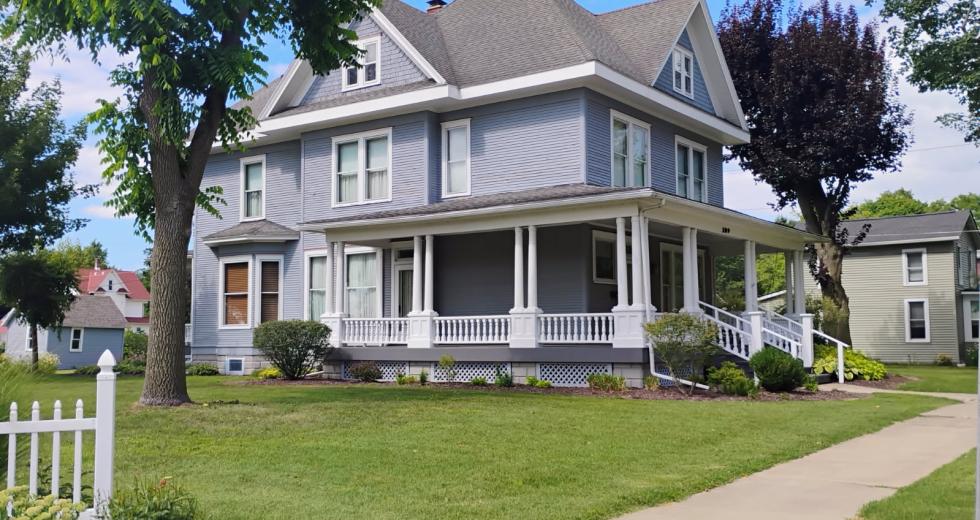
Notably, as far back as the early 1900s in America, mail-order ‘kit‘ homes, with pre-cut lumber pieces and detailed directions, were popular. Sears Roebuck was among the manufacturers. Many of these houses were quite impressive. This UK Column writer photographed one this summer in Berrien Springs, Michigan, a three-story gem that anyone would love to inhabit. (See the cover image for this article).
The ROAD Act, championed by the National Association of Realtors, also excludes military veterans’ disability compensation from being counted as income for government-backed housing programs, thereby making more vets eligible for such programs.
And while the cons of the ROAD Act aren’t too numerous, there is a concern that would-be homebuyers hoping for quick relief may have to wait years for the growing housing supply to reach a pivotal level. Moreover, some say the ROAD Act’s heavy emphasis on homeownership won’t do enough to assist low-income renters, since renting will still have its place in the overall housing landscape.
Hollow Threats and Diversions
Politics cannot help but gum up the works. The 28 June edition of NBC’s weekly Meet the Press was a perfect specimen of recent obsession over President Trump cancelling the signing ceremony for this housing bill. The press would not stop talking about his gambit to withhold signing it into law until Congress passes election-reform legislation known as the SAVE America Act that, among other things, would establish stricter voter-identification requirements.
The press, however, was up in arms about a presidential gambit that turned to be hollow, while overlooking other key factors. Trump tried to use a threat of vetoing the housing bill unless Congress passed the SAVE America Act. But since the House passed the housing bill 358-32 and the Senate passed it 85-5, a veto override by Congress was all but assured.
The press completely missed the fact that, under the Constitution, legislation not signed by the president automatically becomes law after 10 days anyway, so, the ROAD Act (HR 6644) officially became law on 11 July. Under different political circumstances, tying the signing of the housing bill to the SAVE America Act’s passage would have created a massive impasse that would have needlessly delayed vitally important housing reforms.
This is not to say that the SAVE America bill is irrelevant. Democrats decry virtually any attempt to create stricter voter-ID laws, claiming they are needless and stymie the ‘right to vote,’ while most Republicans rightly insist that better voter-ID laws and a massive reduction in vulnerable mail-in ballots — two measures in the SAVE America Act — would help ensure that electoral outcomes reflect the will of actual American citizens and involve a more accurate vote-count.
Home Prices Up 54%
“Home prices [in the US] are up 54 percent since 2020. The median cost of a mortgage has nearly doubled. By some estimates, we have a housing shortage of nearly seven million units,” news anchor Anna Nawaz stated on that above-noted 24 June PBS broadcast.
Former HUD chief Shaun Donovan replied to Nawaz: “For decades now, we have not been building enough housing in this country … [This bill] unleashes local communities and the private sector to [build more] housing. And it gets regulations … out of the way to help do that. Congress did its job. Now it’s time for all the rest of us to do our jobs.”
Greater Europe
Europe is not faring any better. Driven by a severe shortfall of homes, surging building costs, and stagnant wages, average house prices in the EU have jumped more than 50% since 2015, while urban rents have climbed significantly, heavily burdening millions of residents.
According to several sources, including the European Parliament and the European Investment Bank, better-paying jobs and schooling tend to be concentrated tightly in major cities, which sparks intense competition and high prices in metropolitan areas.
Notably, a look at whether ‘global cities,’ including urban areas with ‘15-minute cities,’ attributes (convenient locations for necessities and amenities) draw more people into the already highly concentrated cores of larger cities, reveals that these city cores already are the most expensive and sought-after areas.
So, while there is not a strong tendency for more people to move from rural to urban areas in this age of actual and would-be global cities, there’s more internal movement of people who already live within these cities, and the high demand among city-dwellers for localised high-amenity neighbourhoods drives up property values and the overall cost of living. And that, in turn, tends to price out lower-income residents, who most often are younger people.
Thus, as is so often the case in the US, the UK, and Europe, among the majority of people, household earnings have failed to keep pace with soaring market prices and elevated borrowing costs. Moreover, and this is an important matter that affects the entire Western world and largely beyond, surges in short-term tourist rentals (such as Airbnb) and the treatment of housing as a luxury financial asset reduce options for locals.
The European Investment Bank, which has published housing studies in cooperation with the European Commission and European Union, has devised housing remedies, such as they are, that may help in some respects.
The EIB lends at favourable long-term low interest rates to ensure that local authorities and not for-profit providers can deliver housing without prohibitive debt burdens, although that’s often limited to rental units. And so-called ‘green energy’ upgrades are targeting long-term utility costs for lower-income tenants, not necessarily for actual homeowners.
Meanwhile, the EU has shifted housing from an almost purely national issue to a more centralised priority, amid an estimated EU-wide shortfall of 10 million homes. The European Affordable Housing Plan, somewhat like the US ROAD Act, calls for reducing red tape in construction. It also has introduced digital permit-granting, aiming for a 60-day maximum deadline.
And the EU Parliament, also similar to US measures, is reportedly tightening regulations to prevent platforms like Airbnb from converting too much residential housing stock into tourist accommodations.
UK tenants’ rights are said to be on an upswing. The UK Parliament, among other things, is moving to restrict rental increases to once a year, enact strict housing upkeep standards against landlords, and cap spiralling ground rents, while, similar to the US and EU, advance legislation to prevent housing stock depletion.
The set of lawful reasons to evict UK tenants is being expanded, for example, and landlords must give at least two months’ notice for any rental increases, even while tenants supposedly can challenge above-market rental hikes.
The UK, where about 65% of the population own their homes and about 35% rent them, is reportedly intent on maintaining and increasing the housing supply, while guaranteeing low-deposit mortgages and cutting the costs and time-frames of home-buying transactions. One drawback is that mortgages with small deposits can backfire on either side of the pond because low down payments mean higher ongoing monthly payments.
Final Thoughts
In his widely known ‘Hierarchy of Needs,’ one of the most enduring contributions to the field of psychology, the American psychologist Abraham Maslow (1908-1970) established key requirements for human survival and thriving, consisting of food, water, air, sleep, and shelter in the physiological realm, along with four other broad realms: safety, love and belonging, self-esteem, and self-actualisation. The safety category includes financial stability.
Seen through this lens, isn’t housing, as well as things such as agriculture, too central to human existence to be left solely to the vagaries of the free market? If you think of the private sector as players on a football field, governments ideally ought to play the role of the impartial referee to ensure private competition doesn’t degenerate into chaos and corruption, and see that the benefits of market competition come forth.
Just as Maslow predicated his insights on fulfilling innate human needs as the foundation for a happy and productive life, governments, ideally in tandem with monetary reforms that reduce or nix the enslaving debt-based financial system, could treat basic human needs as essential and prioritise them over, say, massive military spending and other often wasteful and ultimately destructive schemes.
Maslow believed every person, whatever their faults, was inherently worthy, a view clearly not in vogue within the higher realms of today’s governing authorities, who too often are allied with the world’s ultrarich and their deputies. The ‘referee’ is taking sides in the ‘game’.
While full-blown socialism, of course, is not the answer, and the US, UK, and EU housing measures noted here may help to a degree, a fundamental re-assessment and re-endowment of the rights of everyday citizens, of just who governments should serve, and of the overall monetary system that affects housing and everything else, is way past due.
What good are the rights of speech and assembly to a dispossessed population of serfs who are too beset by making ends meet to effectively exercise those rights? Put another way, is it really so radical to consider calling access to decent housing, food and other essentials a right unto itself? Maslow likely would concur.
The bottom line: if the housing crisis is treated as a symptom of larger problems, success is more likely. If not, then such problems, under the soothing slogans of ‘progress’ that we’ve all seen before, will fester indefinitely — until the next ‘crisis’ is announced.
Cover image: A beautiful Berrien Springs, Michigan, ‘kit’ home built in the early 1900s. Source: Mark Anderson, 2026