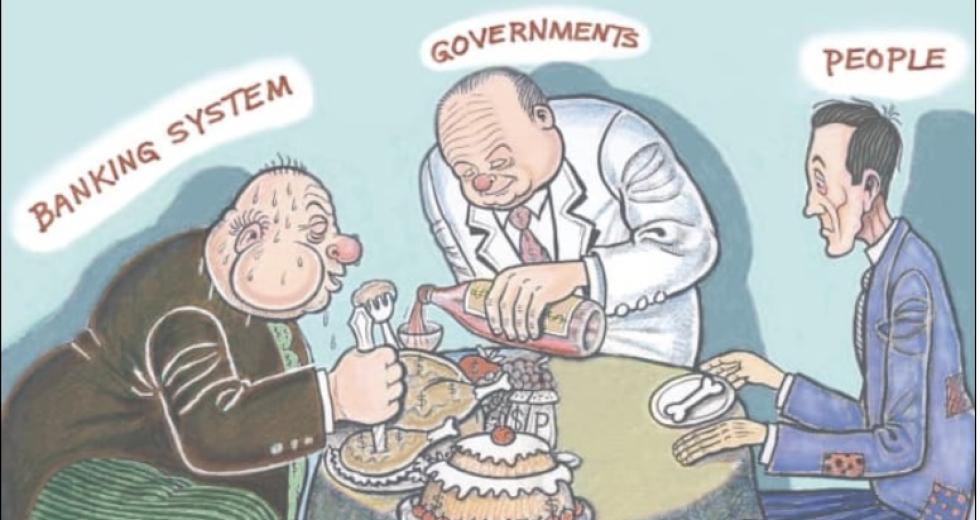
The banking class and its wide-ranging rogues' gallery of supporters recently became unnerved when Donald Trump started making too much noise about Federal Reserve Board Chairman Jerome Powell’s indecision on whether to lower US interest rates as Trump wanted. Trump came down on Powell hard. So, the usually soft-spoken bankers of the European Central Bank, in a rare move, had a bit of a wobbler and issued a rather 'loud' statement to ride to the rescue of their illustrious ‘brother Powell’.
The Banks of England and Canada concurred. The suborned legacy media signalled a similar outrage. But Trump, always eager to throw his considerable weight around, come what may, suddenly took things a step further and, while suggesting that legal action may be carried out against Powell — an apparent bluff — nominated former Federal Reserve Regional Governor Kevin Warsh to replace Powell, pending Senate approval.
For the record, Warsh is seen as something of a maverick who might disempower the Federal Reserve to whatever degree; yet, there are other indications that he’d streamline it but make it more efficient, relevant, and give it a new lease on life. We shall see.
Interest Riddle UntangledAt any rate, such discord, ironically entertaining though it sometimes is, tends to mask the mechanics of the banking system itself, where the true nexus of world control lies.
Thus, it’s helpful to examine key details of the often-mysterious monetary landscape. The news the public receives about money and economics is muddled, contradictory and outright confusing, often intentionally so. Yet, a public that learns to see through the fog enveloping that landscape and grasps monetary mechanics, with sufficient clarity, is a dangerous public — to the bankers and their entrenched usurious racket, that is.
So, let’s look less at personalities and instead seek that clarity. If we don’t, the news bytes we get on such matters will keep misleading and deceiving us to the point where they become so indiscernible that they just bounce off our collective psyche and plop into the digital waste bin of history.
In Trump’s first term, like now, he took issue with the Federal Reserve’s claim, treated as holy writ, that higher interest rates always make things cost less at the point of purchase — the underlying assumption being that higher rates mean fewer and smaller loans; therefore, with less purchasing power in circulation — so the reasoning goes — the economy won’t ‘overheat’ from ‘too much’ purchasing power entering the economy.
In all actuality, however, interest charges also function as yet another production cost — no different from taxes, raw materials, general supplies and equipment, utilities, lease or rental charges for office or factory space, the cost of labour itself, complying with regulations etc. It is these things that producers must shoulder, which they typically push along to the end consumer, at least in part.
The metaphorical ‘fog’ clears a lot more when you realise that the Fed’s stated means of controlling price inflation is based on just one type of inflation when, in fact, there are two types:
1. Demand-pull inflation, on which the Fed bases its monetary outlook and policies. The idea is that too much circulating currency and credit weakens the value of everyone’s purchasing power; that, in turn, creates a need for more monetary units to buy a given product or service. It’s also sometimes explained as aggregate demand for goods and services outpacing aggregate supply, often described as ‘too much money chasing too few goods’. Prices are bid up as demand exceeds production capacity.
But considering the massive output of modern production via the combination of human labour and increasingly sophisticated and super-efficient automation, including both domestic-made goods and imported goods, the amount of money in circulation falls far short of the sheer amount of merchandise waiting to be purchased; thus, demand-pull inflation plays a comparatively negligible role in price increases. Unusually low production levels and exceedingly large amounts of money would need to intersect for this type of price inflation to significantly kick in.
2. Cost-push inflation, the most prevalent type of inflation, downplayed by those commandeering the financial system, especially central bankers. Simply put, prices increase because the various costs involved in producing goods and services increase. Interest charges, keep in mind, are one of those costs. Such supply-side shocks can push prices up even if demand does not change.
Obviously, if the bankers raise rates and make things more expensive, under the guise of trying to lower prices, then they must know what they’re doing. Therefore, this claim that raising rates routinely lowers prices can hardly be anything other than deliberate deception.
Besides, in a typical modern economy, the US being a large example, cash and coin typically comprises no more than 10 percent of the purchasing power in circulation anyway (some peg it at 8%). The remaining 90-plus percent is digitised interest-bearing bank credit.
Interestingly, even on a worldwide basis, only about 10% of the purchasing power is comprised of cash and coin. The rest is borrowed credit consisting of loans that beget more loans, which beget still more loans — and on and on, ad infinitum. A world where the average person has money that cannot be, and may never be, physically touched is not far off.
Meanwhile, at the World Economic ForumThis overview of certain aspects of the banking machine is also a useful backdrop to help discern the ‘globalese’ — the often-vague, double-tiered verbiage spouted by globalist groups like the World Economic Forum and several others.
And, lo and behold, at the January 2026 World Economic Forum Annual Meeting in Davos, a rather ambiguous ‘new financial order’ was discussed at length. The basic thrust of the discussion conducted by various participants — including ECB President (and longtime Bilderberger) Christine Lagarde and International Monetary Fund Managing Director Kristalina Georgieva — was that this new ‘order’, featuring a structural shift characterised “by AI-driven efficiency gains”, will reduce production costs and therefore tame price inflation.
There is some truth to that premise. As already noted, the cost of labour figures into the final prices that end-consumers pay for goods and services. So, if AI can reduce production costs, that should result in reduced prices, although heavy AI usage is thought to create a high-risk environment for investors (such as when AI trading systems, which use similar learning models and data sets, create a monoculture wherein algorithms act in unison and reach similar conclusions, reducing market diversity).
At the 2026 World Economic Forum Annual Meeting, the main economics-focused topics were:
- Monetary Policy/Future of Finance: Discussions were on the roles of central banks, navigating high debt, and that ‘new financial order’ arising from the intersection of persistent inflation and rapid AI integration.
- Economic Statecraft/Debt: Discussions on the “broadening of economic statecraft” included national security, strategic autonomy in finance, and urgent calls for debt restructuring in developing countries.
- Resilience Economics: How economies recover from shocks (pandemics, climate change, financial crises), highlighting the need for structural, monetary and fiscal reform.
- Finance & Sustainability: According to the WEF’s Global Risks Report 2026, environmental risks are now heavily analysed in financial terms.
Notice that "navigating” high debt and debt “restructuring” in developing countries are mentioned in a way that assumes that debt need only be managed. In other words, getting rid of the debt-based monetary system — which is the only way to democratize the overall economic system, spread the wealth equitably and reduce both extreme wealth concentration and extreme poverty — is simply not in the bankers’ cards.
And take note that the impacts of so-called ‘climate change’ on the financial system, impacts which include onerous taxes and heavy regulation of raw material mining and industrial production, impose costs on the business-productive sector that are passed on to consumers via the cost-push inflation already outlined in this article.
Thus, the financial mandarins of the world only want to tweak their ‘sacrosanct’ system, which has created shockingly high concentrations of wealth for a tiny sliver of the world population. To nurture and protect their proverbial ‘goose’ that keeps laying endless ‘golden eggs’, the banking brigands therefore must keep actual cash in relatively short supply and keep everyone, individuals as well as nations, addicted to interest-bearing, lifelong debts.
Their false claim that raising rates always reduces prices is one of their main well-entrenched lines of deception to keep their financial fiefdom alive and thriving, and to try and prevent a real revolution that could overturn that fiefdom.
The Global Risks Report 2026The above-noted Global Risks Report released in the aftermath of the 2026 World Economic Forum’s annual meeting contains more economic matters than ever before. Much of it is quite gloomy.
But the irony is that the main cause of economic tremors, stagnation, and sometimes-steep decline is the banking system itself, in league with the governments of the world, which still do not grasp that they can and should create their own monetary units free of usurious interest charges and the control by central banks of national destinies.
The centre piece of the 2026 report is the concept of “economic confrontation” which, says the report, “has emerged as the most severe risk over the next two years”.
Meanwhile, the report notes, economic risks in general:
… have experienced the sharpest rises among all risk categories … with concerns growing over an economic downturn, rising inflation and potential asset bubbles as countries face high debt burdens and volatile markets. The multilateral system is under pressure. Declining trust, diminishing transparency and respect for the rule of law, along with heightened protectionism, are threatening longstanding international relations, trade and investment and increasing the propensity for [this economic confrontation].
Notice that while “declining trust” is acknowledged, the implication of the report is that this falling trust couldn’t possibly have anything to do with the flaws, fraud, and tyrannical nature of the monetary-banking system itself — a tyranny that finds fertile soil in the ‘sacred’ multilateral system.
This multilateral system, which is part and parcel of the globalists’ post-war ‘rules-based international order’ that the most entrenched elements of the world plutocracy established must not be allowed to ‘take the stand’ and honestly ‘testify’, so to speak, in the ‘court of public opinion’.
Too many hard-pressed questions levelled at such a ‘witness’ would reveal that rising inflation, high debt burdens, and the rest of the worries within the WEF’s 2026 report are the direct effects of policies hard-wired into the financial system itself, especially its monetary and banking components, and are not inexplicable developments beyond everyone’s control, as the legacy media portrays them to be. It’s also worth noting, if only for being thorough, that the WEF is part of the problem, while acting as if it is pursuing solutions.
The 2026 report goes on to say:
The centrality of geoeconomic confrontation in the global risks landscape is not restricted to 2026, with respondents selecting it as the top risk over the two-year time horizon (to 2028) ... up eight positions from last year.
In a world already weakened by rising rivalries, unstable supply chains and prolonged conflicts at risk of regional spillover, such confrontation carries systemic, deliberate and far-reaching global consequences, increasing state fragility.
Thus, scores of problems are acknowledged — such as unstable supply chains, a problem caused by the plutocracy that ushered in unforgivably long and unwieldy world-straddling supply chains in the first place, eschewing a more nation-based approach wherein each country first produces crops, goods, and services for its own population and then exports surpluses and/or unique items that may be scarce elsewhere and are in high demand on an international scale.
So, the true causes of our economic ills are papered over in a manner that treats price inflation and various other ills as quasi-random storms that just blow in from nowhere. In response, we’re simply told to batten down the hatches and continually ride out these economic storms that, according to the worldview of the WEF and their close brethren in the banking fraternity and legacy media, are totally unavoidable and represent a permanently unsolvable problem.
Fiscal This, Digital ThatOf course, like magicians, the bankers want to put on a good show. The long-running US-Federal Reserve partnership is flirting with a supposedly beneficent innovation called Central Bank Digital Currency — where the existing deceptive banking policies would be augmented by the removing what little cash is left relative to massive production levels and the loan racket. From there, via total digitisation, all transactions no matter how small could be monitored.
Not to be left behind, the European Central Bank, which scheduled eight monetary policy meetings in 2026, is looking at joint debt issuance (i.e., NextGenerationEU), crisis management — and a potential, some would say probable, digital euro.
All of this pushes the eurozone toward even tighter economic integration, thereby setting the stage for member states to make the necessary treaty changes to inaugurate a fiscal union. Moreover, Europe is actively working to complete its long-term banking union, “to strengthen financial stability”, of course. And then there’s the Savings and Investment Union, which wormed its way into the 2025 Bilderberg Meeting.
All told, we must never lose sight of the fact that modern banking is the ultimate stronghold of tyranny. We mustn’t allow ourselves to get overly concerned with mouthy politicians and flashy headlines about more ephemeral issues; rather, we must look past the headlines at times and carefully study how the banking ‘magicians’ conduct and conceal their crafty policies and practices. The Isle of Guernsey emancipated itself some 200 years ago from the banking system’s hocus-pocus for 20 years.
Can we do it again, only this time way beyond a small island in the English Channel? While we ask that key question, let’s get busy and do it, a day at a time.