
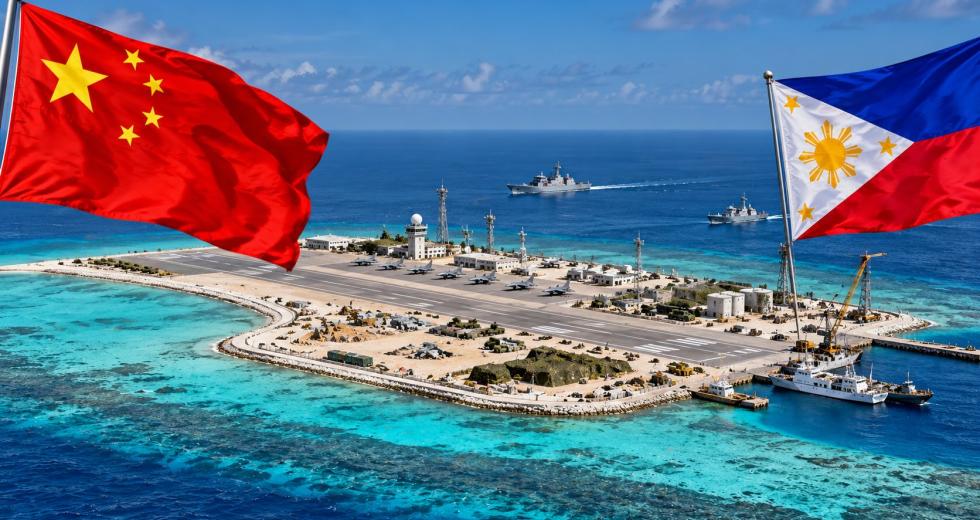
This is the story of how China's construction deep inside Philippine waters, which ended up before a 2016 tribunal in The Hague, began two decades earlier, on 2 February 1995, aboard a small patrol boat about 130 nautical miles off Palawan.
UK Column's previous article on the issue, ‘Trouble in the Tropics: Terraformation as a Tool for Territorial Theft’, described China's ongoing seizure of a sea bordered by several Southeast Asian states. The current article tells the Philippine side of the story from 1995 to the present.
A Philippine Navy crew, sailing near a barely submerged coral platform called Mischief Reef, found something that hadn't been there: a cluster of structures built on stilts, rising out of the water and flying a Chinese flag.
Days earlier, Chinese soldiers had detained a Filipino fisherman who'd stumbled across the site. Once released, the fisherman reported what he'd seen. When Manila raised this with Beijing, the Chinese Foreign Ministry said, “Structures had been built on the Reef by China to ensure the safety and lives as well as the production operations of the fishermen who work in the waters of the Nansha [Spratly] Islands”.
The Philippines did not accept the explanation. Mischief Reef sits well inside the Philippines' own Exclusive Economic Zone (EEZ) waters — nowhere near anything resembling a natural stopover for Chinese fishing boats.
In March 1995, Philippine forces went out and physically tore down Chinese survey markers planted on several other reefs in the Spratlys, intercepted Chinese fishing boats near Half Moon Shoal with air support, and — according to China — detained 62 fishermen. Then, on 13 May, Philippine vessels sailed for Mischief Reef itself, with the intent to force their way onto the structures and remove them by hand.
A Chinese fisheries patrol ship was already there and was waiting for them. A confrontation followed. Chinese accounts describe an eight-hour stand-off; contemporary reporting described the immediate ship-to-ship confrontation as lasting about 70 minutes.
The Philippines was in no position to force the issue. Its military was badly outmatched by China’s, while Manila had made clear that it wanted to avoid a direct confrontation. After the clash, the Philippine vessels withdrew.
From Hut Stilts to Helipads
Three years on, in late October 1998, Filipino surveillance aircraft spotted a cluster of Chinese naval supply ships and roughly 100 workers at Mischief Reef, pouring concrete for what analysts suspected was an airstrip, and the Chinese ‘shelters’ story collapsed entirely. Beijing's explanation this time was that it was merely replacing the old 1995 fishing shelters — now with multi-storey buildings, communication arrays, and a helipad.
In 2025, Philippine defence chief Gilberto Teodoro summarised the whole arc that had unfolded over the previous three decades, starting in 1995: “There were a few bamboo structures erected there. And China said that these were ‘temporary havens for fisher folk’. Now you have artificial military islands — heavily militarised”.
President Joseph Estrada ordered additional Philippine forces into the area to monitor the site and block entry and exit points. The forces were under explicit instructions to avoid direct confrontation.
The structures stayed, and they grew.
The pattern would define much of the next three decades: a small and deniable first move, too limited to risk war over, followed by patient escalation once resistance proved rhetorical rather than kinetic, in any meaningful sense. The result was an outcome that outlasted anyone's willingness to fight a hot war to reverse it.
Decades later, when China resumed major reclamation at Antelope Reef in the Paracels, analysts at CSIS's Asia Maritime Transparency Initiative noted that Fiery Cross, Subi, and Mischief Reefs had already “established the operational template now being applied” there — the same pattern, run a second time, on a different reef.
Salami Tactics
The Chinese modus operandi at Mischief Reef has been described by some Western analysts as ‘salami-slicing’ or ‘salami tactics’: incremental actions, each small enough to avoid provoking a major confrontation, but which cumulatively, over time, shift the status quo.
Strategic analyst Brahma Chellaney sees the same pattern across Aksai Chin (1954–62), the Paracels (1974), Johnson Reef (1988), Mischief Reef (1995) and Scarborough Shoal (2012): a persistent Chinese strategy of incremental moves that gradually alter the facts on the ground while avoiding a confrontation large enough to trigger a decisive response.
The Sierra Madre
On 9 May 1999, the Philippine Navy deliberately ran the BRP Sierra Madre, a Second World War–vintage tank landing ship, onto Second Thomas Shoal, 105 nautical miles from Palawan and 20 from Mischief Reef itself. The stated purpose was to establish a permanent presence on a feature well inside the Philippines’ EEZ four years after Mischief Reef had been lost to China.
A small Marine detachment has been stationed aboard the hull continuously since. The ship remains a commissioned Philippine Navy vessel. This is a status that Manila regards as material, since an armed attack on Philippine armed forces or public vessels in the South China Sea would potentially activate its 1951 Mutual Defense Treaty with the United States.
Washington has explicitly affirmed that the treaty covers such attacks.
The Sierra Madre was, in effect, Manila's tit-for-tat response to what China did at Mischief Reef: establish a physical presence. The crucial difference, however, is that Second Thomas Shoal lies within the Philippines' EEZ, where China's attempts to assert control interfere with rights that UNCLOS assigns to the Philippines.
Beijing, still claiming the shoal as its own, branded the grounding as an unlawful occupation and insisted that Manila remove the ship.
Philippine resupply runs to the detachment have been repeatedly blocked by China: obstruction manoeuvres, water cannon, and, on 17 June 2024, a confrontation in which China Coast Guard personnel rammed and boarded Philippine inflatables carrying knives, poles and an axe, injuring eight Filipino sailors, one of whom lost a thumb. Beijing's account holds that a Philippine vessel deliberately collided with a Chinese ship and that the Chinese response was lawful enforcement.
The following month, the two governments reached a provisional resupply arrangement, which has held unevenly.
In 2013, Chinese Major General Zhang Zhaozhong described on Chinese television what he called the “cabbage strategy”: surround the Philippine outpost in successive layers of Chinese fishing vessels, maritime surveillance ships, and warships, preventing supplies from getting through until the small Philippine garrison was forced to leave. Once gone, he said, the Chinese military would make it impossible for them to return.
Perhaps the most notable thing about that interview, however, is the mindset framing the discussion, which was evident in the TV host's opening question:
Well, we have watched the footage, and now let’s look at the big screen showing the Chinese islands and reefs illegally occupied by the Philippines. What one has stolen has to be returned. The Philippines has occupied these Chinese islands and reefs illegally, and has carried out a series of rude and barbarian actions. So, faced with these actions, what should China do? How should we respond?
As of this writing, the Sierra Madre is still there, with a rotating Philippine military contingent stationed aboard.
Scarborough Shoal
On 8 April 2012, a Philippine surveillance aircraft spotted eight Chinese fishing vessels inside the lagoon of Scarborough Shoal, and on the same day, BRP Gregorio del Pilar — the Philippine Navy's largest warship, a decommissioned US Coast Guard cutter — was dispatched and reached the shoal on the morning of 10 April.
According to the Philippine Navy's account, the first vessel inspected was carrying giant clams, coral, and live sharks — species whose harvest is restricted under Philippine and international law. Before arrests could be made, two China Marine Surveillance ships positioned themselves at the mouth of the lagoon between the warship and the fishing boats.
On 12 April, Manila pulled the warship out and substituted it with a coast guard vessel.
The ensuing stand-off lasted two months.
During the same period, Chinese authorities began holding Philippine banana shipments at port, and Chinese tour operators suspended travel to the Philippines.
On 23 April, Beijing announced the withdrawal of two of its own vessels. Manila did not reciprocate and sent a second Philippine fisheries patrol vessel into the lagoon.
In June, with typhoon season approaching, both sides withdrew.
Philippine and US accounts describe a mutual withdrawal brokered by Washington; Beijing has never confirmed that any such arrangement existed. The Philippine ships left.
The Chinese ships returned and, since then, Beijing has controlled access to the shoal.
On 10 November 2024, China announced the geographic coordinates of 16 points around Scarborough Shoal, deep inside the Philippine EEZ, and declared straight baselines from which it would measure its claimed territorial sea.
In September 2025, China's State Council approved a 3,523-hectare national nature reserve around Scarborough Shoal, ostensibly to protect its coral ecosystem.
Manila's national security adviser, Eduardo Año, said:
This move by the PRC is less about protecting the environment and more about justifying its control over a maritime feature that is part of the territory of the Philippines and its waters lie within the exclusive economic zone of the Philippines. It is a clear pretext towards eventual occupation.
The Road to The Hague
In 2013, Manila formally challenged China under UNCLOS Annex VII, filing for arbitration at the Permanent Court of Arbitration in The Hague.
The case didn't ask the tribunal to decide who owns which island; sovereignty sits outside UNCLOS' jurisdiction. Instead, it asked a narrower and more damaging question: does China's nine-dash line, and the ‘historic rights’ Beijing claims within it, have any basis under the Convention?
Beijing, despite being a party to UNCLOS, refused to participate in the proceedings and rejected the tribunal's jurisdiction outright — even before the process had started.
In July 2016, the tribunal ruled. It found:
- That the nine-dash line had no legal basis under UNCLOS.
- That China had unlawfully interfered with Philippine fishing rights and caused serious environmental harm through its island-building.
- That none of the Spratly features, however built up, could generate an EEZ of their own.
It was close to a clean sweep for Manila.
China's Foreign Ministry responded the same day: “The award is null and void and has no binding force. China neither accepts nor recognizes it”.
Beijing has ignored the ruling ever since.
The Lost Years
Under President Duterte, the Philippines largely shelved the ruling in favour of economic engagement with Beijing.
The skirmishes at sea continued: laser incidents, fishing boat swarms, and repeated clashes.
Then, in 2022, Ferdinand Marcos Jr. took office, and his administration revived the arbitration ruling as the explicit foundation of Philippine policy, launched a “transparency campaign” inviting journalists to document Chinese coast guard activity firsthand, and deepened military ties well beyond its traditional US alliance.
Confrontations at Second Thomas Shoal and Sabina Shoal escalated: ramming, water cannons, and injuries, drawing statements of concern from the United States, Japan, Australia, and the European Union. China's account of both incidents holds that Philippine vessels manoeuvred dangerously, and that Chinese responses were lawful.
A decade on from the ruling, the legal question remains settled while China still occupies Scarborough Shoal and expands elsewhere.
A Sea of Many Names
Even the name of this body of water in Southeast Asia is contested ground.
‘South China Sea’ is the English name, with deep roots in European maritime usage.
In 2010, the Vietnamese Nguyen Thai Hoc Foundation launched a Change.org petition to rename the sea from ‘South China Sea’ to ‘Southeast Asia Sea’, arguing that coastlines around it total roughly 130,000km against China's 2,800km.
As of this writing, the petition has gathered close to 100,000 signatures.
The UNCLOS
The United Nations Convention on the Law of the Sea (UNCLOS) was signed in 1982 and entered into force in 1994.
The idea it codifies goes back centuries.
As European powers began to ply the world's oceans in the 1500s and 1600s, a fundamental question arose: could anyone own the sea?
Portugal and Spain claimed vast maritime monopolies by papal decree.
In response, the Dutch legal scholar Hugo Grotius published Mare Liberum (The Freedom of the Seas) in 1609, arguing the oceans belonged to no one and were open to all nations for navigation and trade.
England's John Selden countered with Mare Clausum (Closed Sea), defending the right of states to claim and control adjacent waters.
That argument — free sea versus claimed sea — ran for over three hundred years, through colonial fishing disputes, naval blockades, and two world wars, before nations finally sat down in the 20th century to write a single rulebook: UNCLOS.
Starting in 1973, UNCLOS was negotiated over nearly a decade at UN conferences and, in 1982, it was signed by 119 states. It was the crowning achievement of over three centuries of collective human endeavour: establishing a treaty to keep the high seas open whilst granting coastal states control near their shores.
As such, it is a cornerstone of international law. Tommy Koh, the conference president who gavelled it through in 1982, called it “a constitution for the oceans”.
By mid-2026, 172 states were party to UNCLOS, making it one of the world's most widely adopted international legal frameworks.
The US is one of only a handful of countries that remain outside the Convention. This is despite Washington having supported accession for decades. The obstacle is the Senate. Ratification requires the consent of two-thirds of senators, and although the Senate Foreign Relations Committee has repeatedly recommended accession, the full Senate has never given its consent. The US nevertheless maintains that it generally observes the Convention's rules governing traditional uses of the oceans.
No Referee
The US is poorly placed to act as a referee. First, it has not ratified UNCLOS. Second, Taiwan — Washington's informal security partner in East Asia — makes essentially the same maritime claim Beijing does.
It still holds on to the eleven-dash line drawn up by Chiang Kai-shek's Nationalist government in 1947, to which Beijing's nine-dash line is just a successor.
Two ostensibly different Chinas, Siamese twins of the same civil war (1927–1949), were read from the same map. They were drawn by the same government and were both afflicted by the same imperial impulse.

Kristoffer Hell
Kristoffer Hell is an independent writer and journalist covering high politics and how technology shapes human experience. He holds an MLitt in Strategic Studies from the University of Aberdeen and a Diploma in News Journalism from the London School of Journalism. He previously worked as a software developer, contracting in banking, pharmaceuticals, and retail.