
In the hazy distance, huge alien contraptions with mysterious symbols emblazoned upon them are terraforming a tropical planet. The machines arrived without announcement or explanation. One day, they were simply there. Now fear is spreading among the indigenous species.
It sounds like a pitch for a science fiction script: an alien species moves in and reshapes a planet to serve its own needs.
Let the plot thicken.
Assume the planet is not barren, like Mars or the Moon, but teeming with life. Now ET is an invader. Terraforming is no longer merely about making the environment less inhospitable to its own kind. It becomes a weapon against pre-existing life.
Welcome to Earth 2026 — to a region mislabelled the South China Sea — a name coined by 16th century European traders that predates, and has nothing to do with, who actually owns the water.
ET Has a Name
The terraforming invader is the Chinese Communist Party (CCP) — an anachronistic totalitarian entity that still clings to mainland China and somehow survived 1989 and the Tiananmen Square massacre.
Since 2013 (or 1995, depending on how one counts), the People's Republic of China (PRC) has been building islands where none previously existed in waters under the jurisdiction of other states.
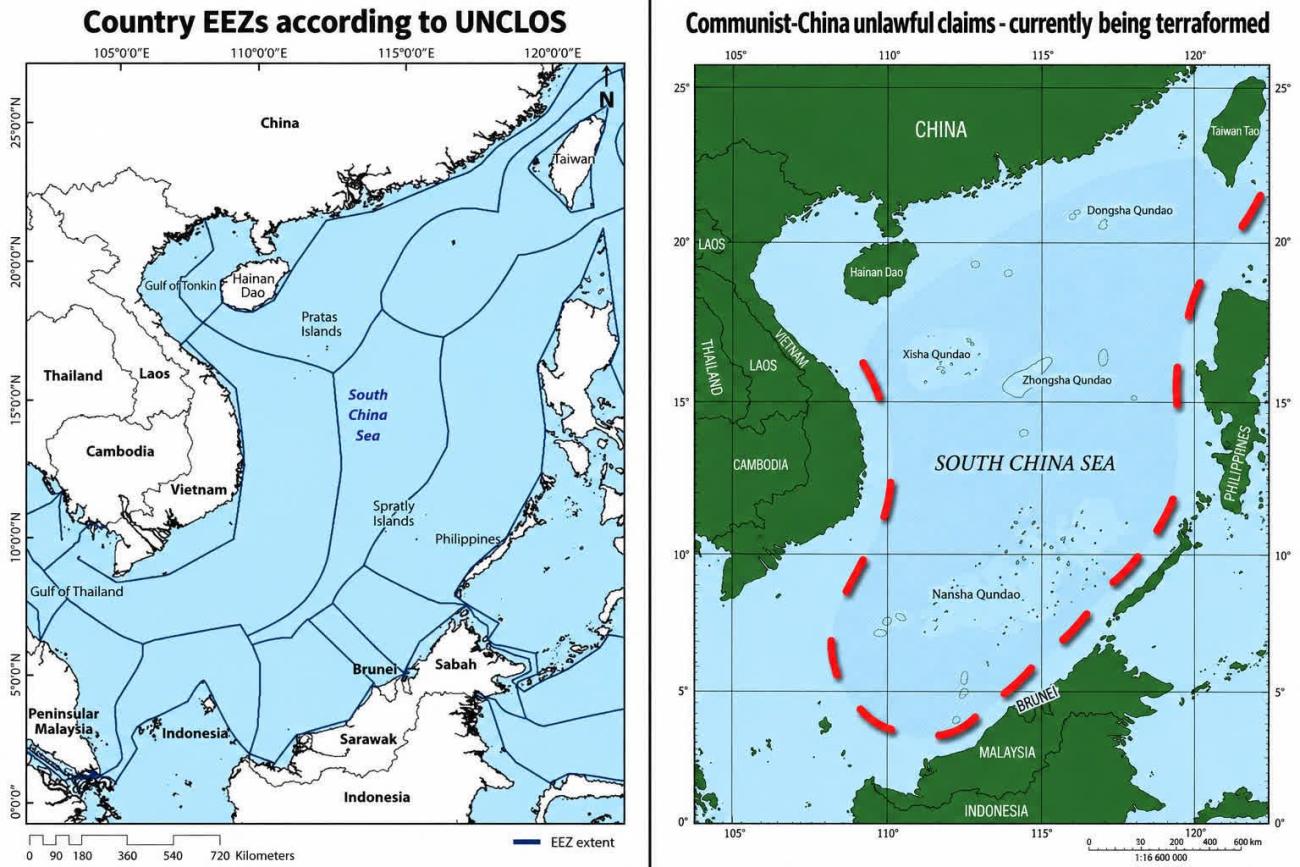
Those other countries have rights that need no army to defend and no tribunal to grant them. International law draws them in a straight line 200 nautical miles from their own shore.
It is called an Exclusive Economic Zone (EEZ), and under the UN Convention on the Law of the Sea (UNCLOS), a treaty China itself ratified but has since repeatedly violated, the coastal state has sovereign rights over the natural resources of the waters, seabed, and subsoil within that zone, along with certain jurisdictional rights.
Full stop.
No dredger changes that maths. No fresh mountain of sand pumped up from a reef turns someone else's territory into a birthright.
Yet, that is precisely what has happened. Reefs once barely visible at high tide have been transformed into military runways, with the transformation itself invoked as justification, as if pouring concrete over a reef could somehow rewrite who has the right to it.
Killing a Sea
China's cutter-suction dredgers slice directly into living coral reef, pump the resulting sediment through floating pipelines, and dump it as landfill. It is a process that also throws up plumes of abrasive silt that drift onto neighbouring reefs and smother them.
The Asia Maritime Transparency Initiative of the CSIS (AMTI) puts China's direct toll from dredging and landfill at close to 4,648 acres (18.8 square kilometres) of buried reef.
But the dredgers were not the first to arrive.
Before the landfill came the clam boats. Chinese fishing crews harvest giant clams by dragging specially made brass propellers in a semicircle around the anchor chain at the bow, churning up the reef surface to free both live and dead shells. The technique leaves arc-shaped scars visible in satellite imagery, and only Chinese fishers are known to do this. The shell resembles ivory closely enough to have replaced it in Chinese statuary and jewellery; a single worked clam has sold for over US$100,000.
On top of the 4,648 acres of buried reef, AMTI also estimates another 16,353 acres (66 square kilometres) of reef has been damaged this way.
In 2016, the Annex VII Arbitral Tribunal constituted under UNCLOS — in the case brought by the Philippines against China, PCA Case No. 2013-19 — ruled against China's terraforming campaign in the South China Sea, making the extensive reef damage part of the verdict.
The dredging and harvesting were different phases of the same destruction. Satellite analysis of the 2014–2015 landfilling at Fiery Cross, Subi, and Mischief found that waves of clam boats had cut their arcs across the same reefs shortly before the dredgers arrived, stripping the coral of its most valuable extractable asset before it was paved over. The tribunal reached the same conclusion:
China, despite its own rules protecting giant clams and coral reefs, was fully aware of the practice and actively tolerated it as a means to exploit the living resources of the reefs in the months prior to those reefs succumbing to the permanent destruction brought about by the island-building activities.
Marine biologist John McManus of the University of Miami, whose research the tribunal cited directly, calls it “the most rapid permanent loss of coral reef in human history”, and pointed out that “once a portion of coral reef has been buried under tons of sand and gravel, it cannot ever recover”.
The tribunal found that China's construction caused “severe harm to the coral reef environment” — one of the most biodiverse marine environments on Earth, with over 500 coral species, and the nursery grounds on which fish larvae across the entire sea depend on to replenish it. The damage it held is irreparable.
Vietnam Follows
China's wilful destruction of reefs and sea has since taken on a life of its own. Vietnam, apparently responding to the Chinese military buildup, has adopted the same practice and became the second-largest offender in terms of reef destruction.
The difference is that for Hanoi, it is seen as a defensive survival measure. Raymond Powell, director of Stanford's Project Myoushu, said, “Vietnam has drawn the conclusion that it has little choice but to respond”.
The End is Nigh
Analysts believe Beijing is close to making permanent its hold over 80-90 per cent of the South China Sea, a shared body of water bordered by several Southeast Asian states. Five Southeast Asian states have between a third and nine-tenths of their EEZs swallowed by China's nine-dash line:
- Philippines: ~80% of its West Philippine Sea EEZ, including all of Reed Bank and part of the producing Malampaya gas field
- Malaysia: ~80% off Sabah and Sarawak, including most of its active oil and gas fields
- Vietnam: ~50% of its total EEZ
- Brunei: ~90% of its total EEZ
- Indonesia: ~30% around the Natuna Islands, including waters around the Natuna D-Alpha gas field
The Philippine defence chief Gilberto Teodoro Jr., addressing China's terraformation in the South China Sea, said, “No ASEAN country accepts the legitimacy of that 10-dash line because that is the biggest fiction and lie that can be sold to any right-thinking person”.
ASEAN includes the countries of Brunei, Cambodia, Indonesia, Laos, Malaysia, Myanmar, Philippines, Singapore, Thailand, Vietnam, and Timor-Leste.
One Mission and Three Clusters of Dispute
China's attempt to dominate the South China Sea conceals three distinct categories of legal dispute.
Category one is unambiguous. The Spratly reefs China occupies and has terraformed into artificial islands functioning as virtual aircraft carriers: Fiery Cross, Subi, Mischief, and the rest sit roughly 550–600 nautical miles from Hainan, far beyond the 200 nautical mile breadth of a normal exclusive economic zone measured from China's mainland coast.
Nothing in UNCLOS gives these artificial outposts a new Chinese maritime entitlement simply because China built them.
Category two is the Paracels: Woody Island, Triton Island, Antelope Reef, and Yagong Island. They sit roughly equidistant between China's Hainan Island and the Vietnamese coast, both inside 200 nautical miles. UNCLOS does not decide who owns the Paracel Islands; sovereignty does, and that fight is between Vietnam's historical ownership and China's forcible seizure of the archipelago from South Vietnam in 1974.
Category three is akin to an island scramble. Most of the Spratlys sit outside both Vietnam's and the Philippines' mainland-measured EEZs — 250 to 310 nautical miles out — meaning the legal prize is sovereignty over qualifying islands. Under UNCLOS, such a feature can generate maritime zones of its own. But not every reef or rock does.
Vietnam, the Philippines, Malaysia, Taiwan, and China are all parties to this game: getting there first and staying. It is aggressive, and occasionally violent; for example, in 1988, 64 Vietnamese sailors were killed defending Johnson South Reef against China.
Taiwan, the other China, or the Republic of China (ROC) — is also part of the scramble, through Itu Aba, the largest natural island in the whole Spratly chain, garrisoned since 1956.
China's nine-dash line (originally 11 dashes in 1947, reduced to nine on later maps, with a tenth added later) does something categorically different: it doesn't stake a claim feature by feature. It draws a boundary around an entire sea at once, based on vaguely defined ‘historic rights’, and treats every other country's claim as something to be absorbed rather than left alone or negotiated over.
China is not an equal participant.
It is an empire declaring the whole board its own before a single piece has been placed; a Napoleonic gesture dressed up as a property dispute — if it is wearing any clothes at all.
What the Hague Tribunal Changed
The 2016 Hague tribunal ruling did more than condemn individual Chinese actions. It rejected the legal basis for China's claim to historic rights in maritime areas beyond the entitlements permitted by UNCLOS. Even if such historic rights existed, the tribunal found that they could not override the maritime-zone system established by UNCLOS:
China's claims to sovereign rights and jurisdiction, and to 'historic rights', with respect to the maritime areas of the South China Sea encompassed by the so-called 'nine-dash line' are contrary to the Convention and without lawful effect to the extent that they exceed the geographic and substantive limits of China's maritime entitlements expressly permitted by UNCLOS.
As stated in The Economist, "If the terraforming no longer makes headlines, it is because it is largely complete".
A Fleet of Unsinkable Aircraft Carriers
By September 2026, the CCP had established 27 outposts, many of them militarised: 20 in the Paracels and seven in the Spratlys. Among them was Mischief Reef, about 125 nautical miles from the Philippine coast, a distance a Chinese fighter jet could cover in 15 minutes at 500 knots, or six minutes, at Mach 2.
Professor Ran Bogong said that “China will be able to expand its military capabilities in the South China Sea by using these islands as unsinkable aircraft carriers”.
The three major artificial islands are now complete and operational as military bases. Fiery Cross, Subi, and Mischief Reefs each carry runways over 3,000 metres, which is long enough to operate China's major combat and support aircraft. Satellite imagery from 2020 showed KJ-500 early-warning and KQ-200 anti-submarine aircraft based at Fiery Cross. In 2022, the US Indo-Pacific Command confirmed China had deployed jamming equipment, fighter jets, and surface-to-air and anti-ship missiles across the outposts.
The Next Step: An Air Defence Identification Zone
An Air Defence Identification Zone (ADIZ) is a declared airspace in which a state requires aircraft to identify themselves for security purposes, typically extending beyond its territorial airspace.
China declared its first ADIZ over the East China Sea in 2013, and a PLA source has confirmed Beijing has held a parallel internal plan for a South China Sea ADIZ since at least 2010, one that would reportedly cover the Pratas, Paracel, and Spratly chains simultaneously — airspace control over the entire contested sea declared in a single stroke.
China now has the capability to impose such an arrangement in the South China Sea. The question is when it will switch it on.
Beijing's own answer, from a PLA source speaking to the South China Morning Post, was: “If the US military makes provocative moves to challenge Chinese sovereignty in the region, it would give Beijing a good opportunity to declare an ADIZ”.
Scarborough: Earmarked for Terraformation?
In early August 2026, the Chinese drilling-capable survey vessel Haiyang Dizhi Shihao entered the Philippine EEZ, where it spent some three weeks inside Scarborough Shoal's 12 nautical mile territorial sea conducting seabed mapping.
Why map the seabed of another country's waters? Is this preparation for further terraforming in the South China Sea?
If, or when, China starts terraforming Scarborough Shoal, the Philippines could find itself with a Chinese military forward operating base just minutes by fighter jet from its capital, Manila.

Kristoffer Hell
Kristoffer Hell is an independent writer and journalist covering high politics and how technology shapes human experience. He holds an MLitt in Strategic Studies from the University of Aberdeen and a Diploma in News Journalism from the London School of Journalism. He previously worked as a software developer, contracting in banking, pharmaceuticals, and retail.