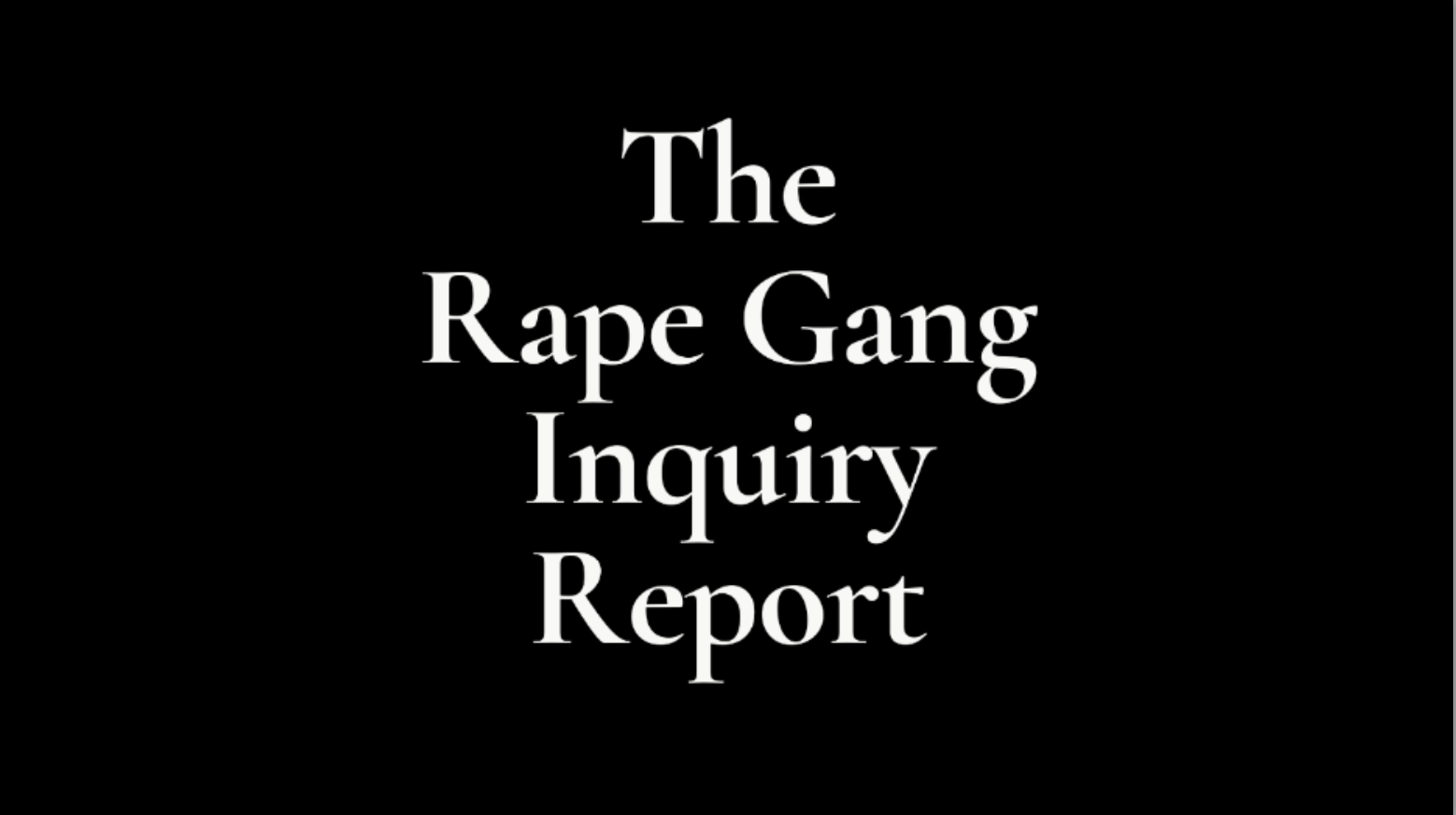
At 218 pages, Rupert Lowe’s Rape Gang Inquiry Report (published in June 2026) has landed with a considerable virtual ‘thud’. The report is detailed, and the subject matter is extremely serious, but like all reports, it should be judged just as much by what it does not contain as by what it does. The first words of Lowe’s own Foreword contend that “Britain doesn’t have a racism problem, it has an immigration problem”. This may well be the right line to take, but not necessarily one reinforced by the report which follows.
The focus of this briefing will be limited to the recommendations made towards the end of the report because they represent the whole point of it. The focus of the report itself is much narrower than its title suggests, as it set out to deal with what is described as “the systematic targeting of vulnerable girls, overwhelmingly White British, by predominantly Muslim Pakistani gangs across towns and cities up and down the nation.” Presentation of the report as the result of a truly objective inquiry is undermined by the strong inference that it is the moral steadfastness of the native breed which “inspired over 20,000 British patriots to help fund our Rape Gang Inquiry”.
Whilst the Introduction tells the reader that the “Inquiry welcomed girls, boys, men, and women of all races and religions to testify” in order to “to gain a complete picture of the rape gang phenomenon,” the recommendations are not reflective of this. In the opening text of the Recommendations section, it is made perfectly clear that sympathy is to be curated: the issue to be redressed is the “profound betrayal of hundreds of thousands of British children”. Not just children, but British children, as distinct from ‘Muslim’ children or ‘Pakistani’ children.
The recommendation on prison sentences is founded on an absolutely solid base, which is that “current sentencing guidelines are grotesquely inadequate for organised child rape”. The report believes that “racial or religious motivation” should be considered as one of several “statutory aggravating factors that push sentences toward their maximum extent”. Are Rupert Lowe and the report authors unaware of just how wide the “racial and religious aggravation” net may be cast? The Crime and Disorder Act 1998 states that an offender must demonstrate hostility based on “the victim’s membership (or presumed membership) of a racial or religious group” and that hostility qualifies even if only “partly” based on such membership. The Act stipulates that membership “includes association with members of that group”. In other words, the threshold for the introduction of the element of supposed aggravation is extremely low.
Just a few paragraphs later, the report also states: “The Equality Act 2010, if not repealed altogether, should never be applied to criminal justice and safeguarding context”. Though the Equality Act follows the legislation on aggravation by some years, there is no doubt that the “protected characteristics” it enshrines have amplified the effect of the Crime and Disorder Act. As an aside, it should not be forgotten that the Crime and Disorder Act was passed during the first full year of the Blair tenure, which included 48 other general acts; the Human Rights Act is among them. As far as the report is concerned, this presents a contradiction of some magnitude, and only adds weight to the notion that the reader is supposed to go away with a very particular point of view.
The Executive Summary has already stated: “Perpetrators from Pakistani Muslim and other Muslim backgrounds operated under an honour-and shame-based clan code that treated non-Muslim girls, especially white working class girls, as property available for sexual use”. First of all, this means that an enactment of these recommendations would see any abuse of a white girl by a Pakistani Muslim as racially or religiously aggravated, without further need of qualification. Also, based on the recommendations, a gang of white men would receive lesser sentences for abusing a white girl than a gang of Pakistani Muslims would for the same offence. It is not made clear how this would constitute ‘justice’ for the victim.
The sentencing paragraph closes with a call for the reintroduction of the death penalty, which is described as “more than proportionate”. The reader is reminded that Rupert Lowe has already called for this, which he has. In fact, he misrepresented data collected by a poll that he had commissioned, in order to claim that the British public agreed with his position. This, and the uncanny temporal proximity to parallel activity in the Israeli Knesset, was dealt with in ‘A Capital Coincidence’.
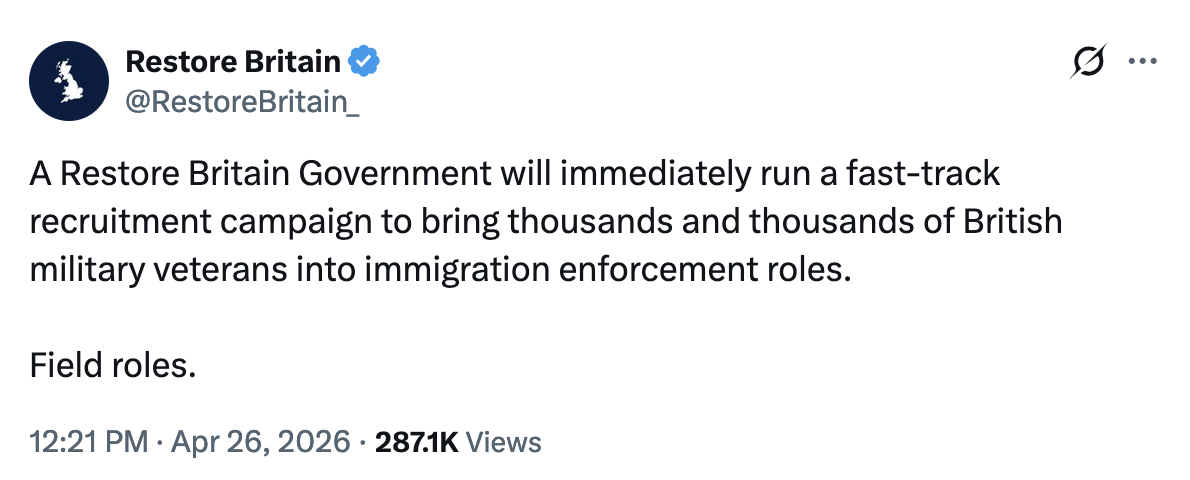
With regard to immigration, deportation, and denaturalisation, the line is clear: “Every foreign national convicted of group-based CSE must at the very least be deported”. There is no plan for this, and nor does there need to be; it is tossed out as a vote winner. It joins the list of jingoistic claims coming from the Restore stable, like the X post appearing to suggest that trained killers would be released to round up immigrants in “enforcement roles”; specifically, “field roles”. This was the declaration in April 2026 that military veterans will be recruited to conduct pogroms up and down the land. For those considering Rupert Lowe as an alternative to mainstream politics, it should be noted that ‘denaturalisation’ is a core tenet of the National Security Act 2023; one of the building blocks in the wall to contain ‘extremists’.
So now to the paragraph dealing with a Legislative Response, which begins with the entirely valid point that the current system “records thousands of individual offences while concealing, deliberately or otherwise, the organised nature of the predation”. The report calls for a Childhood Sexual Exploitation Act which, among other things, would “impose a statutory duty on every relevant public authority to record and publish the ethnicity, immigration status, nationality, and religion of both victims and perpetrators in all such cases”. Given the way in which the current absence of granularity of this data allows those on all sides of the ‘debate’ to inflame and agitate by insisting that they are ‘right’, such a recording process does look like the obvious answer.
However, one hardly needs to bring Twain or Churchill to mind in considering the many ways in which statistics may be misused or miscalculated. Besides which, such a provision in any proposed legislation is assuming a reliable collection of data in the first instance. This is an important point because there is almost universal agreement on the systematic failure of the responsible bodies to act correctly. Yet, the Inquiry Report suggests that they are to be entrusted with accurately collecting and collating data that could very well be used to stoke vigilante action or civil war. How else to interpret this: “Anyone from a country whose nationals are disproportionately represented in rape gang convictions must no longer be entitled to a visa”?
To qualify the sense of unease brought by the mention of ‘statistics’, look no further than the Home Office Counting Rules (HOCR). The data fed into the Home Office by police — according to the provisions of HOCR — are used to provide the statistics relied upon by the Government and the public to determine the prevalence and incidence of particular types of crime. The first issue to deal with is that a recorded ‘crime’ is, in fact, the creation of a crime report which occurs during the very early stages of investigation of an incident or allegation. Consider, then, how some of the elements of HOCR may skew this process entirely:
- If there is evidence of a crime having occurred, but no victim can be found, a crime is not recorded.
- If there has been a “public order incident where, on the arrival of the police, there is no continuing disorder and no obvious victim, the incident will not be routinely recorded as a crime”.
- “The general rule of one crime per victim applies to crimes with specific, intended, or identifiable victims”, but if “there is no obvious victim of a crime, or if the crime is ‘victimless’, then one crime must be counted for each offender or group of offenders”.
- However, “An incident comprising a sequence of crimes between the same offender (or group of offenders) and the same victim should be counted as one crime if reported to the police all at once”.
On top of these confusions and contradictions, it must be made very clear that if the crime report is closed and no further action is taken, the incident is still considered as a recorded crime and becomes a statistic. Is it in any way realistic to imagine that recording of the details set out in the report would yield accurate results?
A little further down this section, the ‘mainstream’ credentials of Restore and Rupert Lowe are solidified. A ‘reform’ is proposed which would deliver the Sexual Risk Order (SRO). This is identical to the way in which recent and successive Governments have attempted to ‘clamp down’ on various ‘unwanted’ behaviours, doing away with any sense of fairness or proportionality. This is precisely how ‘buffer zones’ have been created around abortion clinics; by use of Public Spaces Protection Orders. This is tyranny in plain sight, and the Inquiry Report is recommending another mechanism which may mandate or prohibit behaviour “even where a criminal conviction has not yet been secured”. How many that dream of pencilling their cross into a Restore box grasp this reality?
Moving to the All Frontline Response, all relevant professionals “must receive mandatory annual training on group-based child sexual exploitation”. This could be viewed as a good idea, in an objective sense, if it were not for the fact that it is qualified immediately so that it conveys “the documented ethnic and religious patterns” to the professional. Even with a determined attempt to assume good faith, it is impossible to read this as anything other than a proposed directive to look almost only at Pakistani Muslims. Further, how should mandating such training be regarded as distinct from the other sorts of dreadful bias introduced by the various disciplines of woke?
Policing is called upon for a significant enhancement of its “multi-agency coordination”. This seems hopeful, since the body of the report makes a strong case for these being the very relationships which allowed the abuse to perpetuate in the first place. Police are also to be “trained to interview rape gang suspects in relation to their religious beliefs and investigate the witness evidence of victims in relation to the religious elements of their abuse”. By this stage, it is blindingly obvious that police would be expected to read the word ‘religious’ as ‘Islamic’.
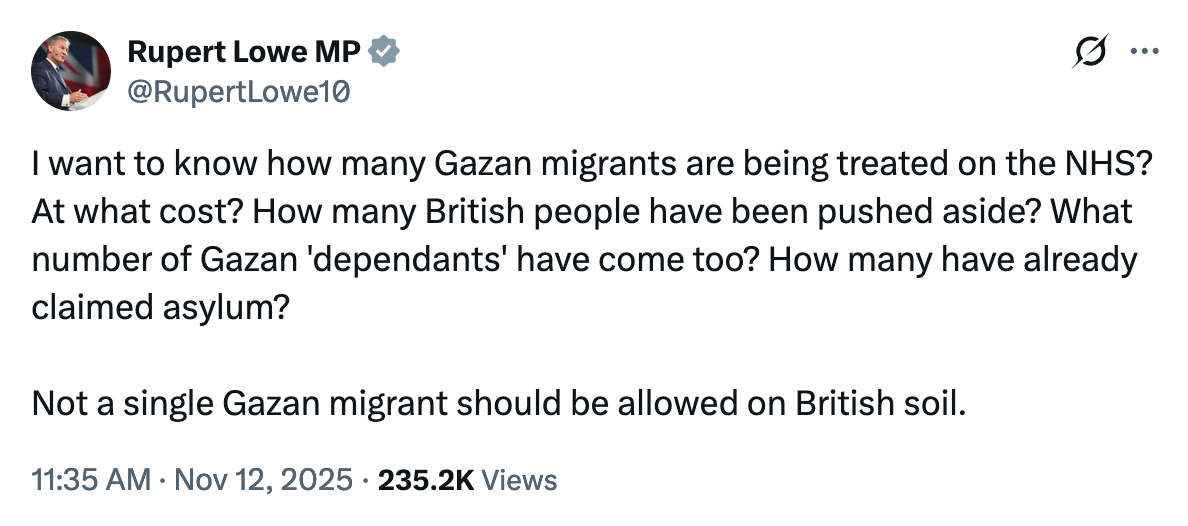
The Healthcare recommendations make wild assumptions about the capacity and organisational structure of the National Health Service (NHS). Rupert Lowe despises the NHS because it will insist on hiring (qualified) people who speak languages other than English. He despises it, too, because it has treated Palestinian civilians on the receiving end of a current genocide at the hands of the state of Israel.
The recommendations made at the end of the Rape Gang Inquiry Report read like an election manifesto for Rupert Lowe’s Restore. Employing the tactic of generating apparently nationalistic and political support via the presentation of the threat of coordinated sexual predation from non-natives comes straight out of 1920s and 1930s Germany. This report and its recommendations belittle the suffering of those at the hands of white British abusers, and it ignores altogether the experiences of any victims not classified as white or British. The intense focus on the ‘gang’ element — which should not, for one moment, be ignored — does completely marginalise the systematic abuse of so many others in all sorts of other settings.
Lowe may be right about Britain not having a racism problem — yet — but he seems absolutely determined to create one. The invective directed at Muslims in particular is not only designed to agitate an already destabilised country, but it promulgates and strengthens the position of the Israel lobby and the wider Zionist agenda. Though purporting to solve the problem, Rupert Lowe is magnifying it by aiding and abetting the very system which drives young men from their homelands towards the British Isles in the first place.