
Note: This piece originally appeared as an invited article in the Scottish Union for Education's Newsletter No. 158 on 30 April 2026.
The Herald recently published an opinion piece by James McEnaney, its education reporter, claiming that “Cutting school librarians is a clear threat to pupils’ support systems” in Scottish schools. At first glance, it would seem to the casual reader that doing so would indeed be detrimental to our children. But is this unquestionably true?
If you believe that librarians should be in the business of providing books with content about rape, suicide, murder, illegal drug use, and coerced underage sex with teachers, then perhaps you agree.
In March, The Daily Mail reported that a Manchester-area secondary school librarian had removed 193 ‘inappropriate’ books based on instructions from the school’s administration. The article gave seemingly innocuous examples of the offending titles, such as Stephenie Meyer’s Twilight and Michelle Obama’s Becoming. The school placed the librarian under investigation for safeguarding concerns because she had provided these books in the first instance, and she eventually resigned before the disciplinary procedure completed.
The report stated that the school used AI to complete the list of inappropriate titles, which made the story even interesting; could AI determine what secondary school pupils should not read? The Mail article linked to a more detailed article on the case by Index on Censorship. According to this article, Emily, the librarian involved, said, “We have the exact same group of children who come in every single day, and a lot of them are LGBTQ+, a lot of them are neurodivergent, and they come into the library because it’s their safe place”. The LGBTQ+ inclusion argument is used extensively by librarians and their professional bodies, including the Chartered Institute of Library and Information Professionals (CILIP) in the UK and the American Library Association. This, in my view, is a distraction from the dangerously explicit nature of the content within these books. Much of it has nothing to do with LGBTQ+ material.
Index on Censorship’s report makes it clear what was actually happening behind the story, which is increasingly happening in American libraries, and is now coming to the UK, via Emily's case: librarians are disingenuously using the guise of ‘censorship’ and the manufactured threat of ‘book burning’ to make the public think there is sinister action behind those who seek to limit access to age-inappropriate content. This is an inversion: it is the opposite. Let’s explore this further.
A new documentary called The Librarians is now being screened in libraries across America. It is available for free streaming on the PBS through 9 May 2026, although a VPN set to the United States is needed to watch it from within the UK. The film’s website reveals that it has received high praise as an ‘official selection’ at Sundance Film Festival, SXSW, and others. Sarah Jessica Parker is one of its executive producers; it would seem that the funders behind the project need further investigation. The film is filled with emotive content, all of which sides with the supposedly brave librarians who have sacrificed their jobs, their mental health, and indeed their personal safety to fight for the right of children to read without the threat of censorship. The librarians interviewed in the film claim the parents of the children they serve in their libraries, seek to vilify the librarians. After all, all the librarians ever wanted was to educate children and support their intellectual and library development, correct? What could possibly be wrong with their intentions?
As a former librarian who also educated future librarians for two decades, a basic tenet of librarianship is to ensure that your library’s services and collections meet the needs of your readers. In a school library, this naturally should involve input from the children’s parents, and public librarians should incorporate the desires of those who pay council tax within their local authority. If parents or other authority figures are asking to have input into children’s collections, librarians should engage in dialogue with those concerned, rather than play the victim and frame themselves as individuals targeted by those who only seek to destroy them. What about the concerns of parents who hold religious views that counter exposure to explicit content, such as Christians and Muslims? Their views, in the librarians’ claims, are seen as hateful and not inclusive. We again can see the inversion occurring here.
I recently interviewed Bonnie Wallace for UK Column. She is a concerned mum in Texas who has been tirelessly fighting the inclusion of age-inappropriate books in children’s library collections. In the interview, she mentioned books available in children’s collections such as Pulitzer Prize-winning The Sympathizer, in which a 12-year-old boy ejaculates into a squid, and then his mother cooks it. Bonnie also talked about Boy Toy, featuring a 12-year-old boy entering into a sexual relationship with his teacher. The examples became even more graphic as our discussion proceeded, as she read excerpts from other books describing graphic scenes of not only sex involving underage children, but also other types of criminal activity.
These books are available in school libraries and children’s sections of public libraries in the US, and also here in the UK. On UK Column, I also have interviewed the brave women of Devon-based Protect & Teach, which leads a growing group of concerned parents who are questioning and fighting the inclusion of explicit materials in schools and libraries. Earlier this year, I interviewed Protect & Teach leaders Cathy Mudge, Jenny Dingsdale, and Gilli Blick about Exeter Library’s 2025 child-centred event called Queer Fest. The following is from my interview write-up:
Cathy has written an accompanying article for UK Column, 'Queer Fest at Exeter Library: Devon County Council's Child Safety Test', which outlined the event and clear child safeguarding problems involved. The article includes graphic photographs taken at Queer Fest that provide irrefutable evidence of inappropriate sexual objects and materials being displayed to people of all ages who entered the library on the day.
In this interview, Protect and Teach members detailed the contents of Queer Fest, the concerns they raised with the library manager prior to the event taking place, and how those concerns were dismissed. These included how to measure for the correct condom size, the display of dildos, and explanations of illegal sexual practices such as chemsex. Children who attended Queer Fest were encouraged to provide their contact details via a QR code in exchange for sweets.
The discussion then broadened to the deeper issues underpinning Queer Fest, including the sexualisation of children, the attack on children's developing minds, how it paves the way for paedophiles, the role of academic queer theory in breaking down boundaries, this misuse of the Equality Act 2010, and the globalist agenda behind it all.
They made a lucid point in the interview: in the past, authorities could determine whether a child had been groomed or otherwise exposed to inappropriate behaviour if they knew about sex. Now, because sexual content is mandated in the Scottish Curriculum for Excellence as well as Relationships and Sex Education (RSE) in England and Wales, social workers can no longer use sexual knowledge for determination for safeguarding because all children who are growing up in the UK are required to learn about it now. The only devolved nation in which parents can remove their children from this content is Northern Ireland, as Hugh McCarthy has reported.
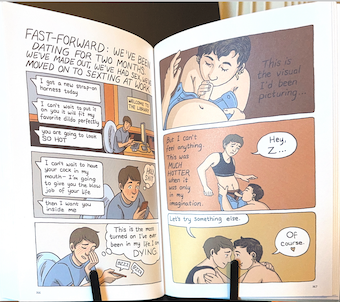
Librarians are trained to protect intellectual freedom and fight censorship, which is certainly a worthy, if difficult, position to take in 2026. With UK Government actions such as the dubiously named Online Safety Act 2023 claiming to protect children from harmful content online, which truly impacts Internet users of all ages, freedom of access to information is at risk for everyone in the UK. Scotland led Westminster in these censorious efforts through its Hate Crime and Public Order (Scotland) Act 2021. Humza Yousaf, the then-First Minister, wanted people to be arrested for what some, including UK Column’s Brian Gerrish, have called “hurty words”, whilst placing sexual and criminal content in front of children as a national requirement is labelled ‘inclusive’ by the Scottish Government. Here, we see the paradox in which ‘misgendering’ via social media a man dressed in makeup and a dress is worse than exposing children as young as eight years old to graphic novels such as Gender Queer, which depicts a young person performing oral sex at the request of an older person.
Just a bit of surface-level research can uncover what the librarians are doing under the guise of censorship. In all fairness, it is not only the librarians, but also the authors who are behind the agenda. On 10 April, EveryLibrary, an activist group affiliated with the American Library Association that claims it “builds support for libraries and helps Americans fight book banning in their communities”, posted a YouTube video of young adult author Katherine Applegate saying that “they” have “banned” her book “about trees” called Wishtree, when there are simply some parents who don’t want their children exposed to gender ideology instantiated by an anthropomorphised plant. Here is a direct quote from the book:
Some trees are male. Some trees are female. And some, like me, are both.
It’s confusing, as is so often the case with nature.
Call me she. Call me he. Anything will work.
Yes, it is confusing, especially to children and their developing minds. Parents, grandparents, and all taxpayers in the country should have a look in their local library to see what books are present in the children’s collections. It is guaranteed that it will not take long to find content containing violence, graphic sex, drug use, and more. Then it is up to us to decide, individually and collectively, whether this is what we believe children should be exposed to, and act accordingly if not.
In my professional opinion, the safety of our children is at stake. Do not let librarians tell you that they are simply protecting children. Based on the definition of safeguarding, they are doing the opposite. If you don’t believe me, watch the official trailer for The Librarians, read the new young adult novel Sibylline by Melissa de la Cruz — in which teenagers have a threesome with a dead body — and then decide for yourself.

Professor Diane Rasmussen
Professor Diane Rasmussen is UK Column's Commissioning Editor for Written Content. Her reporting includes historic institutional child abuse, education, Western culture, and globalist policy. Before joining UK Column full-time in February 2025, she was a librarian and a professor of social informatics.