
Editor’s Note: A UK Column interview regarding Queer Fest with Cathy Mudge, Gilli Blick, and Jenny Dingsdale of Protect & Teach, and Professor Diane Rasmussen, is also available on the UK Column website.
At Devon County Council’s next full meeting, on 24 February 2026, independent Councillor Ed Hill's motion on child protection will be debated. This was drafted following a shocking series of safeguarding red flags surrounding an event held at Exeter Library late last year: Out There Exeter’s second annual Queer Fest. The motion:
… seeks to strengthen safeguarding governance across all Devon County Council-linked services, ensuring children and vulnerable people are protected from exposure to inappropriate materials, unsafe environments, or indecent conduct at publicly-funded events. It calls for independent review, contractual reform, and — where necessary — new local byelaws to ensure Devon sets the highest possible standard for child safety and public decency.
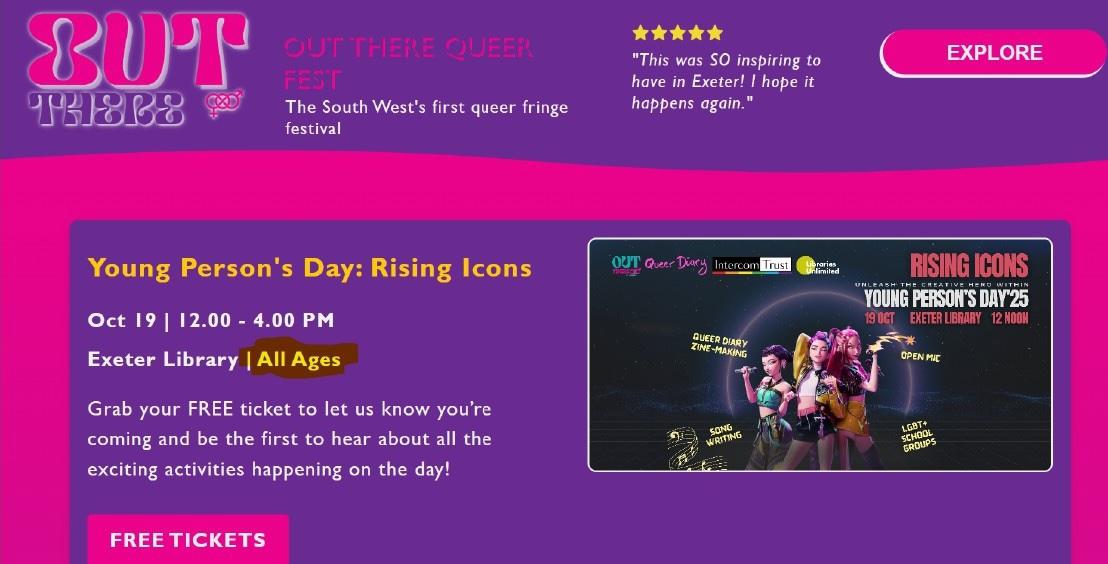
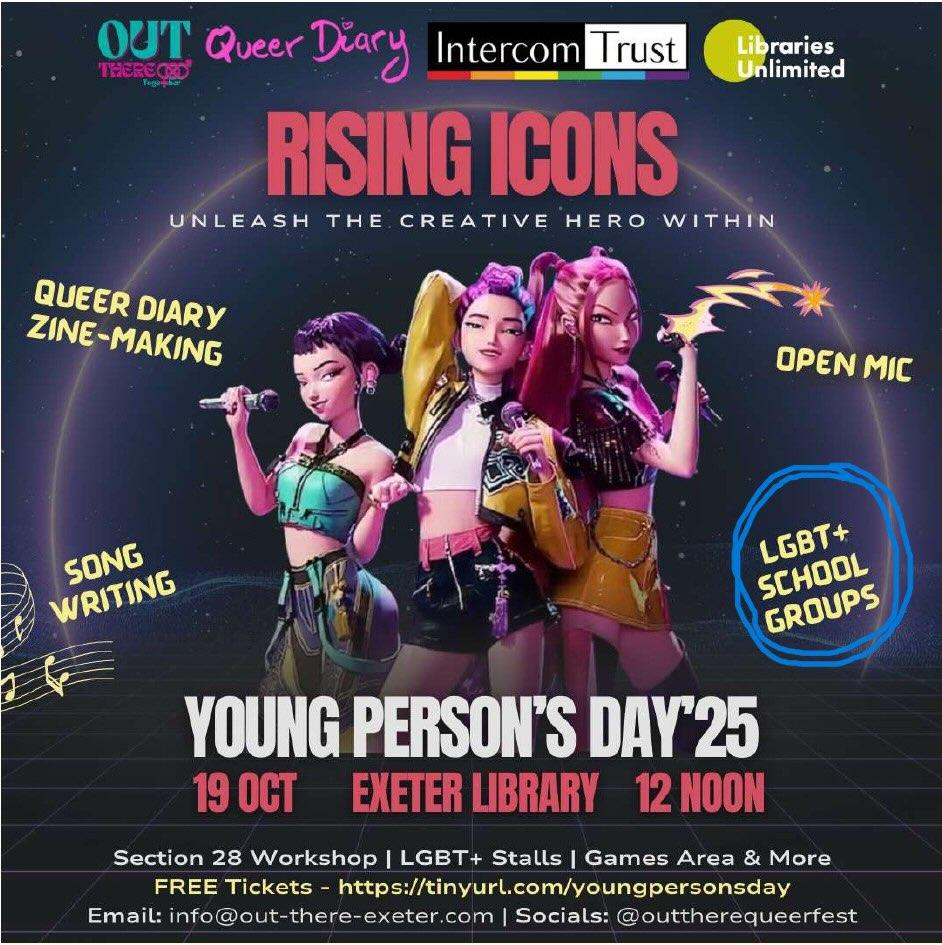
Cllr Ed Hill and Cllr Angie Nash attended the event, and both were very disturbed by what they witnessed there. They asked who was supplying the money, but no one seemed to know.
Safeguarding concerns were raised prior to the event by Protect & Teach and others to the library and the council due to the fact that it was advertised as a family event, for all ages, with K-pop branding to appeal to young children. There was no publicly available safeguarding policy on the library website, no Designated Safeguarding Lead (DSL) details, and no satisfactory response to emails, so three members of Protect & Teach visited Exeter Library ten days before the event and spoke with the manager. We asked who to raise safeguarding concerns to, and the manager volunteered himself, instead of the DSL.
The manager told us he was “excited” about the event, and was unable to recognise any problems in teaching children about sexuality. He also told us that there had been many complaints received and that he felt those emails were offensive. He described us and the concerned adults who had emailed as “people like you”, lumping us all into a bigoted category of people whose opinions and concerns should be ignored in the interests of “inclusion and diversity”. He told us that while some of the adults hosting the event might have a DBS check, it was not something requested by the library before allowing access to children. We suggested that the library should restrict access to the event to adults only, and were offered assurances that only children accompanied by a parent or guardian would be admitted to the event.
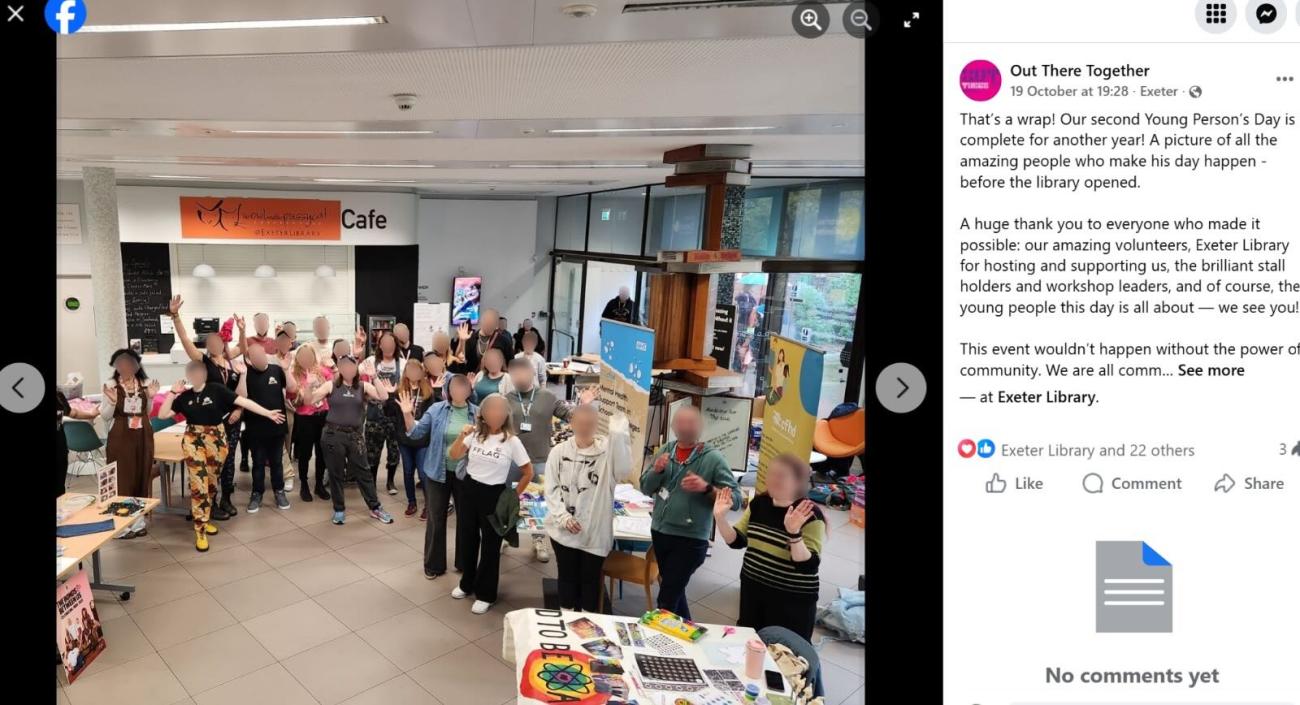
The team at the event were from various groups, and some may have been DBS checked in their work role, but apparently as they were not alone with the children, there was no need to do a DBS check on all of them. You can see from the photo that many men identifying as women were in attendance, along with adults calling themselves ‘queer’ or ‘non-binary’. Why is this considered safe for children? Why does the use of labels like ‘LGBTQ+’ or ‘queer’ not undergo the same safeguarding scrutiny that men running a ‘Child Fest’ would receive? Why didn’t anyone in this photo with a DBS check advise some of the stands to tone down their message and remove inappropriate material? Safeguarding is everyone’s responsibility.
Rather than taking place in one of the conference rooms or space at the back of the library, the event took place in the foyer, between the entrance doors and the children’s section. This meant that anyone who wanted to change their library books on that day could not do so without being met by the ‘Queer Fest Greeter’ and seeing displays which were totally unsuitable for children, contrary to the assurances given to us by the manager.
Libraries Unlimited is an independent charity running Devon and Torbay libraries. It is a National Portfolio Organisation (NPO) funded by Arts Council England (ACE). It received £720,369 in public investment (Government Grant-in-Aid and National Lottery funds) for 2023–2026 to deliver high-quality cultural programmes aligned with ACE's Let’s Create strategy (2020–2030), which aims for "a country in which the creativity of each of us is valued and given the chance to flourish, and everyone has access to a remarkable range of high-quality cultural experiences by 2030".
Out There Together in Exeter have been running the Queer Fest for two years. Out There work in collaboration with Exeter Phoenix, Exeter Library, Exeter City of Literature, Intercom Trust, and Exeter Pride. Out There Together describes itself as being on a mission to amplify LGBTQIA+ voices. In 2024, it compiled a report on Queer Fest attendees, and found that 18.5% who attended were under 18 years old. In 2025, it hosted the Queer Fest library event — for children only.
Out There believe community involvement is vital to its promotional strategy. University of Exeter societies, Exeter College groups, schools, and local community societies enthusiastically spread the word. Leading up to the festival in 2024, Out There attended key events such as Exmouth, Torbay, and Teignmouth Prides, and engaged with young people at Exeter College's EXtra Fair. Out There also received specific support from Devon County Council's 'Places To Go, Things To Do' funding via the Youth Council. Devon County Council started this fund to “support inclusive, accessible and enriching activities for those aged 11 to 25”.
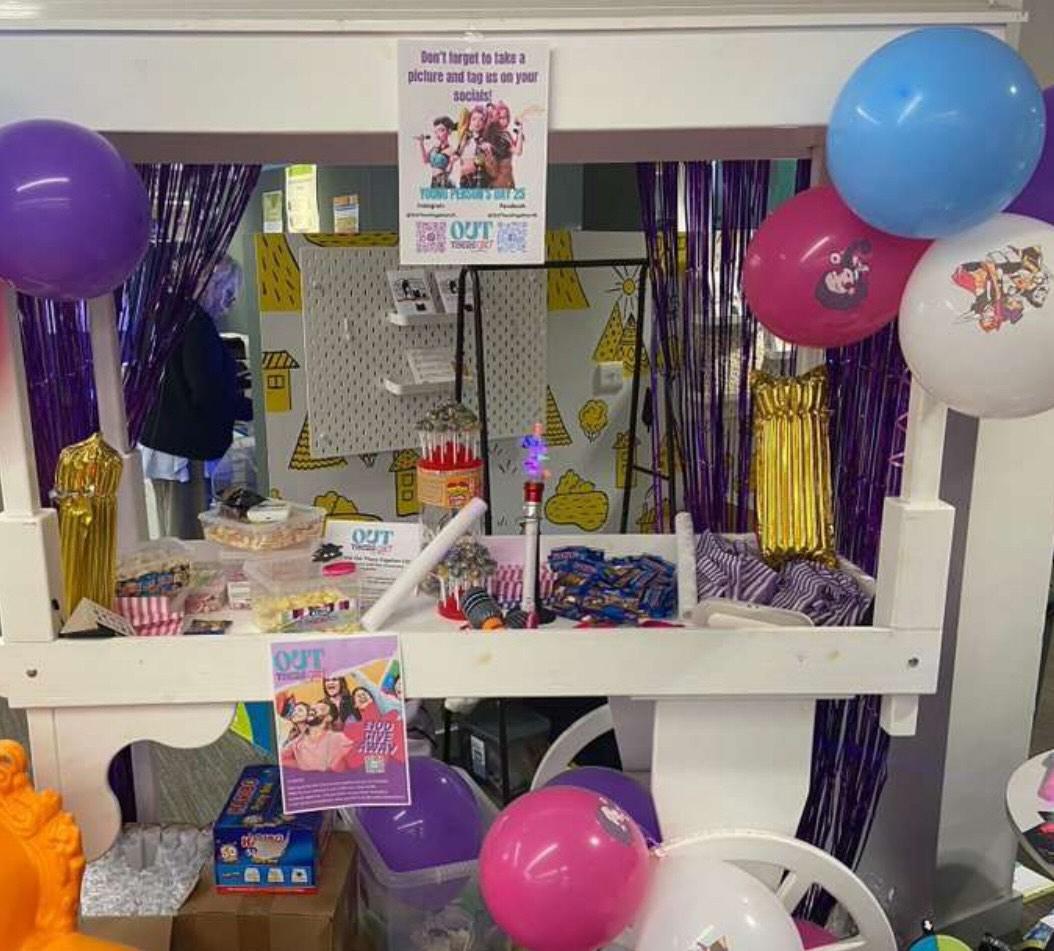
Above is a photo of the sweet trolley stand provided by Out There event organisers. It seems to be aimed at attracting children, but it has been defended by Devon County Council, which claim adults like sweets too. Readers can decide for themselves if it looks more appealing to children or adults. On the trolley are two posters with a QR code. It asks for photos to be shared on social media tagged with Out There and Queer Fest. Children with a phone can easily do this. Who is collecting this data? Would you want your child to post photos and tag Queer Fest? The poster below the stand offered £100 in a draw, a QR code, and a request for contact details.
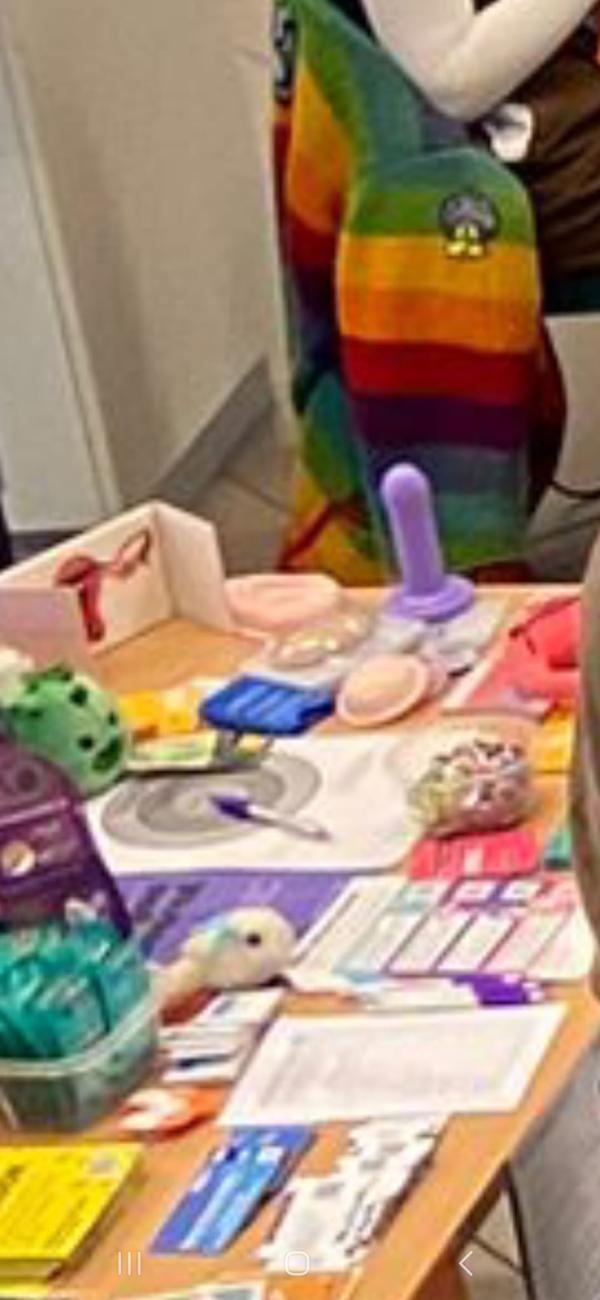
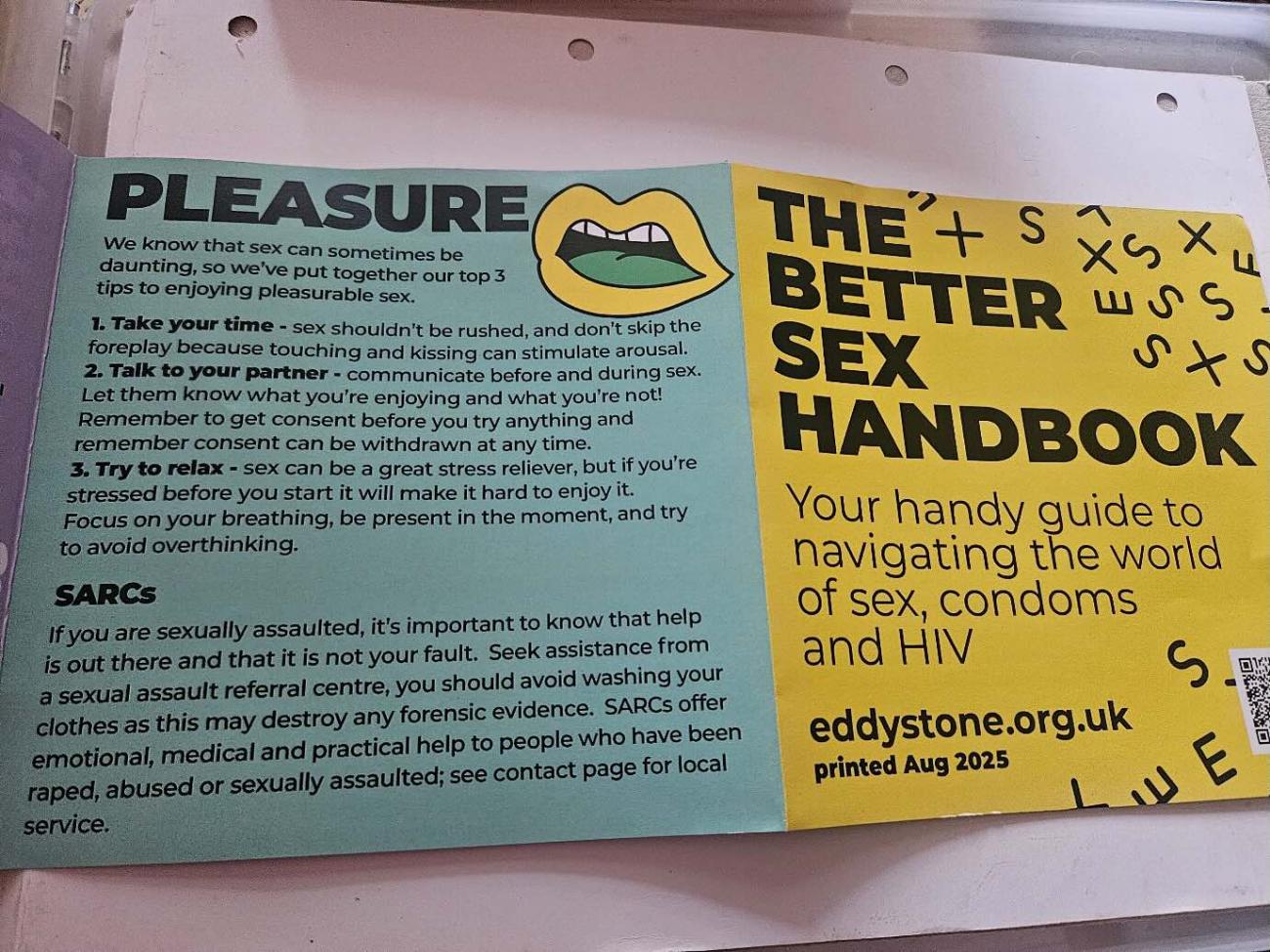
The Eddystone Trust is an “independent sexual health charity” based in Devon. Its table, shown above, featured anatomical models of female genitalia, a condom-fitting device, condoms, lubricant, and a penis girth measuring card to help choose the correct condom size. It also contained a large poster about chemsex (“sexual activity, mostly between men, while under the influence of drugs”), PrEP (a medication that HIV-negative people take to prevent contracting HIV during sex), and HIV testing. It provided leaflets about sex as well; an example is shown in the below photo.
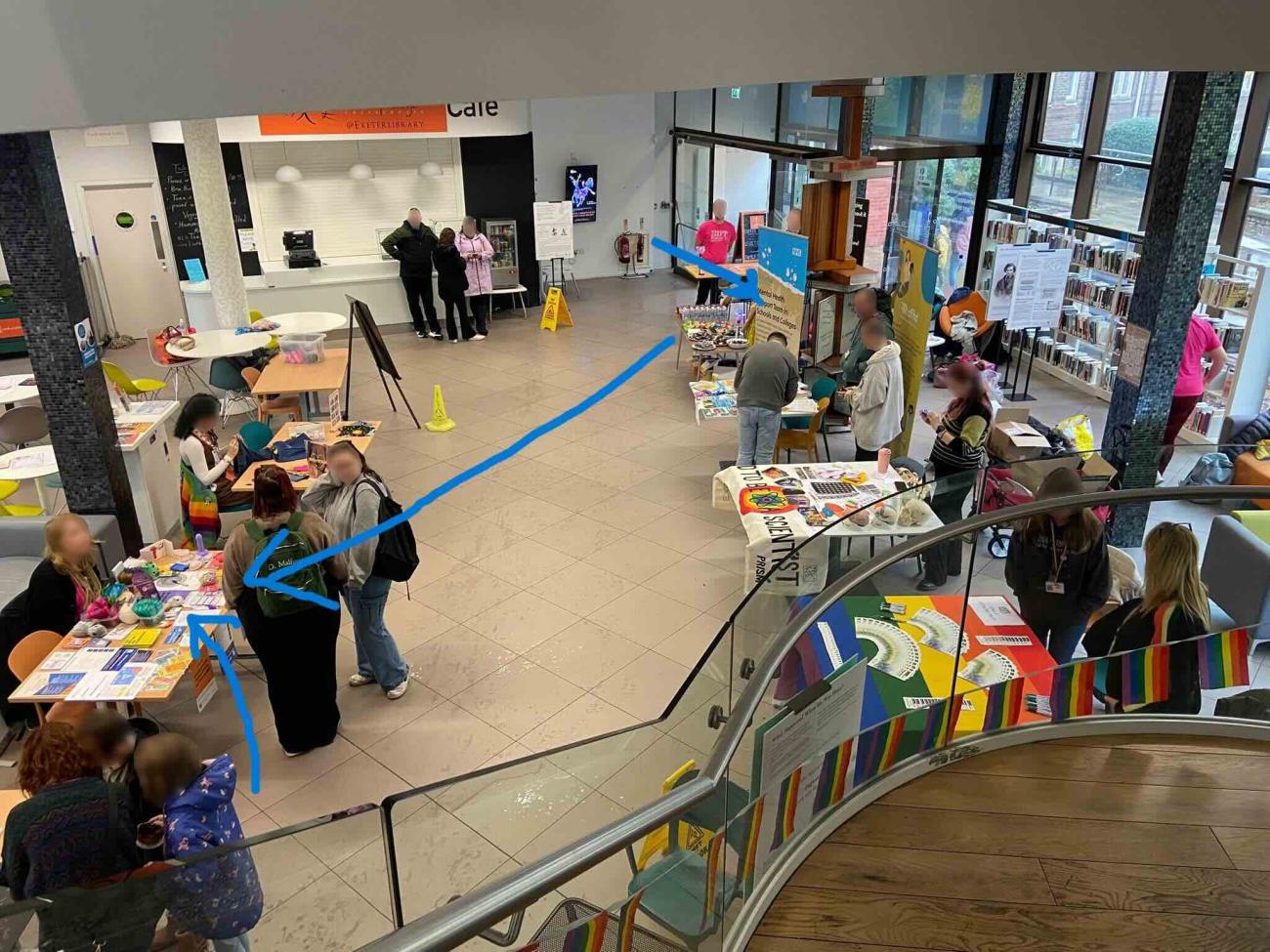
The following photo shows a young girl in a yellow dress by the door who can see this table. Two other children are moving around the tables. Behind the offending table is the children’s colouring area, which is circled in blue.
The event poster advertises LGBT+ school groups. These are mainly run by the Intercom Trust, Proud2Be, Pop’n’Olly, and The Proud Trust in Devon and Cornwall. The groups receive substantial amounts of funding. We have found 110 groups involved in schools around the UK, and our list keeps growing. The Intercom Trust is an LGBT+ group that was set up in 1997 initially to support lesbian, gay, and bisexual people who suffered violence or had housing problems. Even before Stonewall’s move into transgenderism in 2015, Intercom were already talking about the fabricated idea of transgender children. PC Steven Cannon and Toby Best, Diversity Officer in Devon & Cornwall Constabulary, wrote the Cornwall Schools Transgender Guidance (CSTG) document in 2012, which informed many Transgender Children’s Guidance documents that followed. The infamous Brighton and Hove Transgender Inclusion Schools Toolkit, written with Allsorts in 2014, says, “We used the following documents to inform the development of the 2014 toolkit: Cornwall Schools Transgender Guidance, 2012”.
CSTG 2012 advises how to socially transition children in school starting from two years old, including puberty blockers, binders, uniforms by gender (not yet ‘pronouns’ in 2012), changing names on the school roll, allowing children to use toilets and changing rooms based on the gender with which they identify, and sport participation by their self-identifying gender. It said ‘transphobia’ should be reported.
Thanks to £1.2 million from the Lottery alone, which allowed them to expand into schools, they now say 80% of their work is for people under 18 years old. They even note that 19% of their clients have other needs and that a high number are on the autistic spectrum, without any irony.
Groups like the Intercom Trust promote LGBTQ+ clubs in schools. They will be run by an Intercom LGBTQ+ practitioner, an LGBTQ+ older child at the school, or an activist teacher. We think that a young child discussing gender and sexuality with older children and adults outside the classroom is extremely concerning, and a clear part of the grooming children have experienced before the declaration of a transgender identity. Parents do not know or need to give permission for their child to attend; parental consent is considered to be given by enrolling their child at school. An external provider should raise additional consent and checks, but this is not happening.
The Intercom Trust stood against our criticism of Queer Fest. They did not see any safeguarding issues or any need to tone down the Eddystone Trust's table:
This stall provided information and support around safe sex, with the aim of reducing stigma and promoting public health. It was not designed to promote sexual activity, but to offer a safe space for those with questions or concerns.
Among the many stalls was one focused on sexual health, located in the entrance foyer, far away from the children’s library.
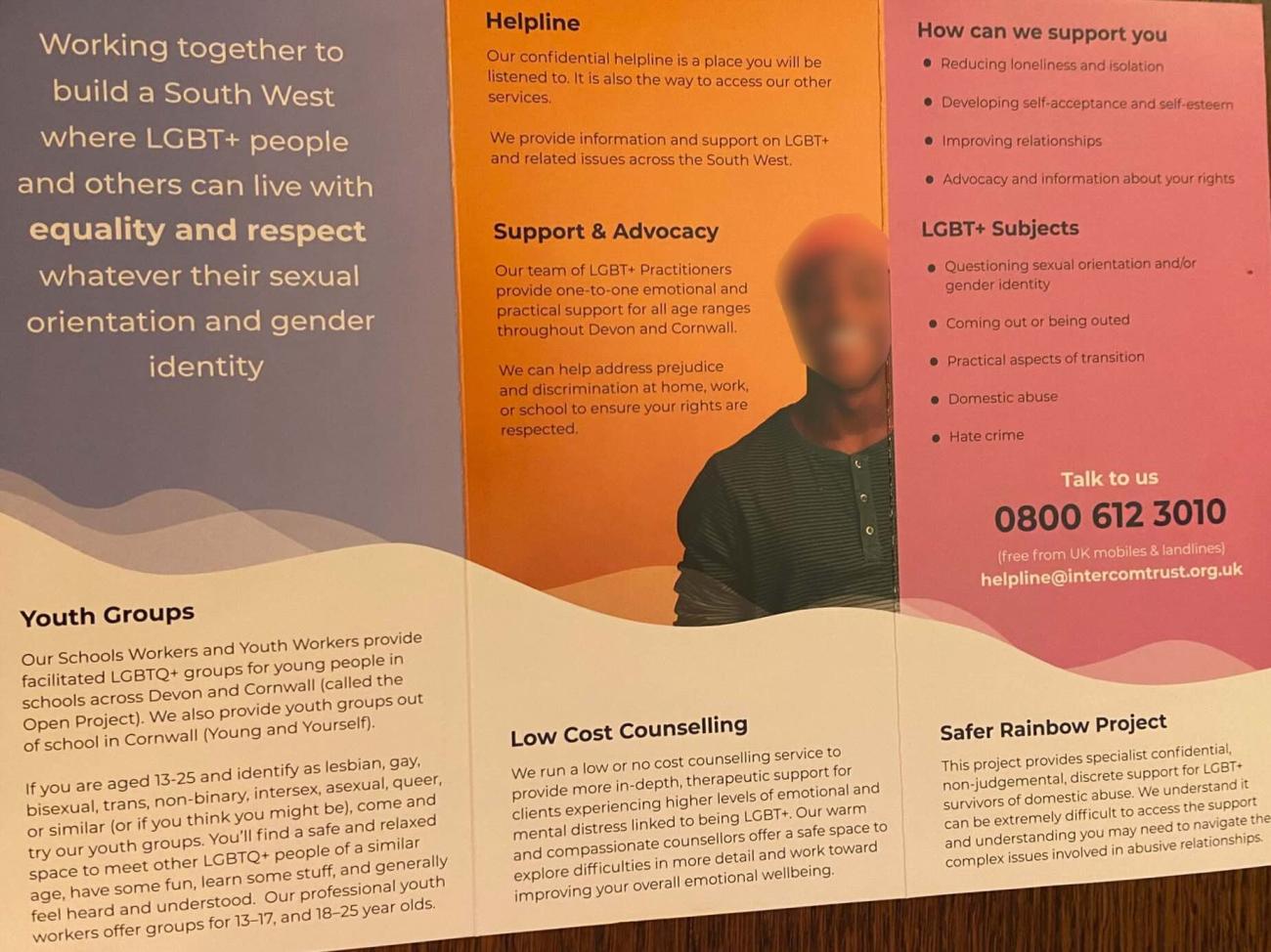
Not far enough away from children, though, Intercom Trust. Following is a leaflet from Intercom Trust's Youth Services.
Names should be taken for fire safety at the start of the session, but they can be discarded as soon as the session ends. There is no need for minutes, notes on discussions, or outcomes of the meeting. For an autistic child, or one who is bullied and not fitting in, an LGBTQ+ club is often seen as somewhere safe to go once a week.
The Indecent Displays (Control) Act 1981 aims to protect the unsuspecting public from unwilling exposure to indecent material, such as explicit posters or objects visible in public view. Causing it or permitting it is an offence. Art galleries, museums, and sex shops are exempt from the Act, as adults choose to enter to see the material, and there are often age warnings beyond a point. Libraries are not exempt, as they are open to all.
Outraging public decency, which is common law in England, states that displays must be capable of outraging public decency and occur in a public place accessible to the public. Historic Good Rule and Government Byelaws, made under Section 235 of the Local Government Act 1972, empower councils to prevent public nuisances, indecent language, indecent displays, and offensive behaviour in public spaces — principles which remain relevant to the safeguarding of children in modern public venues.
As well as the inappropriate stands, the open mic was dangerously loud, and included a performer referring to a song by the band Femtanyl! When official complaints were raised after the event, the responses highlighted the worrying lack of safeguarding oversight of third-party events, disregard for protecting children's data, and, perhaps most worryingly, the destruction of CCTV footage from the event.
Cllr Hill's upcoming motion aims to address the safeguarding failures that enabled this event, but will the other councillors be too captured by queer ideology to vote for improving child protection? Unfortunately, we suspect so.
We wonder whether there are similar events taking place in your geographical area. We wonder how many children have been introduced to sexual concepts inappropriate for their age and level of development. We wonder how many children have given their names, age, and contact details to a website collecting such data in exchange for a sweet treat.
None of this should have been possible.
Together, we can stop this happening at a library near you in 2026.