From blockade starvation to Red Sea solidarity with Gaza, Yemen’s resilient struggle against imperial coercion remains inseparable from the wider regional fight against foreign domination.
For more than a decade, the people of Yemen have endured a relentless campaign of aerial bombardment, naval blockade, economic strangulation, and foreign-funded fragmentation. Yet, they have emerged as one of the most resilient anti-imperialist forces in the wider region, standing firm against external powers that have sought to bend a fiercely independent nation to their strategic will. These forces wrap their interventions in the soothing vocabulary of international norms, regional stability, and humanitarian concern.
To understand how such protracted violence and economic warfare have been justified to Western publics, one must look closely at the ideological machinery that translates imperial ambition into respectable policy analysis. In a wide-ranging conversation, Shireen Al-Adeimi, EdD, an associate professor of language and literacy in the Department of Teacher Education at Michigan State University, dissects the narratives used to obscure Yemeni agency and deconstructs the myth of mere American logistical support. She examines how Yemen’s struggle for sovereignty intersects with the broader regional confrontation against Western and Israeli hegemony.
At the heart of Western policy discourse on Yemen lies a deliberate inversion of reality in which foreign intervention is cast as benevolent stabilisation and indigenous resistance is dismissed as foreign manipulation. Drawing on research published in Middle East Critique, Al-Adeimi explains that her analysis of Western think tanks focused on how these institutions “reproduce imperialist narratives cloaked in the language of objectivity, expertise, and national security”. They routinely depict Yemen as “a failed state, plagued by perpetual internal conflict, while Ansarallah is characterized as an Iranian proxy rather than an indigenous political movement with its own history, grievances, and popular support”.
By reducing a deeply rooted indigenous movement to an external appendage, this framing erases Yemeni political agency and conceals the political and economic conditions that gave rise to Ansarallah, including “widespread opposition to foreign interference”. The framing simultaneously works “to minimize or entirely omit the role of the United States and its allies in fueling the war, while presenting their military interventions as necessary for regional stability and security”.
Equally striking, Al-Adeimi observes, is the near-total exclusion of Yemeni voices from these policy debates, as Western experts are positioned as the authorities on Yemen while Yemenis are denied the ability to narrate their own experiences and political aspirations. As she puts it, this is what she and her colleague mean by think tanks functioning as “stenographers of the state”: they “reproduce narratives that serve US imperial interests under the guise of independent analysis, manufacturing consent for military aggression while denying Yemenis their right to sovereignty and self-determination”.
This narrative distortion extends seamlessly into mainstream media and diplomatic circles, where Yemen’s resistance to foreign influence, bombardment, and occupation is misrepresented as either operating as a ‘proxy’ of Iran or dismissed as irrational. In current US policy, it is even regarded through the lens of ‘terror’, reducing Yemenis to “helpless victims in need of Western intervention rather than political actors capable of determining their own futures”. Such a portrayal conveniently obscures the fact that the powers claiming to protect Yemenis are responsible for their suffering, preserving a false narrative that the United States and its allies are operating within legal frameworks and international norms — even as they trample Yemeni sovereignty.
While Western analysts accuse Ansarallah of acting on behalf of outside powers, the actual mechanics of foreign partition in Yemen have relied heavily on local armed factions and political figures bankrolled by Riyadh, Abu Dhabi, and Washington. Despite US, Saudi, and UAE efforts to portray their intervention as supporting Yemen’s so-called “legitimate” or “internationally recognized” government, Al-Adeimi points out that the reality is “these Yemeni forces are themselves proxies of US and Saudi imperial power, which seeks to maintain its dominance over Yemen rather than respect its sovereignty”. From hosting Yemeni political leaders in Saudi Arabia and the UAE to funding numerous armed factions on the ground, these foreign powers continue to shape an anti-Ansarallah coalition whose members have often clashed with one another.
A clear example of this external manipulation came in 2022, when Saudi Arabia effectively dismissed Hadi’s government and installed an eight-member Presidential Leadership Council based in Riyadh, in what was officially presented as a transfer of power. The council conveniently inherited the status of an “internationally recognized” government. As Al-Adeimi notes, this exposes “the hypocrisy of foreign powers claiming to defend Yemeni legitimacy while determining who gets to govern Yemen”, and it also helps explain why these efforts have failed to defeat Ansarallah because “foreign funding and military force cannot substitute for an independent political project with genuine roots and support within Yemen”.
A persistent talking point across Western commentary is that Washington’s role in the war on Yemen has been secondary, amounting to little more than providing “logistical support” to Saudi Arabia rather than being a primary belligerent. Al-Adeimi dismantles that myth directly, stating that the reality is that “this war could not have been launched in 2015, nor sustained for almost 12 years, without extensive US backing, both diplomatic and military”. Four successive US administrations have played a central role in supplying their Saudi allies with weapons, providing spare parts and maintenance for their military vehicles and aircraft, training their armed forces, providing targeting assistance and intelligence. Until 2018, they refuelled their jets mid-air. This is a role that the Royal Air Force has taken on in support of recent Saudi military operations.
Washington also provided intelligence and logistical support for the Saudi-imposed naval blockade, which restricted the flow of food, fuel, and medicine into a country heavily dependent on imports, contributing directly to famine and mass starvation. Even after the US agreed to a ceasefire with Ansarallah in May 2025, following its direct bombardment of Yemen in response to Ansarallah’s intervention in support of Gaza, Washington’s longstanding role in enabling the war cannot be dismissed as mere “logistical support”.
From Obama to Trump to Biden and Trump again, Al-Adeimi emphasises that US administrations “have treated Yemen as a country they are entitled to dominate, much as the US has historically treated Cuba and other Latin American countries as its own backyard”. She wrote that without US support, “the Saudis would not have launched the war, and they could not have sustained the bombardment or blockade on this scale”.
When Ansarallah launched naval blockade measures and military operations in solidarity with Gaza against Israel’s genocidal assault, the United States and Britain escalated to direct airstrikes on Yemen, recycling the same colonial tropes used during the Saudi-led war. Examining two distinct periods in her analysis of Western think tank narratives — the US-backed Saudi-led war on Yemen from 2015 to 2022 and Yemen’s Red Sea blockade and military operations in support of Gaza from 2023 to 2024 — Al-Adeimi explains that across both periods, “Ansarallah was consistently framed as an irrational, violent, Iranian-backed threat, while US intervention was portrayed as necessary to protect peace, security, and regional stability”.
The same colonial narratives were recycled following Yemen’s intervention in support of Gaza, with little acknowledgment of the genocide that prompted Yemen’s response. Ansarallah was once again portrayed as a threat to international security and US and UK bombardment as a necessary response.
The leaked Signal chat between senior Trump Administration officials in March 2025 was particularly revealing of the calculations behind this official rhetoric. As Al-Adeimi observes, while publicly framing the bombing of Yemen under Operation Rough Rider as necessary to protect freedom of navigation, just as the Biden Administration had done under Operation Prosperity Guardian, “officials privately discussed the economic benefits to Europe, the costs of military intervention, and even extracting financial compensation from European allies”. There was “no discussion of Palestinian lives or Yemeni sovereignty”, offering “a rare glimpse into the imperial interests behind the language of peace and security so often used to justify violence against Yemen”.
Nowhere is the sanitising power of official language more evident than in how international institutions and Western governments describe the blockade imposed on Yemen’s ports and airports. The institutions and governments insist on describing the consequences of the blockade as a ‘humanitarian crisis’ rather than specifically an act of imperial siege warfare. Al-Adeimi points out that the UN Security Council’s adoption of Resolution 2216 in 2015, which provided the framework for inspecting cargo entering Yemen under the pretext of enforcing an arms embargo, “effectively enabled Saudi Arabia to impose its control over Yemen’s ports and access to lifesaving imports”, which she describes as “an unforgivable betrayal of the Yemeni people”.
International complicity went further in 2016 when UN Secretary-General Ban Ki-moon removed the Saudi-led coalition from a blacklist of parties responsible for killing and maiming children after threats to withdraw funding from UN programmes, including those supporting Palestinian refugees. Even the question of formally declaring famine in Yemen became political with powerful interests at stake in how the catastrophe was classified. Calling Yemen’s suffering a ‘humanitarian crisis’ rather than the consequences of a deliberate blockade obscures the political decisions and foreign powers responsible for mass starvation. The ‘humanitarian crisis’ label makes an act of economic warfare into “a tragedy without perpetrators, thereby shielding the US and its Western and Gulf Arab allies from accountability”.
Against diplomatic frameworks and “peace initiatives” that repeatedly try to sideline Ansarallah or force concessions that undermine Yemeni sovereignty while protecting Saudi and Emirati strategic interests, genuine liberation and sovereignty would mean “nothing less than a complete withdrawal of Western and Gulf interference in Yemen, both militarily and politically”. The country’s future, whether as “a united Yemen or a Yemen with an autonomous southern region”, should be determined by Yemenis. It “should be resolved through Yemeni-to-Yemeni dialogue, free from foreign pressure and coercion”.
Yemenis are tired of war, and Al-Adeimi notes that she finds it “difficult to imagine a sustained civil war following foreign withdrawal, especially when foreign funding and weapons are no longer flowing to the various armed factions”. This is because, without external powers financing and prolonging their divisions, “Yemenis would have to negotiate and settle their differences among themselves, as they have done for centuries”. Genuine sovereignty would mean “allowing Yemenis to determine their own political future, even when the outcome does not serve Western or Gulf interests”.
That insistence on independence is rooted in “a long history of anti-imperialist and anti-colonial struggle, coupled with an indefatigable determination to achieve sovereignty”, which helps explain Yemen’s ability to resist. As Al-Adeimi points out, Yemenis have also shown “as the Vietnamese once did, that asymmetrical warfare can overcome vastly superior military power”. She said that Yemenis’ “knowledge of the land, their ability to adapt, and above all, their determination to resist foreign domination cannot be matched by military technology, economic siege, political isolation, or any other tool of imperial power”. She makes it clear that “Yemenis have paid dearly, with their lives, livelihoods, and futures, for their pursuit of sovereignty”.
Crucially, military superiority does not necessarily translate into political legitimacy or control. This is because, despite overwhelming military resources, the US, Saudi Arabia, and the UAE have been unable to impose a political order in Yemen that can sustain itself without foreign backing. Bombardment and economic warfare may devastate a country, “but they cannot defeat a population’s determination to resist foreign domination”.
That refusal carries profound implications across the wider region, particularly around the Red Sea and Bab al-Mandab. Al-Adeimi observes that if they’re not concerned with protecting Palestinian and Lebanese lives and lands from Israel, “countries like Jordan, Syria, and Saudi Arabia should at least be concerned about Israel’s expansionist project, which has already manifested itself in Syria”, yet instead Arab regimes have pursued normalisation with Israel or worked to shield it from resistance movements “which ultimately emboldens its aggression and undermines their own sovereignty”.
Yemen’s strategic position along the Red Sea makes this particularly consequential because the UAE’s efforts to establish control over Socotra, Bab al-Mandab (where its efforts have failed), and other strategic locations “are not just about Yemen, but about extending foreign influence over one of the world’s most important maritime corridors”. This makes Yemen’s struggle for sovereignty “inseparable from the broader struggle against foreign domination in the region”.
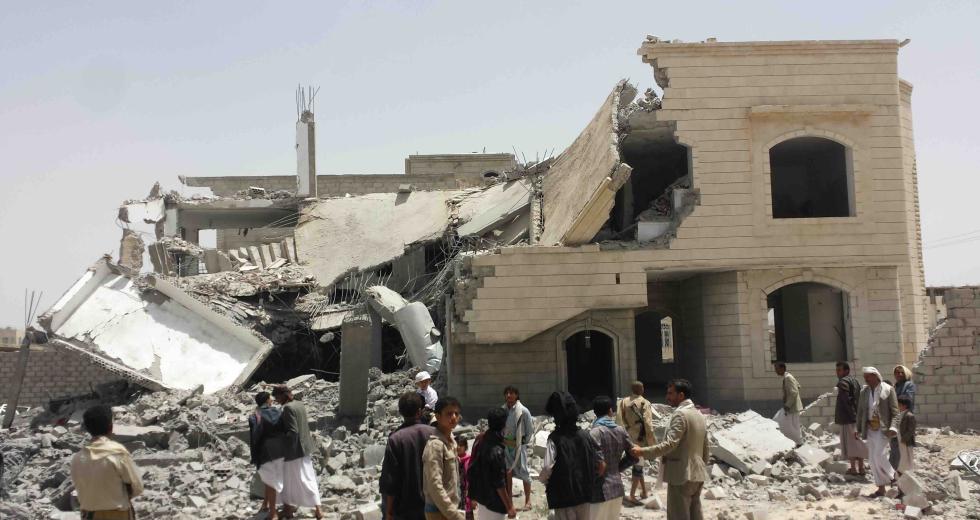
Cover image: Destroyed house in the south of Sanaa, 12 June 2015 | Mr. Ibrahem via Wikimedia Commons