
Most UK Prime Ministers from the mid-1990s onwards appear to manifest Dark Triad personality disorders to the great detriment of the country. Is this a bold statement to make? Is it utter nonsense? Well, is it? Let’s have a closer look at this claim, while acknowledging upfront that an official diagnosis would require all the individuals concerned to be subjected to psychological examination in a clinical setting. This is clearly unlikely to ever occur, so we are confined to making assessments upon well-documented behaviour.
What are the Dark Triad personality disorders? Obviously, there are three of them: narcissism, Machiavellianism, and psychopathy.
The key characteristics of narcissism are inflated self-importance and the need for admiration, with typical traits of grandiosity, entitlement, attention seeking, status seeking, sensitivity to criticism, desire for recognition, desire for dominance, and strong self-presentation skills. Narcissists can appear charismatic, confident, and persuasive.
The key characteristics of Machiavellianism are strategic manipulation for personal advantage, with typical traits of calculated social behaviour, emotional detachment, a cynical view of others, manipulation and impression management, long-term strategic thinking, and pragmatism over morality. Machiavellian personalities are often associated with political and social manoeuvring as well as adaptive deception.
The key characteristics of subclinical psychopathy are low emotional empathy and reduced remorse for inflicted harms with typical characteristics of callousness, impulsivity, risk taking, shallow emotional affect, fearlessness, low guilt, low remorse, and sometimes superficial charm. According to PsyPost:
There is some evidence that subclinical psychopathy involves the strategic exploitation of others. This effect specifically involves primary psychopathy, which is defined by callousness and interpersonal manipulation. While people with clinical primary psychopathy tend to defect in all situations, people with subclinical levels defect strategically, opting to cooperate in situations when it will maximize their gains.
Across all three Dark Triad personality disorders, researchers commonly observe the prioritisation of self-interest, reduced concern for others, the instrumental use of relationships, the pursuit of power, status, and control, and the willingness to violate social norms when it is advantageous to that individual.
It almost goes without saying that many of the above-mentioned Dark Triad traits — grandiosity, attention seeking, status seeking, dominance, strategic manipulation, impression management, callousness, low guilt, low remorse, and pragmatism over morality — overlap the observed behaviour of modern UK Prime Ministers and senior Ministers of State.
Tony Blair may well merit the title of a Dark Triad supervillain, as he would appear to demonstrate the full triumvirate of the Dark Triad. He notoriously sent British troops into five separate wars. There are those who attribute 300,000 violent deaths to him personally. His former friend, Robert Harris, described him in a Guardian article as a narcissist. And writing about his former boss, Blair’s former chief of staff Jonathan Powell wrote The New Machiavelli: How to Wield Power in Modern Britain. The Blair–Brown alliance was initially cooperative and strategically essential to New Labour, but also deeply transactional. The alleged ‘Granita pact’ understanding over leadership succession allowed Blair to obtain his premiership using the perceived competence and reputation of Brown, while repeatedly postponing the handover of power to Brown.
Blair has been portrayed as flamboyantly narcissistic, with excessive centralisation around his own authority, a strong belief in personal judgement, and ‘presidential’ leadership tendencies. Examples include his highly controlled media management, his preference for informal inner circles, his confidence in personal persuasive ability during Iraq-era politics, his emphasis on his personal communication style, and his image. Some critics argued that he developed an increasingly elevated sense of personal historical mission, as did Margaret Thatcher during her latter years in power. There is little room for doubt about Blair’s Dark Triad personality.
In contrast to his predecessor, Gordon Brown only appears to manifest Machiavellian behaviour from the Dark Triad. He has been accused of Machiavellian tendencies in the way that he strategically used Blair to get into power, and when Blair failed to fulfil his side of the bargain, Brown started to create a camp of Brownites to undermine Blair’s power base. Many may find that behaviour excusable given Blair’s betrayal of the ‘Granita Pact’.
In contrast to other modern leaders, Brown didn’t become PM by scheming through elections and making false promises and so on; he got into power as the result of a strategic deal. This makes Brown’s path to power exceptional in recent times, and he didn’t need Dark Triad personality disorders to achieve power, excepting relatively mild (for a powerful UK politician) Machiavellian behaviour as explained in this Independent article: ‘Machiavelli’s finest pupils are Tony Blair and Gordon Brown'.
Professor Steven Taylor, senior lecturer in psychology, wrote about Boris Johnson as exhibiting a Dark Triad personality in The Conversation:
Here are many aspects of Johnson’s behaviour that make sense in terms of these models. ‘Dark’ personalities are marked by psychopathic traits of a lack of empathy, conscience, and guilt, and a failure to take responsibility. They can’t accept that they are ever at fault, so they instinctively blame other people — or other external factors for negative events. We’ve seen Johnson deflect blame for the Downing Street parties ever since allegations about them first emerged.
… Johnson is often accused of dishonesty. However, it may not be so much that he intentionally lies, but that he doesn’t have a fixed notion of truth. Since dark triad personalities are self-absorbed, they are disconnected from objective criteria of behaviour and have a strong tendency towards self-deception. They select information which supports their positive image of themselves and ignore negative information. They believe whatever suits their view of reality. When he claims not to have broken lockdown rules or not to have misled parliament, Johnson may simply be selecting information to support his preferred version of reality.
Before the Brexit referendum, Johnson had relationships across both Leave and Remain camps, and there was extensive commentary that he delayed committing strategically. He then assessed which side better served his leadership ambitions before committing; however, the timing of the alignment chosen materially benefited his later leadership trajectory within the Conservative Party. Johnson was frequently criticised for rapidly elevating allies, marginalising dissenters, and shifting loyalty networks, according to immediate political need. Critics interpreted this as highly instrumental relationship management. Boris Johnson was frequently accused of lying without compunction; indeed, much of the UK’s population might consider that lying and/or aiming to deceive would probably be ‘normal’ behaviour for modern UK Prime Ministers and Ministers in general. In an Economist article, Johnson’s personality was described as "Machiavellian".
A disregard for truth is strongly associated with Machiavellian traits; specifically, strategic deception, calculated dishonesty, impression management, selective truth-telling, and the manipulation of narratives. Machiavellians use deception as a deliberate, controlled instrument to advance their goals. Indeed, Niccolò Machiavelli was himself a politician, civil servant, and diplomat. The advantageous association between politics and deception is nothing new.
Similarly, Boris Johnson was known for his strong self-regard, theatrical self-presentation, personal brand prioritisation, need for attention and admiration, exceptional confidence despite controversy, and his tendency to frame events around himself. Examples often cited include his highly performative media persona, his cultivation of a deliberately eccentric public image, his apparent belief in personal political invulnerability, and repeated confidence after scandals that would normally end careers. Former colleagues and journalists often described him as unusually ego-driven, highly self-promotional, and intensely focused on personal political mythology.
In the case of Theresa May, her evident lack of empathy for those around her and the population at large, her authoritarian style of prime ministership, and her general ruthlessness suggest subclinical psychopathy. The only genuine emotions she appeared to demonstrate in public appeared during her resignation speech, which is suggestive of a narcissistic personality.
While May showed indications of subclinical psychopathy and narcissism, David Cameron by contrast showed indications of a Machiavellian personality, particularly in his own 2005 leadership campaign. Cameron presented himself less as a conventional ideological candidate and more as a rebranding vehicle for the Conservative Party. His campaign deliberately softened the party’s image after repeated election defeats. He emphasised environmentalism, social liberalism, public services, and a more relaxed cultural tone, while downplaying traditional Conservative obsessions like Europe. Secondly, the campaign was extraordinarily media-aware. Contemporary reporting described painstaking image management behind the apparently effortless ‘modern’ persona — open-necked shirts, cycling to work, casual language, ‘Call Me Dave’, and carefully staged symbolism meant to communicate generational change and normality.
That combination — highly calculated informality — is precisely the kind of thing critics often associate with Machiavellian political skill: understanding audience psychology, adapting presentation strategically, and using symbolism instrumentally.
There was also a notable contrast between presentation and underlying ideology. Some critics later argued that Cameron’s ‘compassionate conservatism’ functioned partly as an electoral modernisation strategy rather than a deep ideological transformation. Academic analyses note that parts of the modernisation agenda were later abandoned or diluted, especially after the financial crisis.
Keir Starmer is often considered as Machiavellian, as discussed in this 2024 article from Scotland’s The National newspaper:
Being famous as a cruelly malicious person and a stranger to the truth defeats the point. The devil is a man with smiling eyes. If you’re known as a Prince of Darkness, chances are you aren’t doing it properly.
Sir Keir Starmer, by contrast, seems to understand Machiavelli’s insight all too well. For a man whose time in politics has been characterised by an astonishing and brazen series of lies, Starmer’s reputation for probity remains strangely robust. More than that probity and fidelity (and well as change) are refashioned as key selling points. His supporters continue to tweet about how the return of a new Labour government will restore “decency” to British politics.
A short resume. He stands for election on 10 pledges and commits to promoting the ethos of the platform. Having won, Starmer not only dumps the majority of these pledges, but makes it clear that he regards all these policies as hopelessly crackpot and unrealistic. He says Jeremy Corbyn is his “friend”. He then denies ever saying this despite proof positive to the contrary.
This early impulse on how to deal with his predecessor’s reputation inaugurated a bit of a trend. Starmer says Israel has the right to cut off water and electricity from Palestinian civilians on camera. He then denies having done so.
He criticises Boris Johnson for sacking internal critics. And last week? You know where this is going – he seizes the opportunity to deselect potentially dissident voices, based on last-minute complaints and social media surveillance going back decades. He denies anything sinister has been afoot, while his outriders and apologists simultaneously brag about the wonderful political ruthlessness this demonstrates …
So, what we can surmise from the prevalence of Dark Triad personality traits in recent prime ministers is that it is no accident at all. Aspects of Dark Triad personality disorders actively favour the path to UK political leadership. This is where the subject becomes particularly interesting.
Machiavellianism is the most ‘useful’ of the Dark Triad traits. Machiavellians are skilled at cultivating networks, brokering deals, and balancing competing factions — essential in a party-centric system like the UK’s. They anticipate rival ambitions, plan several moves ahead, and exploit procedural loopholes (e.g. Brown’s careful consolidation of Treasury allies). They can turn others’ mistakes to their advantage without moral hesitation.
Narcissism is more about image, charisma, and confidence. A confident, charismatic figure can dominate media narratives and inspire party activists. Narcissists are often willing to take political gambles that cautious rivals would avoid. Narcissistic traits help in crafting a compelling leadership persona: ‘I am the person history needs now’.
Psychopathy is about emotional detachment, risk tolerance, and ruthlessness. Psychopathic traits allow leaders to make unpopular but strategically valuable decisions without being paralysed by moral or emotional concerns. In electoral politics, bold moves can secure wins that cautious politicians might forfeit. Psychopaths can tolerate personal enmity, betrayals, or backstabbing in ways that would destabilise others.
But it is when the Dark Triad personality disorders work together in an individual that the route to the top becomes a particular strategic advantage. Narcissistic charisma and self-promotion ensure visibility. Machiavellian cunning ensures that allies, networks, and procedural rules are leveraged effectively. Subclinical psychopathy — or its milder traits — allows decisive action and resilience to political attacks. All three traits, in combination, make others more likely to follow, defer, or underestimate rivals.
In short, the political arena acts like a filter: traits that help manipulate, impress, and survive tend to accelerate the path to leadership, even if those traits have costs once in office.
The UK democratic process favours candidates who are best at acquiring power, rather than candidates who are best at using power to defend and serve the people.
We could dive into examples of the complete lack of sincere contrition for the many thousands of vaccine injured people, unemployed or handicapped war veterans, systemically raped young Northern girls, wanton destruction of British culture and so on, ad nauseam. This total lack of empathy and regret for victims of political policy is typical of subclinical psychopaths. Our Prime Ministers and Ministers are expected to care for the welfare of the British population as an utmost priority. As former Senator Margaret Chase Smith expressed so well, “Public service must be more than doing a job efficiently and honestly. It must be a complete dedication to the people and to the nation”. By contrast, Dark Triad Prime Ministers focus almost entirely on themselves, with little or no empathy at all for the population and the nation.
The average person might expect that all these people with Dark Triad personality disorders should never get anywhere near positions of authority. Not only are they freely walking around among us, but there appears to be a preponderance of them in positions of leadership, to the extent that the phenomenon has been studied by behavioural scientists. According to an academic paper on ‘Leader Narcissism’:
Narcissism, a subclinical personality trait characterized by the pursuit of gratification from an inflated yet vulnerable sense of self and an insatiable desire for unlimited success and admiration (Ames et al., 2006), has garnered widespread attention among leadership scholars. Research has shown that narcissistic individuals often seek out leadership positions and tend to emerge as leaders.
Narcissists “tend to emerge as leaders!” In other words, not only do people demonstrating Dark Triad personality disorders take part in normal society, but they tend to emerge as leaders where they can indulge themselves and inflict the most harm. When we look at UK politics through this prism, it is easy to understand how much damage has been inflicted on the country and the population, in part due to the subclinical personality disorders of the leaders.
While it is clearly not in the interests of the UK to be controlled by leaders with Dark Triad personality disorders, what exactly should we be looking for in our leadership? Here are some famous hints at the possible answer:
President Eisenhower stated, “The supreme quality for leadership is unquestionably integrity”.
John F. Kennedy said, “Leadership and learning are indispensable to each other.”
Reinforcing the thrust of this article, Marcus Tullius Cicero believed that “The welfare of the people is the ultimate law”.
By stark contrast, Machiavelli stated, “A prince never lacks legitimate reasons to break his promise.”
Is it possible in modern times to return to a form of leadership based on integrity and the welfare of the people, or does the political system in the UK condemn the country to Dark Triad leadership personalities?
And even if we do choose leaders with integrity and the welfare of the people at their heart, by what means do we ensure that the power of office does not corrupt their initial good intentions? There is no oath of office for UK Prime Ministers, so there is no honour-based code against which they can be held accountable.
The only oaths sworn by the Prime Minister are performed by tradition, but not uniquely as Prime Minister. This is the Oath as a servant of the Privy Council in which “You do swear by Almighty God to be a true and faithful Servant unto The King’s Majesty as one of His Majesty’s Privy Council …” It then includes promises to defend the monarch’s authority, give honest advice, keep council matters secret, and disclose threats against the Crown. It concludes: “And generally in all things you will do as a faithful and true Servant ought to do to His Majesty. So help you God”. And secondly, as First Lord of the Treasury, a function historically associated with, but not synonymous with, the role of Prime Minister: “I, [name], do swear that I will well and truly serve His Majesty King Charles the Third in the Office of [office], So help me God.”
So, the only oaths actually sworn are forms of allegiance to King Charles, the reigning monarch, and absolutely not to the people of Britain. Explicitly mentioned in the Privy Council oath is absolute secrecy, i.e. a complete lack of transparency towards the people of the country. There is no formal commitment to defending the interests of the country or its population; there is merely a commitment to serve the monarch as the only sworn priority.
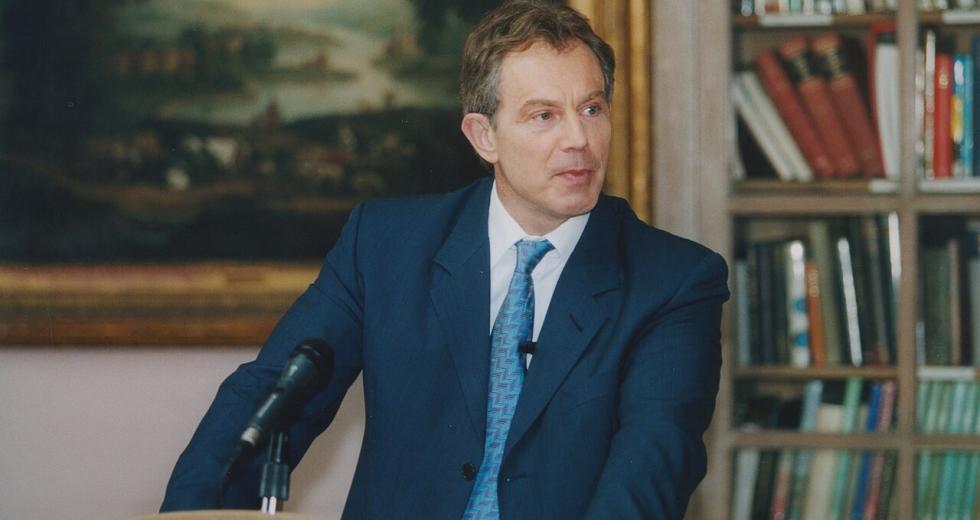
Cover image: Former UK Prime Minister Tony Blair speaking on 'The Next Steps for New Labour' at the London School of Economics (LSE), 12 March 2002 | Wikimedia Commons

Neil Harrison
Neil Harrison achieved a degree in Pure and Applied Physics at Salford University, UK, and went on to work in the space industry for Marconi Space and the German Space Operations Centre near Munich, working on various satellite and NASA space shuttle programmes.