
One might be forgiven for assuming that when President Donald Trump is busy throwing American power around elsewhere on the planet — he would have less time to wreck his own country.
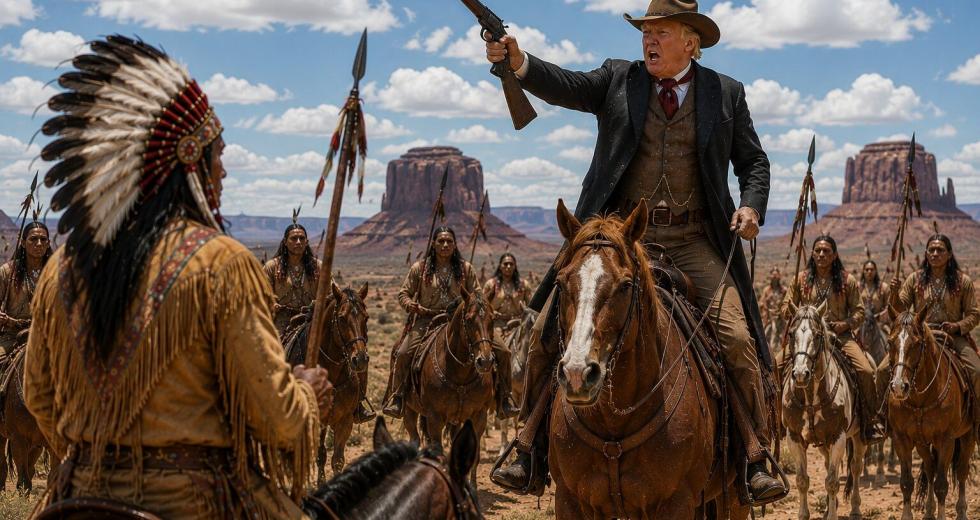
As US strike groups are ploughing the Caribbean, and American bombs are killing schoolgirls in the Middle East, the Dealmaker-in-Chief is quietly embarking on a terminal phase on the perennial Native American problem — what to do with the survivors of the peoples from whom Columbus and those who followed him stole the continent: move them, ignore the courts, and dress it up as kindness.
Trump's campaign against the Native Americans opened on several fronts just hours after he took office: the same quest for land that drove the 1829-1837 Andrew Jackson Administration’s Indian Wars, now re-weaponised with 21st century language: the ground belongs to whoever can extract value from it; treaty obligations are negotiable when they aren't; court rulings are negotiable when they aren't; and the entire arrangement can be narrated, after the fact, as something that was for the Indians' own good.
Termination — ReloadedThe last time things were as bad as they are today was in 1953, when House Concurrent Resolution 108 became the formal trigger of what is known as the Termination Era, when the US Government bypassed the treaties it had (and still has) with Native American tribes by legally nullifying the tribes themselves, making them “subject to the same laws and entitled to the same privileges and responsibilities as are applicable to other citizens”.
The era did not end until 8 July 1970 when President Nixon addressed the Congress:
The first Americans — the Indians — are the most deprived and most isolated minority group in our nation. On virtually every scale of measurement — employment, income, education, health — the condition of the Indian people ranks at the bottom. This condition is the heritage of centuries of injustice.
The argument back then was that tribal political existence was a paternalistic relic, and assimilation into ordinary citizenship was the cure — borrowing the clothing of the Civil Rights Movement taking shape back then. This is the same argument that was used to emancipate Black America was weaponised and used against the Native Americans.
The logic: if America is committed to equality, any group with separate legal status is suspect; therefore, tribes should be dissolved into ordinary citizenship.
In 2026, the argument used against Native Americans is this: They no longer exist because they are no longer a nation or a people, but a race. And claiming racial privilege is racist.
Until today, the final line of defence of Native Americans was their unique political status as Indian tribes. When the US Government, under Trump, starts to peddle the idea that being Indian is not a national, political, or tribal thing, but about race, “almost the entire body of federal legislation relating to Indian and Alaska Native tribes could be found unconstitutional as racially discriminatory”.
Both the Termination Era argument and what is happening today are gravitating toward the same destination: dissolving tribes as distinct political entities.
What the Termination said: You shouldn't be special.
What the Trump Era claims: You can't be special because being special is now illegal.
For the legally minded reader, here are the milestones:
- Morton v. Mancari — Supreme Court, 1974. This was the foundational case that established tribes as political, not racial. The decision was unanimous.
- Brackeen v. Zinke — Texas Federal District Court, 2018. A district judge struck down portions of the Indian Child Welfare Act as race-based. Tribes lost at this level. This is where the ‘tribes are a race’ argument first got legal traction in the modern era.
- Brackeen v. Bernhardt/Haaland v. Brackeen — Fifth Circuit Appeals Court, 2019 and en banc 2021, and then the Supreme Court, June 2023. The Court upheld ICWA 7–2 on Article I and Tenth Amendment grounds, but dismissed the equal protection challenge on standing without reaching the merits. Justice Kavanaugh's concurrence signalled that the race-versus-political question will return, and Justices Thomas and Alito wrote separate dissents hostile to the Mancari framework. Mancari itself was not reaffirmed, and its standing was visibly weakened. The door is now ajar.
The legal haggling on the issue comes down to an apparent, or fictional, contradiction in the US Constitution.
The Constitution forbids the US Government from treating people differently based on ancestry or race, and almost all Native American tribes require blood quantum or lineal descent for membership.
The fear is that if the Government allows parsing a racial classification into a ‘political community’ in this way, then equal protection has a giant loophole. Any group could then be relabelled as a political community by giving it a name and a membership rule based on bloodline.
The contradiction is fictional, and the issue resolved by the very same Constitution when, in Section 8, it names three sovereigns Congress with which can regulate commerce: foreign nations, the several states, and the Native American tribes. The men who wrote the Constitution were not confused about what tribes were. They had just spent the Revolutionary War making treaties with them, and they wrote the Constitution while still negotiating treaties. To claim in 2026 that tribal classification is racial is to insinuate or pretend that the Founding Fathers didn't know what they were doing in 1789.
Then there is the ‘any group could be relabelled a political community to dodge equal protection’ argument. But could they? Could Congress tomorrow create the ‘Sovereign Nation of Italian-Americans’ and exempt them from equal protection scrutiny? It’s not likely, with the reason being that they're not a pre-constitutional sovereign with a 250-year treaty record. The thing that makes the Indian tribes a real political category is what no other ancestry-based group on the continent has: an actual diplomatic history with the United States, including named treaties on dated paper signed by named chiefs and named American officials.
Finally, there is the absurd situation the world would find itself in if every entity the US ever signed a treaty with were a race rather than sovereign — in which case, almost every treaty the US has ever signed is suddenly invalid.
Either treaties are valid, in which case tribes are sovereigns and the classification is political, or the treaties were never valid in the first place — in which case, the US has spent the last 250 years pretending to honour agreements with entities it considered fictional.
And, of course, taking this last position means admitting that the US fraudulently obtained the entire continent.
Terminal PhaseAnd where does the US Government under Trump stand on the issue?
In January 2018, the Trump Administration issued a ‘Dear Tribal Leader’ letter refusing to exempt American Indians and Alaska Natives from new Medicaid work requirements, citing unspecified ‘civil rights issues’. Three months later, Politico reported the reasoning behind that vague phrase: the Administration's position was that tribes are "a race rather than separate governments".
The position mobilised a fierce bipartisan congressional pushback — ten senators led by Tom Udall, and Rep. Tom Cole, a Chickasaw Nation member, all warning that the administration was abandoning the political-not-racial framework that has underpinned federal Indian law confirmed by Morton v. Mancari in 1974.
Mary Smith, acting head of the Indian Health Service during the Obama administration and a member of the Cherokee Nation, said:
The United States has a legal responsibility to provide health care to Native Americans. It’s the largest prepaid health system in the world — they’ve paid through land and massacres — and now you’re going to take away health care and add a work requirement?
The Administration partially relented, saying states could negotiate exemptions — but it never formally withdrew the underlying race-classification position.
Seven years later, that position is the unspoken premise of the second-term enforcement architecture, and during Trump's second term, little is said while the agenda is being implemented. None of the adopted documents names tribes. But also, none exempts them.
Instead, the burden of defending Morton v. Mancari falls, case by case, on every Native IHS employee, every tribally owned federal contractor, and every Alaska Native Corporation, against a federal enforcement architecture newly empowered to treat tribal preferences as suspect.
By mid-2026, the question had become a political tinderbox: one false move could trigger enormous political fallout.
Law firms are aware of it, and accordingly advise staff and clients:
While the core prohibition on ‘racially discriminatory DEI activities’ may seem straightforward, the EO’s enforcement architecture, including False Claims Act liability and qui tam whistleblower provisions, creates risk even for entities whose hiring and business practices are lawful.
Also, as Native American tribes are aware:
Project 2025One of the most common misconceptions is the belief that Native American identity is solely racial rather than political. This misunderstanding has serious consequences, influencing everything from Supreme Court decisions to everyday discussions about Indigenous rights. The record must be clear: Tribal nations are political entities, not racial groups.
An article published by Western Priorities in January 2026 reveals that whereas Trump pretended to stand up against the sweeping land grabs enthusiastically peddled by the Heritage Foundation in its Project 2025 during his election, once in office, he immediately aligned himself with the plan.
Today, an area corresponding to the combined size of France and Spain — over 280 million acres of public land and offshore waters — is on the chopping block.
With Donald Trump in the White House, not only Indian land is at risk of destruction; all land is.
Indigenous Ground Truth 2026In April 2025, the White House added Oak Flat, where a four-day coming-of-age rite has been performed for over 1,000 years, to a fast-tracked list of priority mining projects.
Why?
Oak Flat is believed to sit on the largest copper ore deposit in North America. In March 2026, the Ninth Circuit denied the request for an injunction. Now the bulldozers are rumbling.
The engineering will undercut the orebody until the ceremonial grounds above it collapse into a void — leaving a crater nearly two miles wide and over 1,000 feet deep.
The same pattern is playing out on Indian territories everywhere.
Death by DefundingThe rural land grab takes place in daylight. The bureaucratic war is fought by suits in the shadows in urban terrain. The Trump Administration wants to cut 24% from the core programs that carry the US Government's treaty and trust obligations in a single budget cycle, with further cuts stacked on related programs. These cuts hit where they hurt the most: schools, primary healthcare access, and law enforcement.
Project 2025 redirects the survivors toward private insurance markets that do not exist on the reservations.
The EndgameThe Termination Era of 1953-1970 was reversible because it was the product of ordinary federal lawmaking and Congress could unmake it — and eventually did.
The current attack vector, rebranding some 3 million members of 575 tribes as a race (should it become law), would be reversible only by constitutional amendment or by a Supreme Court overturning its own precedent.
Given that no constitutional amendment in American history has limited federal power on behalf of a marginalised group seeking protection from federal action, and every amendment since 1865 that altered the federal-state balance has expanded federal power, this is a much higher bar to pass.
This is one of the political minefields currently being navigated by humanity in North America in the run-up to January 2029 — when Donald Trump is expected to evacuate the White House.

Kristoffer Hell
Kristoffer Hell is an independent writer and journalist covering high politics and how technology shapes human experience. He holds an MLitt in Strategic Studies from the University of Aberdeen and a Diploma in News Journalism from the London School of Journalism. He previously worked as a software developer, contracting in banking, pharmaceuticals, and retail.