Author's Note: The allegation that the now-deposed Syrian Government systematically deployed chemical weapons (CW) against civilians during the 2011-2020 war is often repeated widely by Western politicians, mainstream media, think tanks, and 'regime change' activists. These claims have been supported, to varying degrees, by reports on investigations by the world's CW watchdog, the Organisation for the Prohibition of Chemical Weapons (OPCW). In 2019, however, whistleblower scientists from within this organisation testified to the manipulation of the investigation of one of these alleged attacks in order to reach a 'pre-ordained conclusion' that the Syrian Government was responsible. In fact, the entire history of alleged CW incidents in Syria, dating back to as early as 2012, remains controversial. This series explores the history of these allegations and sets out a preliminary case that the entire CW narrative is, in fact, a strategic deception designed to underpin a policy of 'regime change' through the delegitimisation of the Syrian Government. Parts 1, 2, 3, and 4 are available here, here, here, and here.
In Part 4, we saw how increasingly fantastical claims were made in OPCW reports about alleged CW attacks. Based on the idea that the Syrian Government had suddenly started, after surrendering its arsenal of CW and joining the Chemical Weapons Convention (CWC), to drop cylinders of chlorine gas on civilians, a bizarre claim about a fanciful and technically implausible chlorine gas 'binary device' was presented in a 2015 OPCW report. Later, in 2017, an absurd scenario was presented, whereby an only slightly damaged chlorine gas cylinder had purportedly smashed into a bunker-cave hospital complex after penetrating a metre-thick layer of soil and a metal bar-reinforced concrete roof. Any serious scientific and engineering analysis would demonstrate that these claims could simply not have been true, and yet OPCW reports presented them as verified.
In 2017, there appeared to be a significant development. On 4 April, a sarin gas attack was alleged in the town of Khan Sheikhoun (Khan Shaykhun) with reported deaths in excess of 80 civilians. The US Government immediately retaliated with cruise missile strikes. Hamish de Bretton-Gordon, who was previously involved in the MI6 sample gathering operations described in Part 2, and who became confused at the chemical makeup of the implausible 'binary device', confidently pointed the finger at the Syrian Government. He told the BBC in late April that "it's very clear it's a sarin attack", adding that the “view that it's an al-Qaeda or rebel stockpile of sarin that's been blown up in an explosion, I think is completely unsustainable and completely untrue”. According to the official Western narrative, then, 2017 marked a return to the manufacture and use of sarin nerve agent by the Syrian Government.
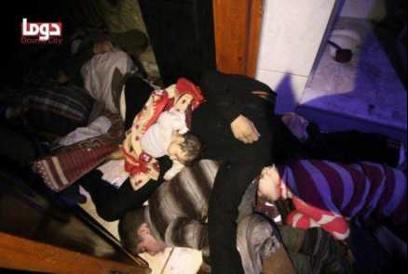
One year later, on 7 April 2018, another mass casualty attack was reported, this time in an outlying suburb of Damascus called Douma. Horrific images of dead women and children, some of them apparently showing foam around the nose and mouth, circulated on social media. Meanwhile, mainstream media showed film of hospital scenes in which civilians were washed down by White Helmets 'first responders'.
Accusations were made that two yellow cylinders had been dropped from Syrian Arab Air Force helicopters. One cylinder had smashed through a metal bar-reinforced roof to then land on a bed in the room beneath. The other cylinder had become poised over a hole in a balcony roof area, after punching a hole in it but then failing to fall through. It was quickly claimed that this cylinder had emptied its contents through the hole in the balcony roof and killed 43 people inside the building.
The US UN representative Nicki Haley declared:
Their eyes are open and lifeless, with white foam bubbles at their mouths and noses. They are pictures of dead Syrians who are unarmed, not soldiers, and fit the very definition of innocent and non-threatening. Rather, they are women and children who were hiding in basements from a renewed assault by Bashar Al-Assad. They are of families who were hiding underground to escape Al-Assad’s conventional bombs and artillery, but the basements that Syrian families thought would shelter them from conventional bombs were the worst place to be when chemical weapons fell from the sky. Saturday evening, the basements of Douma became their tombs.
Within seven days, while an OPCW investigation team was preparing to deploy to the incident site, the Americans, British, and French launched missile strikes against Syria.
The images of dead civilians seeming to have dropped dead on the spot, some of them gathering in piles whilst foaming at the mouth, indicated a fast-acting nerve agent like sarin. This message (see below), alleging sarin gas use, was posted by the Syrian American Medical Society (SAMS), itself a USAID-funded organisation.
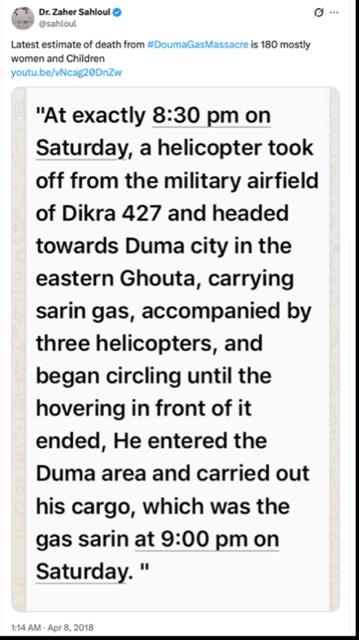
Hamish de Bretton-Gordon, demonstrating a lack of understanding of chemistry, alleged that a nerve agent-chlorine mix had been used whilst US officials reportedly told CNN that test results from “biological samples … have tested positive for chlorine and a sarin-like nerve agent”. UK CW expert Alexander Hay stated that the scenes showing rapid collapse and death were more commensurate with a nerve agent attack. Indeed, it was the presumption of a nerve agent attack — considered much more serious than chlorine gas — that enabled the US-led coalition to justify the missile strikes on Syria seven days later.
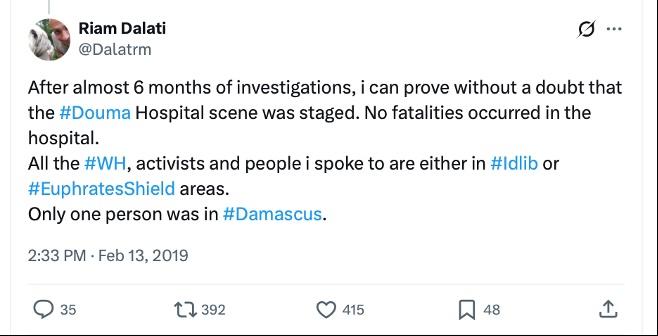
As all of this played out, the Russian Federation and the Syrian Government protested against the developing narrative and, in a remarkable event, the Russians brought a number of witnesses to The Hague, who testified to the staging of the hospital scenes. A year later, BBC producer Riam Dalati, following six months of research and interviews, also declared his belief that the hospital scenes had been staged.
It was in the early stages of this high-profile and high-stakes international controversy in April 2018 when the OPCW Fact Finding Mission (FFM) team began their investigation. Unlike all previous FFMs, however, the Douma team were actually able to get in on the ground and conduct a first-hand investigation at the alleged incident sites. As detailed in Part 3, FFM on-site investigations had been abandoned following a 'rebel' attack on the first FFM deployment back in 2014. This forced the FFM to rely on third-party sources, such as the White Helmets and other Western-sponsored NGOs, for gathering evidence. With Douma, however, the extremist group Jaysh al-Islam surrendered the area to Syrian and Russian forces the day after the alleged attack and the OPCW was able to get full access to the area. This time, the investigating team could gather evidence for themselves.
Between April and May 2018, the FFM interviewed people, collected environmental and biological samples, and analysed the cylinders and alleged impact sites. The team then returned to the OPCW's headquarters in The Hague and set about writing up the results of their investigation. Brendan Whelan, a highly experienced veteran OPCW inspector, led the writing of the initial report. He had an extensive role in the investigation; this included oversight of scientific planning, analysis of data gathered during the investigation, and involvement with the toxicology assessment regarding how the civilians were killed.
The general expectation was that, when the lab tests of the samples that they had gathered came back, a nerve agent attack would be confirmed. However, this turned out not to be the case. Following standard OPCW procedures, two designated laboratories analysed the samples, but neither detected any nerve agents. One laboratory, Spiez in Switzerland, claimed that the test results possibly indicated exposure to chlorine, thus implicating chlorine gas. Whelan would later discover that the test results were far more ambiguous than claimed by Spiez, and could simply have resulted from benign and commonly present substances. Most importantly, without a nerve agent being present, it was difficult to explain the sudden death and foaming at the mouth.
The investigators were presented with a conundrum and, in order to resolve it, Whelan arranged a visit to Germany to consult with NATO CW experts. The meeting included open discussion about the possibility that the decedents found at Douma had been placed and arranged for 'propaganda purposes', as well as the inauthentic appearance of the foam shown in the pictures.

The unequivocal outcome of the consultation was that chlorine gas could not explain the observed symptoms, and that no other obvious candidate chemical causing them could be identified. The scientific reasoning was as follows:
If killed by chlorine gas, damaging the victims’ lungs and leading, via a condition called pulmonary oedema, to the oral and nasal foamy discharge, some length of time would have been necessary for this to occur during which there would have been time to escape and victims would not therefore have collapsed on the spot, gathering in piles. If, alternatively, the victims were killed through, for example, asphyxiation via extremely high concentrations of chlorine gas, there would not have been time for profuse discharge at the mouth and nose to have occurred.
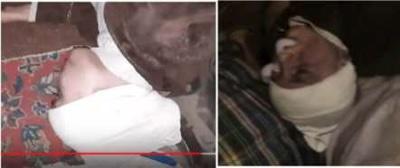
In scientific terms, the two observations — foaming at the mouth and rapid collapse and death — were irreconcilable. The NATO experts knew this, and so did Whelan and the rest of the FFM team.
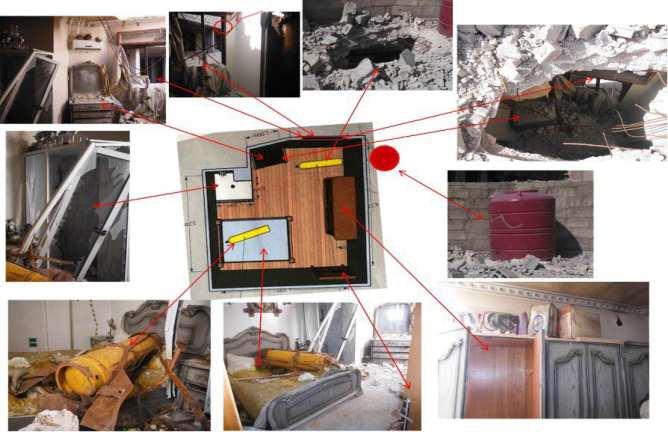
There was also a second prominent scientific issue. The yellow cylinders, purportedly dropped from a Syrian Air Force helicopter, showed remarkably little damage. The cylinder on the balcony had, quite literally, according to the official narrative, smashed a hole in a metal bar-reinforced ceiling and forced the rebars to splay outwards. And, yet, there was very little damage to the head of the cylinder.
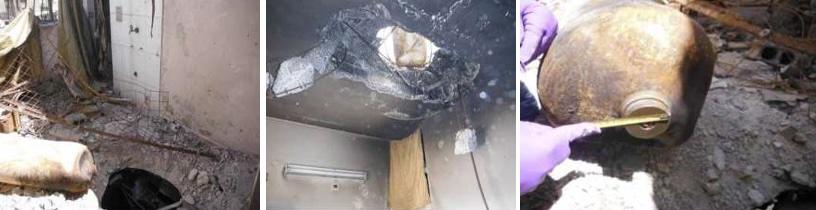
At the second incident site, the cylinder discovered on a bed had smashed completely through the metal bar-reinforced roof, before hitting the floor below and then bouncing three metres sideways across the room, with attached fins remaining intact.
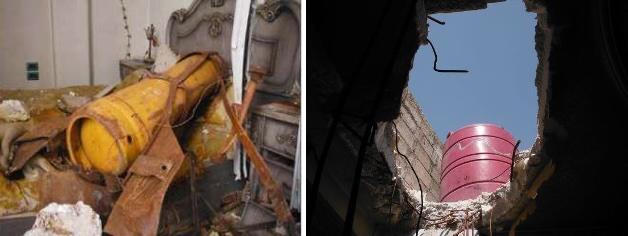
The scenarios made little sense. In particular, Newtonian laws regarding equal and opposite reaction would suggest far greater damage to the yellow cylinders than was actually observed. Furthermore, no plausible explanation could be established for how the bedroom cylinder could bounce, changing direction, to then land on a bed three metres across the room.
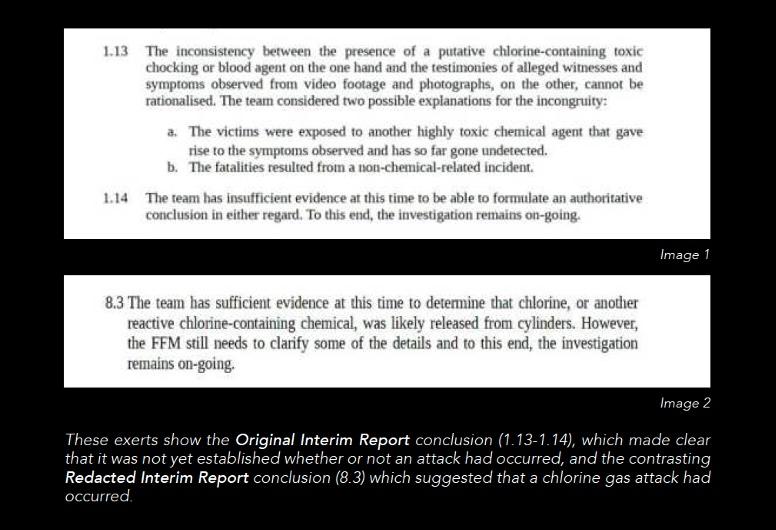
These concerns, along with a host of others related to witness testimonies and chemical analysis results, were clearly indicated in Whelan's initial (interim) report. The report reached no conclusion as to whether the alleged attack had occurred, but suggested two possibilities for the unexplained toxicology and ballistics findings: 1) that there was some highly toxic chemical that still had not been discovered and which could explain the toxicology incongruities, or 2) that the victims died as a result of a non-chemical related incident.
The Douma Investigation Is NobbledIt was at this stage, in June 2018, that the wheels came off the OPCW FFM operation. Whelan delivered his interim report, reviewed and signed off by the Douma team, and was informed that it had “come back from the editors with virtually no corrections”. In fact, the report ended up being heavily edited with the key toxicology and ballistics questions excised and presenting a conclusion clearly spun in the direction of confirming a chlorine attack had occurred.
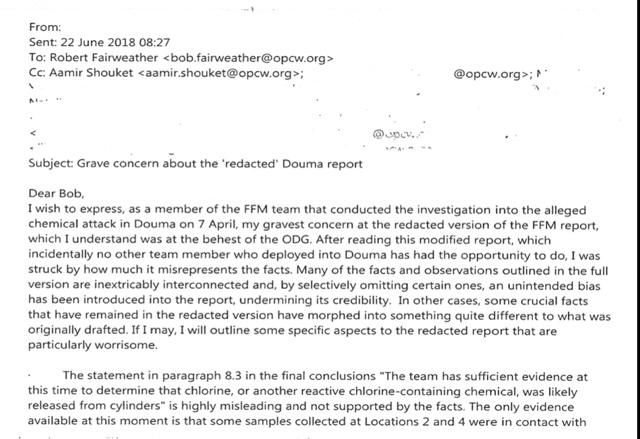
To be clear, some individual, whose identity remains undisclosed to this day, rewrote key sections of the report without the knowledge of, or consultation with, the Douma FFM team. The only reason the censored and manipulated interim report was not published was because Whelan discovered the ruse and formally protested to the Chief of Cabinet Robert Fairweather.
Whelan's protest was only the beginning of what was to become a lengthy battle to try and rectify the corrupted FFM investigation. During the months following the attempt to publish a falsified initial (interim) report, Inspector Ian Henderson continued to investigate the damage, or lack thereof, to the cylinders whilst Whelan awaited the publication of the final OPCW report, hoping that it would finally do justice to his team's original investigation. It was during the run-up to the publication of the final report in March 2019 that the BBC's Riam Dalati posted his findings about the staging of the hospital scenes.
When the report came out, however, Whelan and Henderson discovered that the toxicology conclusions were entirely absent, and that it failed to address key issues identified in Whelan’s initial report.
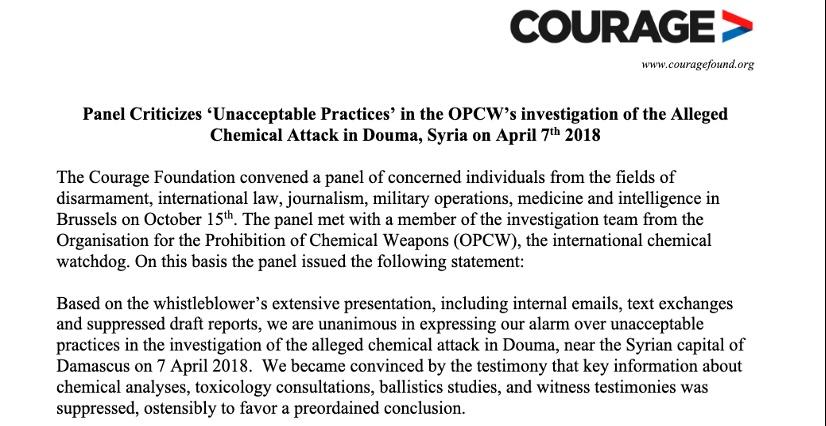
During the following months, formal letters were sent to the OPCW Director General detailing the fraudulent investigation, whilst someone from within the OPCW leaked a draft summary of Ian Henderson's investigation into the cylinder damage to the Working Group on Syria, Propaganda and Media (of which I am the convenor). Later in the year, an OPCW official with knowledge of the FFM investigation testified to a panel in Brussels, hosted by the Courage Foundation. The panel concluded that the Douma FFM investigation was manipulated in order to “favor a preordained conclusion”, blaming the Syrian Government.
There then followed multiple leaked documents, published by WikiLeaks, whilst mainstream UK journalist Peter Hitchens covered the story for The Mail on Sunday. Throughout, the OPCW refused to offer any meaningful response, whilst its Director General, Fernando Arias, refused to even meet with Brendan Whelan.
In 2021, I, along with Hans von Sponeck (former UN Assistant Secretary General), José Bustani (first Director-General of the OPCW), and Professor Richard Falk (Princeton), established BG21 and organised a Statement of Concern. This was signed by 28 leading international voices and called for the OPCW to at least address the issues being raised by its own scientists.
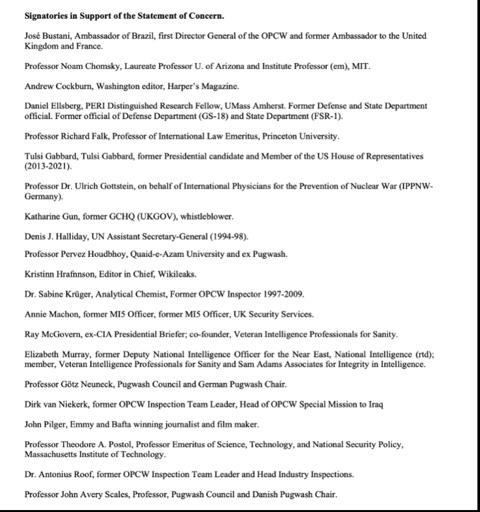
In what was a remarkable insult, a letter from Hans addressed directly to the OPCW Director General, and which included the signatures, was sent back to his home address without any acknowledgment.
In 2023, a 60,000 word review report by BG21, detailing in full the manipulation of the Douma investigation, was commissioned by MEPs Clare Daly and Mick Wallace, and then issued to the OPCW, its 160+ States Parties, the UN Security Council, and the OPCW Director-General.
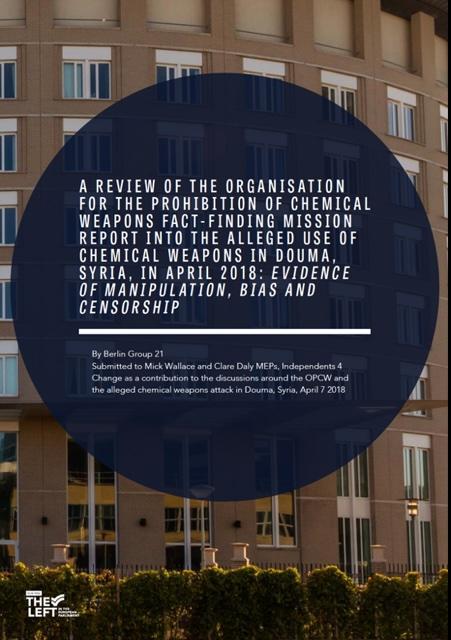
At a UNSC meeting in July 2023, Brazil directly challenged the OPCW to respond to the BG21 report:
Brazil received with deep concern the most recent report circulated by the Berlin Group 21 in The Hague on the process that led to the publication of the final report of the mission deployed to investigate the alleged use of chemical weapons in Douma in April 2018. The document raises a host of extremely concerning issues that the OPCW should not ignore if it is to preserve the credibility of its conclusions, regarding not only the Douma incident but all aspects of non-verification missions. We expect the OPCW Director-General and the Secretariat to address the issues raised in the Berlin Group review in a transparent manner, preferably by the next session of the OPCW executive council.
The BG21 review was followed by a further report from the MEPs issued in 2024.
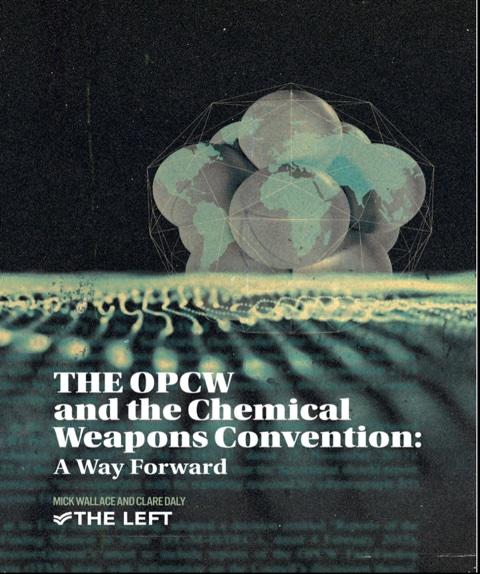
Throughout this entire process, the OPCW refused to engage with the issues raised about the Douma investigation, and the scientists were stonewalled. Perhaps most importantly, there has never been a refutation of the manipulations and censoring documented in the 2023 BG21 review. In fact, the standard response from the OPCW has been one of silence, whilst the US and UK have frequently resorted to smearing anyone questioning the Douma investigation as 'conspiracy theorists' or 'disinformation' activists.
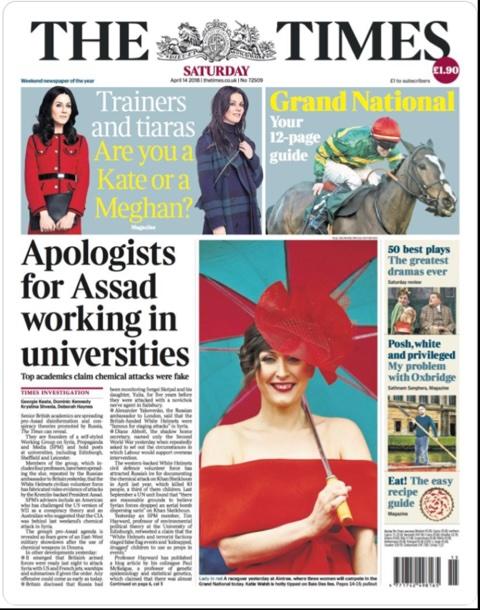
It is of note that smear and character assassination campaigns had already been initiated against me and the Working Group on Syria, Media and Propaganda as soon as we started to research the CW issue back in 2018. Playing the man, not the ball, is a tried and tested tactic used when authorities have something to hide, and they do not want to address the facts. The fact that such a large-scale attack was launched on unknown academics conducting research provides strong prima facie grounds there was a deception operation that needed to be protected and covered up.
In reality, if there were an adequate response to the issues raised by the whistleblowers, then the OPCW would have provided one by now. That they have not, after over five years, confirms that the investigation was indeed corrupted. And if the investigation was corrupted, then it means that, as suspected by the whistleblowers, something other than a Syrian Government chemical attack occurred in Douma.
The most obvious scientific incongruities that the OPCW fails to deal with concern the clear toxicological evidence that the civilians could not have been killed by either chlorine or nerve agent at the apartment in which their bodies were found, and the mismatch between the lightly damaged cylinders and the extensive damage caused to metal-bar reinforced concrete roofs. These issues are of such import to the OPCW's case that they even deployed scientific fraud (summarised in this article and detailed in full in the BG21 Review) in order to obfuscate the problem of the toxicology and the cylinders. There are many further substantial issues involving manipulation of interview data and chemical analysis results, all of which are fully documented in the BG21 Review and none of which have been resolved by the OPCW.
What does this all mean for our understanding of what happened at Douma? Put simply, if the victims were not killed in a chemical attack in which these cylinders were dropped from a helicopter, it means that actors on the ground — Jaysh al-Islam and White Helmets operatives — arranged these scenes and then promoted a false claim that an actual CW attack had occurred. Confirmation from BBC producer Riam Dalati that the hospital scenes associated with this attack were staged provides additional confirmation regarding this truth. In short, this all means that Douma was either staged or a false flag event.
In the final analysis, and drawing together Parts 1 to 4 of this series, Douma was the first alleged attack since Ghouta 2013 in which the OPCW was actually able to gather evidence first-hand, and, when they did, their findings had to be suppressed.
Furthermore, as we have seen throughout this series, Douma 2018 sits within a context of earlier problematic alleged CW events reported via actors aligned with Western belligerents — such as the White Helmets and other Western-linked NGOs — and in close proximity to their intelligence services. US-based journalist Aaron Maté describes this setup, whereby aligned actors like the White Helmets supply evidence to OPCW investigations, as a “chain of corruption”.
It has been demonstrated that none of the major alleged CW attacks blamed on the Syrian Government examined in this series stand up to scrutiny. The alleged nerve agent attack in Homs 2012, described in Part 1, fell apart spectacularly when the US State Department effectively disowned the allegations.
As discussed in Part 2, the run-up to Ghouta 2013 revealed multiple alleged attacks blamed on the Syrian Government failing to meet required standards of evidence and proof, whilst the nerve agent attack on Syrian Government troops at Khan al Asal in March 2013 was actually found to have “corroborating” and “credible” support.
Ghouta 2013 itself has been shown to be completely implausible, not least because of the striking lack of motive. The joint OPCW-UN team, invited in by the Syrian Government following the Khan al Asal attack against its own soldiers, had literally just arrived in Damascus and the Obama Administration had threatened military action if the CW 'red line' was crossed by the Syrian Government. At the same time, forensic analysis of the rocket trajectories reveals key flaws in the joint OPCW-UN report, and confirms the rockets were launched from opposition-held territory.
Post-Ghouta 2013, alleged chlorine gas attacks revealed a pattern in which implausible and outlandish claims came to be rubber-stamped by OPCW investigations. In the case of Talmenes 2014, detailed in Part 3, the OPCW seriously asked us to believe that one alleged CW attack was actually being staged whilst another one, 90 metres away, was occurring for real.
Later OPCW reports, as described in Part 4, presented implausible chlorine binary weapons and a chlorine gas cylinder apparently capable of penetrating through a metre thick layer of soil and then punching through a metal bar-reinforced roof without suffering much damage to itself.
The empirical record, then, reveals the paucity of the OPCW reports and the official narrative they have come to underpin, and makes the case that what we have here is a well-organised and resourced deception campaign designed to frame the former Syrian Government. In sum, the Syrian CW narrative is a strategic deception utilised in order to delegitimise the Syrian Government and, in doing so, underpin the Western-led regime change efforts.
Douma 2018 was simply the point at which the machinations and abuse of the OPCW became blatant and obvious enough for it to spill over in the form of the organisation’s own scientists blowing the whistle.
The story is not yet over, however. With the fall of the Syrian Government in December 2024, and its replacement by the Western-sponsored extremist al-Jolani, the stage is now set for the final act.
As we move into 2026, the OPCW has created an Office of Special Missions (OSM) in order to deal with the 'Syria file', but no stockpiles of CW and no evidence of a secret programme have been presented to date. Of course, it is now so long since the fall of the Syrian Government that any 'evidence' will be completely lacking in credibility. For a start, it will fall foul of chain of custody requirements; anything found now could easily have been planted or manipulated.
The pressure, remains, however, for the OPCW to deliver some kind of confirmation of the decade plus long allegations and bury the litany of manipulated reports and false allegations that the official narrative currently rests upon.
Let's see what they have to say for themselves.
Author’s Note: The final instalment to this series will be written once the OPCW's OSM reports.