Author's Note: The allegation that the now-deposed Syrian Government systematically deployed chemical weapons against civilians during the 2011-2020 war is often repeated widely by Western politicians, mainstream media, think tanks, and 'regime change' activists. These claims have been supported, to varying degrees, by the world's chemical weapons watchdog, the Organisation for the Prohibition of Chemical Weapons (OPCW). In 2019, however, whistleblower scientists from within this organisation testified to the manipulation of the investigation of one of these alleged attacks in order to reach a 'pre-ordained conclusion' that the Syrian Government was responsible. In fact, the entire history of alleged chemical weapons (CW) incidents in Syria, dating back to as early as 2012, is controversial. This series explores the history of these allegations and sets out a preliminary case that the entire CW narrative is, in fact, a strategic deception designed to underpin a policy of 'regime-change' by delegitimatising the Syrian Government. Parts one, two, and three are available here, here, and here.
As we saw in part three, the post-Ghouta chemical weapons narrative segued to claims that the Syrian Government, having abandoned its arsenal of chemical weapons after joining the CWC (Chemical Weapons Convention) in 2013, had decided to start dropping cylinders of chlorine gas on civilians. Reports on the first of these alleged incidents, at Talmenes in 2014, involved the public being asked to seriously believe that one alleged impact site was being staged whilst another impact site, just 90 metres away, was occurring for real. OPCW states that parties, Western analysts, and the remainder of the corporate media failed to recognise the absurdity of this proposition. Most importantly, the OPCW inspectors tasked with this investigation also appeared to be oblivious to the absurdity of what they were writing in their report.
Following Talmenes, from 2014 to 2017, multiple allegations continued to be made against the Syrian Government regarding the dropping of chlorine gas on civilian populations. Many, if not most, of these involved few fatalities and did not attract widespread attention. Some, however, were deemed to be of sufficient credibility to warrant an OPCW FFM (Fact Finding Mission) investigation and here, as with the Talmenes incident described in part three, involved increasingly bizarre and implausible claims, as we shall see here in part four.
Green Bottles and the Potassium Permanganate Binary Chemical WeaponAs noted at the end of part three, one of the more bizarre narratives to emerge was the claim about a so-called ‘binary’ chlorine device. Here the OPCW asked us to believe that, rather than dropping cylinders filled with chlorine gas, the Syrian Government had decided to devise an elaborate device designed to create chlorine gas by reacting potassium permanganate with hydrogen chloride (presumably hydrochloric acid) delivered as part of an improvised exploding munition. This was allegedly achieved by packing bottles of potassium permanganate alongside commercial R22 refrigerator coolant cylinders refilled with hydrogen chloride (see the graphic below that was taken from an FFM report).
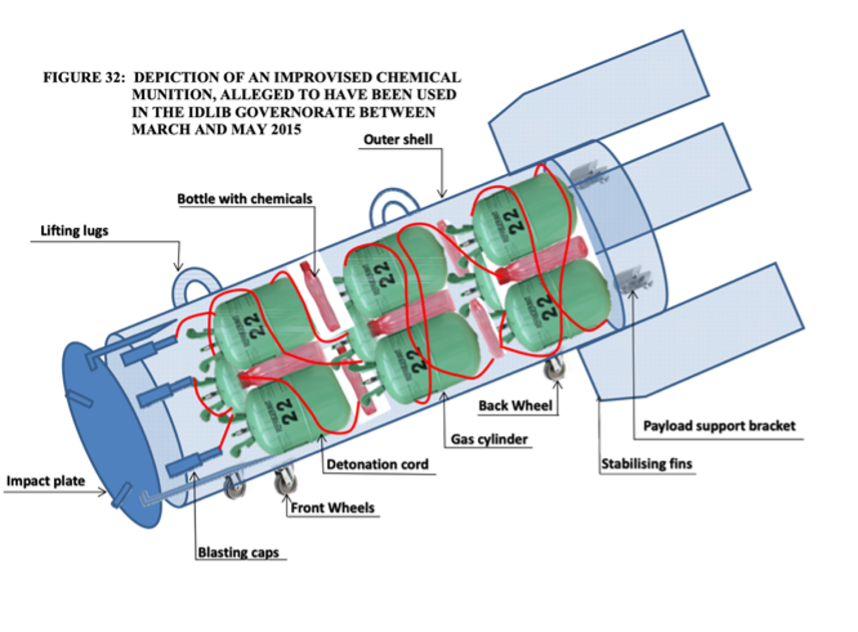
Such a device, even if workable, would only ever be able to create a fraction of the chlorine gas that would be contained in a cylinder simply filled with chlorine. In short, the alleged device made little sense, and yet, it still came to be included in an FFM report published in late October 2015.
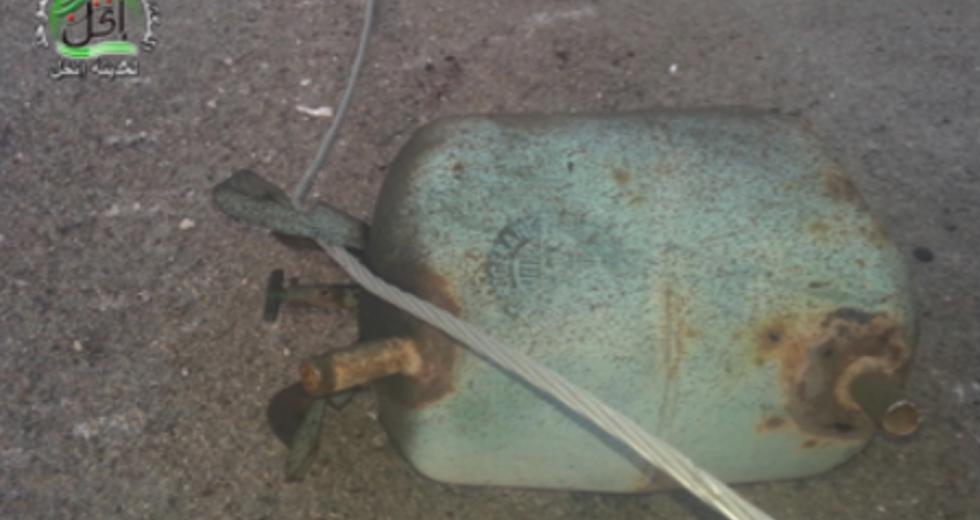
The process by which this imagined device came into existence is informative. As early as summer 2014, images of refrigerator coolant cylinders were being relayed by the Western government-linked propaganda operation Bellingcat along with online speculation as to their purpose.
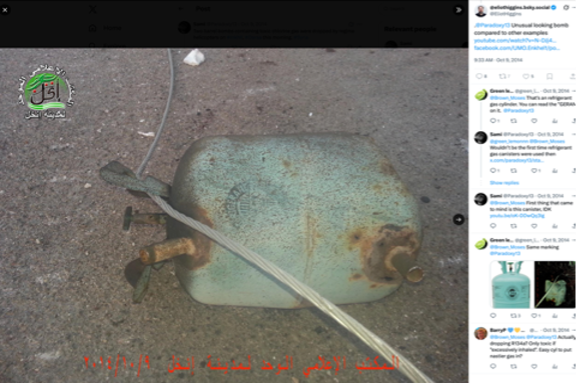
Then, a few months later in early 2015, images started to circulate online showing a reddish material in puddles or having stained soil. Bellingcat's Eliot Higgins posted images of pinkish-red stained puddles whilst the White Helmets, the first responder organisation established by former British military officer James le Mesurier, issued later in May 2015 a film of water being poured over alleged bomb fragments which then turned the water reddish-pink.
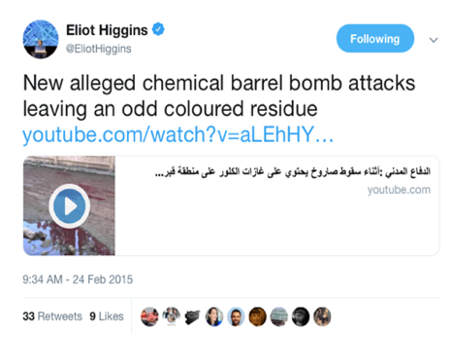
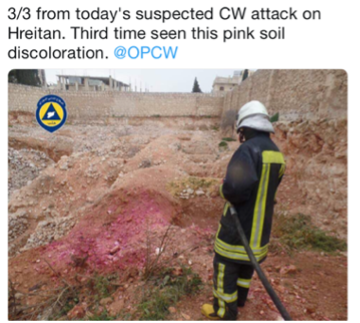
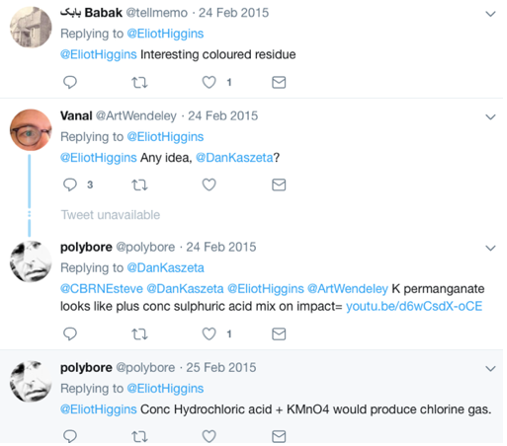
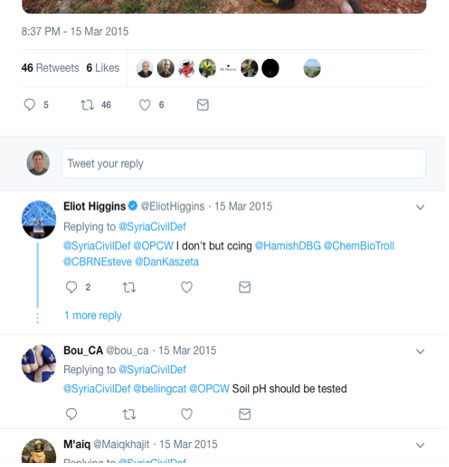
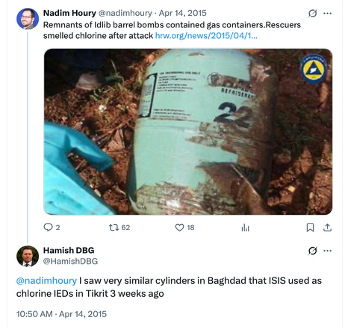
The purported online sleuthing quickly established the pinkish-red residues as potassium permanganate, which turns water pinkish-red, and discussion ensued about the possibility of a device designed to combine hydrochloric acid with potassium permanganate in order to generate chlorine gas (see screenshots below).
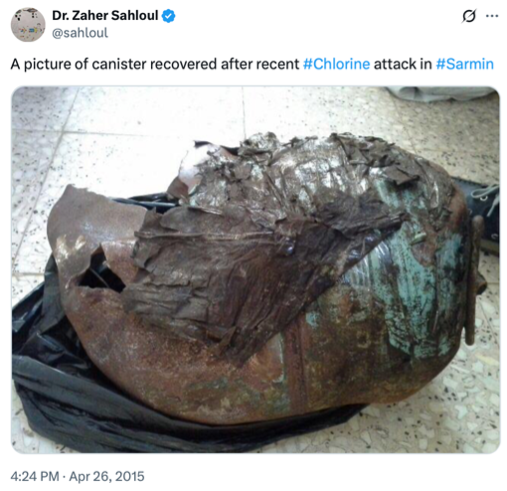
During early 2015, other significant individuals also posted or discussed images of the R22 cylinders, including Dr Zaher Sahloul from the Syrian American Medical Society and former British military officer Hamish de Bretton-Gordon. As we saw in parts two and three, Hamish was involved with an MI6 sample gathering operation back in 2013, and his CBRNE taskforce fed information to the OPCW from the 2014 alleged incident in Talmenes when we know at least one of the alleged attack sites was staged.
Later during the summer of 2015, in what appears to be a crude attempt at creating something that could pass as a binary device, a video was issued by an opposition group showing two individuals apparently excavating material from a barrel that also contained green bottles and red detonator cord. It is impossible to work out exactly what the material being excavated is and, overall, the (re)construction looks ridiculous. However, its similarity with the FFM drawing of the alleged potassium permanganate-hydrogen chloride binary device is notable.
Between 16 March and 20 May, and in the midst of this online narrative construction, a series of alleged attacks occurred, and the OPCW FFM were asked to investigate. As can be read in the FFM report published later in 2015, the R22 cylinders and potassium permanganate were brought together in a speculative exercise, reflective of the online conversations noted above, and the world was presented with the binary chlorine device.
Authored by an OPCW inspector named Leonard Philips, who was awarded an OBE by the British Government in 2019 for services to international security, the FFM report relied upon evidence supplied by third parties because the OPCW FFM was unable to visit the alleged attack sites. As explained in part three, the OPCW had to abandon onsite visits following the ambush by opposition groups of an FFM team in 2014.
Two of the main information sources for the FFM report were the UK-linked White Helmets organisation and the Chemical Violations Documentation Center of Syria (CVDCS). As noted earlier, the White Helmets had been established by a former British military officer, James le Mesurier, and are now understood by many to have been a component of UK propaganda operations during the war to overthrow the Syrian Government. Emma Le Mesurier (née Winberg), le Mesurier's wife, was also head of strategic communications at Mayday Rescue, the NGO that coordinated the White Helmets. She was a 'former UK diplomat' and was reported in Politico to have worked for MI6 (see here for more details).
The background to the CVDCS was obscure and questionable and the Working Group on Syria, Propaganda and Media reported the following back in 2019:
The CVDCS is described on its website as “an office within Same Justice” which was founded as a not-for-profit association in Brussels on 7 April 2015. No accounts for this organization are available on the Belgian business register. The domain names cvdcs.com and samejustice.com were registered (on 11 March 2015 and 8 August 2015 respectively) by Hasan Addaher (sometimes translated as Hassan Aldaher), one of the founders of Same Justice who is also the co-ordinator of a pro-opposition organization.
Drawing heavily on these two sources of information, the FFM apparently pieced together the evidence trail, one that had also been broadcast over social media during the preceding months as we saw earlier, in order to create the fantastical binary chlorine device shown again here.
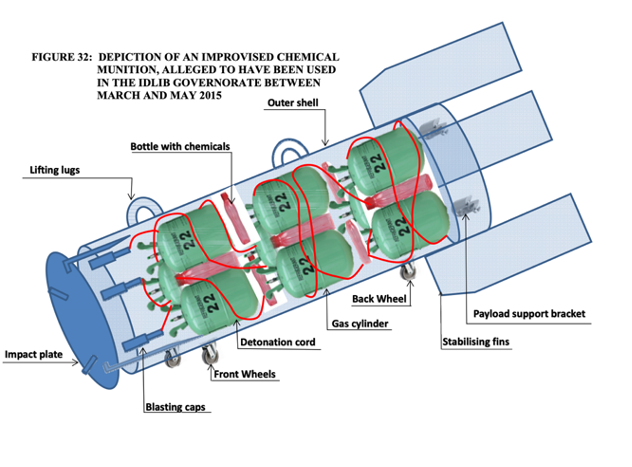
It is extraordinary that this imagined contraption was taken seriously enough to be inserted into an OPCW FFM report. As noted above, the supposed method of delivering the chlorine gas made little sense as, if the intention was to use chlorine as a weapon delivered by air, it would be simpler to drop cylinders of chlorine rather than to go to all the trouble of constructing a complex device that attempted to produce chlorine by a chemical reaction at the point of impact. Moreover, as one qualified commentator pointed out, the device could at most generate enough chlorine to perhaps kill a field mouse. Another commented that the device could certainly be lethal, but only if it landed on someone's head!
More specifically, the supposed binary weapon supposedly relied upon potassium permanganate and hydrogen chloride mixing together as a result of an explosion as the contraption hit the ground. This was at odds with the normal design of so-called binary munitions, which are designed to mix the precursors in flight or before launch. The question is begged whether the contraption represented a schoolboy-level misinterpretation of the idea of a binary munition.
Finally, and perhaps most tellingly, the contraption relied upon the R22 canisters being refilled with an appropriate gas or liquid such as hydrochloric acid. The subsequent Joint Investigative Mechanism pointed out that the “repurposing or refilling of these canisters would require technical modification of the valve”. As described in the 2019 briefing note from the Working Group on Syria, Media and Propaganda, even though the FFM has been provided with examples of these canisters, presumably via the White Helmets, “no such valve modifications were reported by the FFM”. If there were never any modifications to the valves, then the device would never have worked as described.
The question of the contents of the R22 cylinders also apparently had the UK's CW expert Hamish de Bretton-Gordon confused. In an interview with the then Times journalist Deborah Haynes, Hamish declared that terrorists in the UK could simply strip cylinders off the back of household fridges and then deploy them as improvised chlorine devices.
The article, titled ‘Rising Fears of Chemical Attack by UK Jihadists’, reads:
Colonel Hamish de Bretton-Gordon, one of the country's leading experts on chemical warfare, has urged ministers to tighten controls on the sale of chlorine. ‘As more jihadists return to this country there is a growing chance [of a chlorine bomb attack]’, he said. ‘That to me puts it through the threshold where we should look into this seriously’.
The article goes on to state:
The chlorine that is often used in bombs comes from the cylinder on the back of household fridges. Militants strip off the steel bottle and attach an explosive charge to make a simple improvised chlorine device — something that could be repeated in Britain. ‘Somebody could go to a waste site where people chuck away fridges [in Britain] and get a whole bunch of these things and blow them up’, Colonel de Bretton-Gordon said.
As indicated by the BBC's science correspondent at the time, Frank Swain, Hamish had evidently become confused about the content of R22 cylinders and had forgotten they needed to be refilled with a different gas.
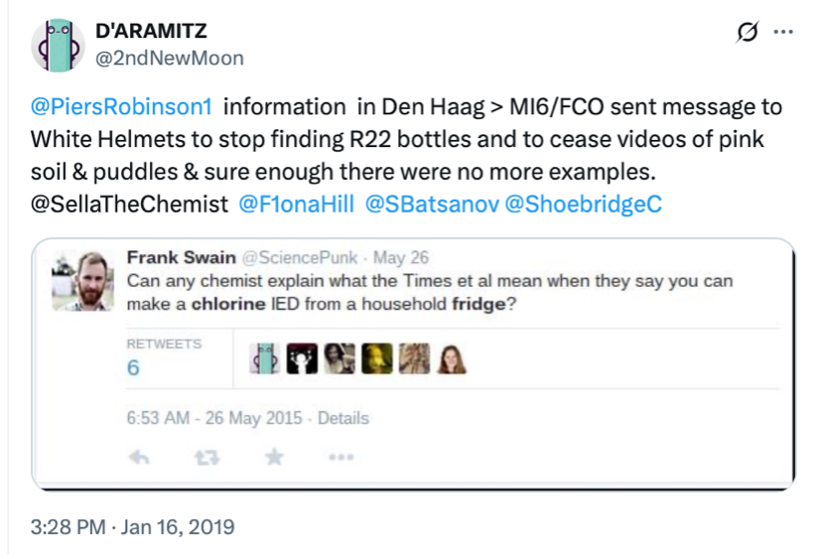
According to the author of the above tweet, who is known to the author, the ensuing embarrassment helped bring an end to the era of White Helmets teams 'finding' the R22 cylinders.
The Bunker-Busting Yellow Chlorine Gas CylinderIt was probably the raised eyebrows and disbelief following the R22-potassium permanganate debacle that ensured the chemical weapons narrative shifted back to the more plausible allegations of standard industrial (yellow-painted) chlorine cylinders being dropped on civilians. White Helmets teams were, in the years that followed, filmed and photographed in a variety of settings, variously manipulating or purportedly recovering the remnants of these alleged weapons. Sometimes they were even presented as both the victims and first responders during alleged chemical weapons attacks. As we shall see in part five, the plausibility of some of these alleged attacks was to come under serious scrutiny in the case of the alleged 2018 Douma attack. But even before that, if one looks closely enough, implausible claims were being advanced by the OPCW's FFM regarding these yellow cylinders. One such case concerns the alleged chlorine gas attack in Ltamenah on 25 March 2017.
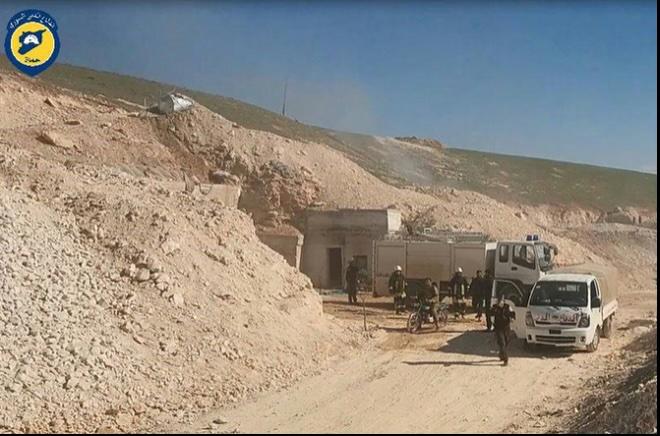
Here, it is alleged that the Syrian air force dropped multiple chlorine gas cylinders onto a hospital complex that was built into the side of an area of raised ground. In the 2020 IIT (Investigation and Identification Team) report, it was described as a 'cave hospital' and the construction was beneath a layer of earth and its ceilings were constructed with metal bar reinforced concrete. Apparently one of these cylinders “hit the hospital, pierced its roof, fell inside, and released chlorine gas” (see IIT report here). This allegedly caused one death and the injury of a further 32 people.
What is incredible about this event are the circumstances in which the yellow chlorine gas cylinder was reported to have penetrated the hospital cave complex whilst then remaining largely unscathed. The original FFM report, published in 2018, did not provide images of the cylinder, but it did relay images of the purported impact site.
From the image shown below, it is difficult to discern exactly where the cylinder is supposed to have penetrated the reinforced concrete roof, but it is clear that the hospital complex was built into the side of an area of raised ground.
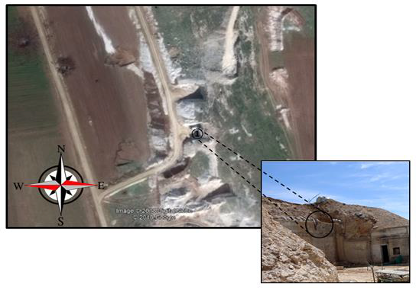
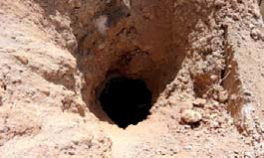
Exactly what depth of soil the cylinder purportedly passed through is left unclear, but the FFM-supplied image below suggests that it was perhaps at least a metre of soil.
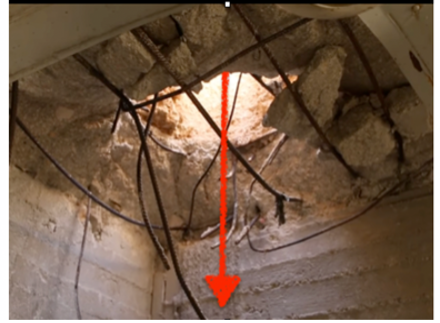
What the FFM report does not show is the following image of the metal bar-reinforced concrete roof that the cylinder apparently penetrated after it had drilled through the metre plus layer of soil.
Interestingly, no images of the cylinder that is supposed to have caused this hole are provided in the 2018 FFM report, and it is only in the 2020 IIT report (tasked with attributing responsibility for the alleged attack) that the OPCW provides some (see below).
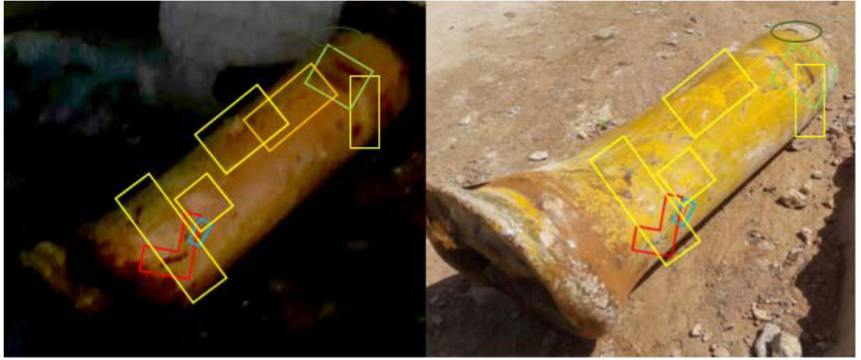
Better images were available, even in 2017, which had been supplied by the White Helmets. As can be seen, the cylinder was largely unscathed aside from a crack and a dent at one end.
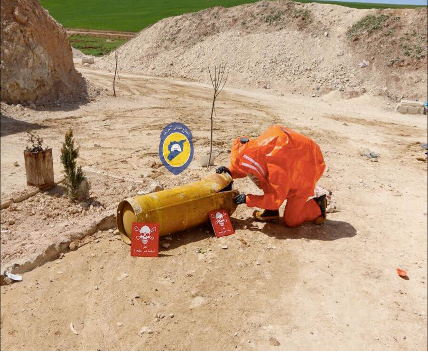
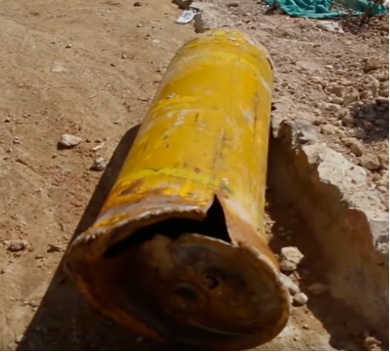
The bottom line here is that the damage observed on the cylinder is entirely incompatible with the damage to the metal bar reinforced ceiling plus the hole drilled into the ground. As we will see in part five of this series, exactly the same incongruity emerged with the yellow cylinders allegedly dropped on Douma in 2018. A former OPCW inspector comments as follows on the absurdity of the Ltamenah hospital cylinder:
... it is inconceivable that a cylinder constructed of relatively thin walled ductile steel, filled with liquid chlorine and dropped from 4000 metres, would end up suffering only the slight flattening and crack seen in the image ... instead of dissipating energy laterally at the impact with the sandy soil (which is there to provide a yielding substrate to absorb impact from any falling object), we are to believe the cylinder would drill a deep hole through the sandy soil covering the hospital roof, punch through the reinforced concrete slab, and still end up looking like the relatively undeformed cylinder in images of the object. If ever there was a case that exposes the implausible narrative, this is it.
Another way of understanding the absurdity here is to consider basic Newtonian physics regarding equal and opposite reactions. Here, the forces exerted on the cylinder will be equal and opposite to the forces exerted on the soil and metal bar reinforced roof: as the soil is punched out of the way and the metal bar reinforced ceiling is penetrated, large forces will necessarily be exerted back on the cylinder. As a result, the cylinder should be severely damaged.
The FFM-IIT DeceptionTo be clear, the authors of the OPCW's reports in 2018 and 2020 perform a merry little dance in order to obfuscate the absurdity of the claim that the alleged cylinder successfully penetrated a metre plus of soil as well as a metal bar-reinforced concrete roof. As noted above, the 2018 FFM report shows images of the hole in the ground and the hospital complex but avoids showing the hole punched in the metal bar reinforced ceiling. The reader, therefore, does not get the full picture of exactly how much damage the cylinder is supposed to have caused. Most importantly, no pictures of the largely unscathed cylinder are shown in the 2018 FFM report. As a result, the 2018 FFM report prevents the reader from picking up on the obvious incompatibility between the damage to the cylinder and the damage to the hospital roof. No comment or analysis is presented in the FFM report regarding the purported 'compatibility' between the damage to the 'cave hospital roof' and that which is observed on the cylinder, other than to glibly state that “[t]he FFM determined that chlorine was released from cylinders through mechanical impact”.
The obfuscation in the 2020 IIT report is even worse. This time no images are shown of the alleged impact site whilst images of the cylinder are shown. Again, the reader is prevented from picking up on the obvious incompatibility between the largely unscathed cylinder and the cave hospital scene, but this time by showing the cylinder whilst censoring the damage scenes from the hospital. Quite literally, the reader of these reports would have to cut and paste both together in order to see the cylinder alongside the damage it is supposed to have caused.
Then, having introduced munition experts who might have been expected to assess the actual compatibility between the damage seen on the cylinder and the damage to the hospital roof, the IIT evades the issue entirely by focusing on whether the size of the hole in the roof matched the cylinder, and confirming the cylinder filmed outside the hospital was the same one filmed inside the hospital. The only mention of the damage to the cylinder relates to an assessment that it was not caused by an explosive device.



As we shall see in part five, exactly the same game of obfuscation and deception played out with respect to the munition expert assessments of the cylinders that purportedly fell on Douma in 2018.
Maintaining the Big LieFrom the derailed allegations of a nerve agent attack in Homs 2012, through the multiple pre-Ghouta 2013 alleged incidents, and the emergence of a fresh round of alleged chemical weapons attacks between 2014 and 2017, a pattern emerges. Western intelligence agencies and aligned groups like the White Helmets supply information to OPCW investigations, leading to reports with demonstrably flawed or untenable claims.
It is a simple, albeit very important, point that information being supplied by belligerents in a conflict over an issue as important and influential as alleged chemical weapons attacks is vulnerable to manipulation and deception. As soon as one recognises that the binary chlorine device is implausible and that the cylinder cave hospital scenario is equally untenable, it becomes obvious that we are dealing with staged or fabricated events. Just like, as the OPCW JIM investigation tacitly acknowledged, the staged crater at Talmenes in 2014 or, as the US State Department back-pedalling indicated, the false claims of a nerve agent attack in Homs in 2012.
The OPCW investigations did not appear to be interested in tackling this 'elephant in the room'. Indeed, in a remarkably candid statement, Professor Ake Sellstrom, former head of UN/OPCW investigations, reported that:
The second problem, encountered particularly during the JIM's initial work, was the difficulty of performing a proper investigation when the guilty party was already obvious to many of the investigators from the outset. Some investigators even refused to consider alternative scenarios.
Some within the OPCW were, however, growing increasingly uneasy at what appeared to be the rather obvious co-optation and control of their investigations, as well as the scientific implausibility of the claims advanced in their reports. As we shall see in part five, this would all come to a head with the explosive revelations surrounding the alleged chlorine/sarin attack on the town of Douma on 7 April 2018.