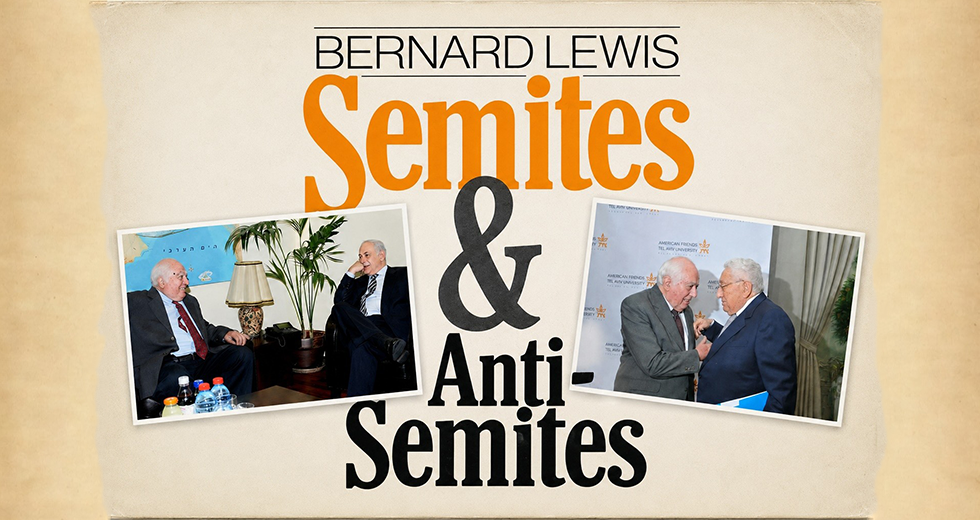
Is there such a thing as ‘antisemitism’, conceived of as racism against the Jews? The dominant picture in academic discourse regarding antisemitism is that the term was coined by a Nazi-adjacent writer, Wilhelm Marr, in 1879, and that it was either rapidly transformed into a term which targeted only the Jews, or that it only ever was a term targeting the Jews. This investigation shows that view to be entirely incorrect.
The doyen of the field of ‘antisemitism’ was undoubtedly Bernard Lewis, the former British military intelligence officer. He was considered one of the most distinguished scholars of the Arab and Ottoman worlds and was known for dazzling intellectual gifts, capable of reading and interpreting sources in over a dozen languages. In his landmark study Semites and Anti-semites: An Inquiry into Conflict and Practice, which has been cited some 564 times by other authors, he sets out the dominant position in the literature with admirable clarity: “The term 'anti-Semitism' was coined in 1879 by Wilhelm Marr ... specifically for racial hatred of Jews ... It has never meant hatred of Arabs or other Semitic peoples.”
This view, and much else in the vast bulk of academic argument throughout the 20th century and into the 21st century, is completely wrong, as I shall show in this article.
It’s widely known that Lewis was a Zionist ideologue, denounced, for example, by Edward Said as a scholar who used academic prestige to justify Western imperialism and denigrate Arab and Muslim culture. Nevertheless, his views above have not been fundamentally challenged or totally dismissed by the academy, even including advocates for the Palestinians like Said, who was among his most trenchant critics, as we will see.
Instead, while there are some more complex accounts from devotees of Zionism, which I will shortly review, the overall view that antisemitism is about the Jews is inscribed deeply in the DNA of almost every academic account of the subject.
In fact, the origins of the term ‘antisemitism’ are not what we have been told.
From Semitic Languages to Semites
The term ‘Semite’ comes from the designation ‘Semitic languages’, which, as is widely known, included ancient Hebrew, Arabic, Aramaic, and several other languages.
August Ludwig von Schlözer (1735–1809), from the Göttingen School, is usually credited with coining the term ‘Semitic languages’ (semitische Sprachen) in a 1781 essay. Between then and 1850, ‘Semitic languages’ and its antonym, ‘Aryan languages’, were transformed in some treatments into designations, not just of language and culture, but ‘race’. It should be noted, though, that ‘race’ was not necessarily defined in the way that we would today. Ernest Renan is most often discussed as the key author in this process.
Renan was the first person ever to be referred to as having ‘antisemitic prejudices’. This designation was extremely effective, and all the way down to today, the dominant view is that he was indeed a racist and an ‘antisemite’. He was not an antisemite, however. He was, in fact, a Judeophile. For example, in 1883, during a keynote lecture in Paris entitled ‘Le judaïsme comme race et comme religion’ (‘Judaism as Race and as Religion’), he declared: “The history of the Jewish people is one of the most beautiful in existence, and I do not regret having consecrated my life to it”.

Furthermore, he did not believe that the Jews — or at least the Ashkenazim — were Semites. He believed, by contrast, that they were ‘civilised’. He said in 1850:
The primordial influence of race, as immense a part that it plays in the dynamics of human affairs, is offset by a crowd of other influences, which sometimes seem to overcome or even smother entirely that of blood. How many Israelites today, who are descended directly from the ancient inhabitants of Palestine, have nothing of the Semitic character, and are only modern men, swept along and assimilated by this great force superior to race that we call civilisation!
The inferior race(s), in his account, were those peoples who, at the time, spoke Semitic languages and — crucially — those who followed the religion of Islam. For Renan, notes Stroumsa, Muslim peoples, (including the Ottoman Turks, who, he noted, were not racially Semites), “were incapable of either science or progress”. This was explained by the “intellectual nullity” of Islamic societies. Islam was “the heaviest chain humanity has ever borne”.
In a handwritten note published after his death, Renan stated:
One conclusion we can draw at this point is that one of the most important writers about Semitic languages did not regard Ashkenazi Jews as Semites, but did regard Arabic speakers/Muslims as Semites. So, to the extent that this was a racial classification, it was only Arabs/Muslims who were referred to by the term Semitic.
Renan’s Accuser
The first person to use the term antisemitism — to accuse Renan — in German was a writer called Moritz Steinschneider. In 1860, Steinschneider wrote in Hebraeische Bibliographie, the journal he edited, that Renan had “antisemitische Vorurteile” (“antisemitic prejudices”). Why did Steinschneider commit this error? Because he either was not aware, or, more likely, was too ideologically driven to accept it. He believed that the Ashkenazim — speakers of Yiddish, which is not, and has never been, a Semitic language — were Semites. We can also note that Ladino (Judeo-Spanish), the language spoken by Sephardic Jews, was not a Semitic language either.

The issue of Steinschneider’s journal Hebraeische Bibliographie in which he coined 'antisemitische'
He believed this was because he was a Zionist. In 1838, along with two lifelong friends, Albert Löwy and Abraham Benisch, he set up a secret Zionist group at the University of Vienna, called Die Einheit, to encourage Jewish colonisation in Palestine. Nahum Sokolow’s History of Zionism, 1600-1918, reports:
The first meeting of the new society was held in 1838, in Löwy’s room. The object, however, had to be kept secret for fear lest it would be defeated by the Government. England was regarded as the country likely to welcome the new movement, and, as an emissary of the Students’ Jewish National Society, Löwy was sent to London in 1841.
Löwy was met with widespread indifference, and the secret society eventually dissolved. However, this failure directly reshaped their political strategy. Both Löwy and Benisch permanently settled in England, realising they needed a new blueprint. In 1842, Löwy became one of the first two ministers of the West London Synagogue, the UK's premier Reform Judaism congregation.
Abraham Benisch, by contrast, focused on the media. He became the influential editor of the Jewish Chronicle from 1864 until 1869, and again from 1875 until his death in 1878. In 1871, the pair founded the Anglo-Jewish Association (AJA). Dr. Benisch and Dr. Löwy were active propagandists on behalf of the Association. Dr. Löwy was a member of the International Palestine Committee, which was formed in 1878 on the recommendation of the Palestine Section of the International Jewish Conference held that year in Paris. Known globally as the ‘Rothschilds of the East’, the Baghdadi-born Sassoon family were influential financiers behind the projects envisioned by Löwy and Benisch. Sir Albert Abdallah David Sassoon (the head of David Sassoon & Co.) immediately stepped in as a Vice-President of the Association. He provided the capital required to turn Löwy’s educational visions into reality.
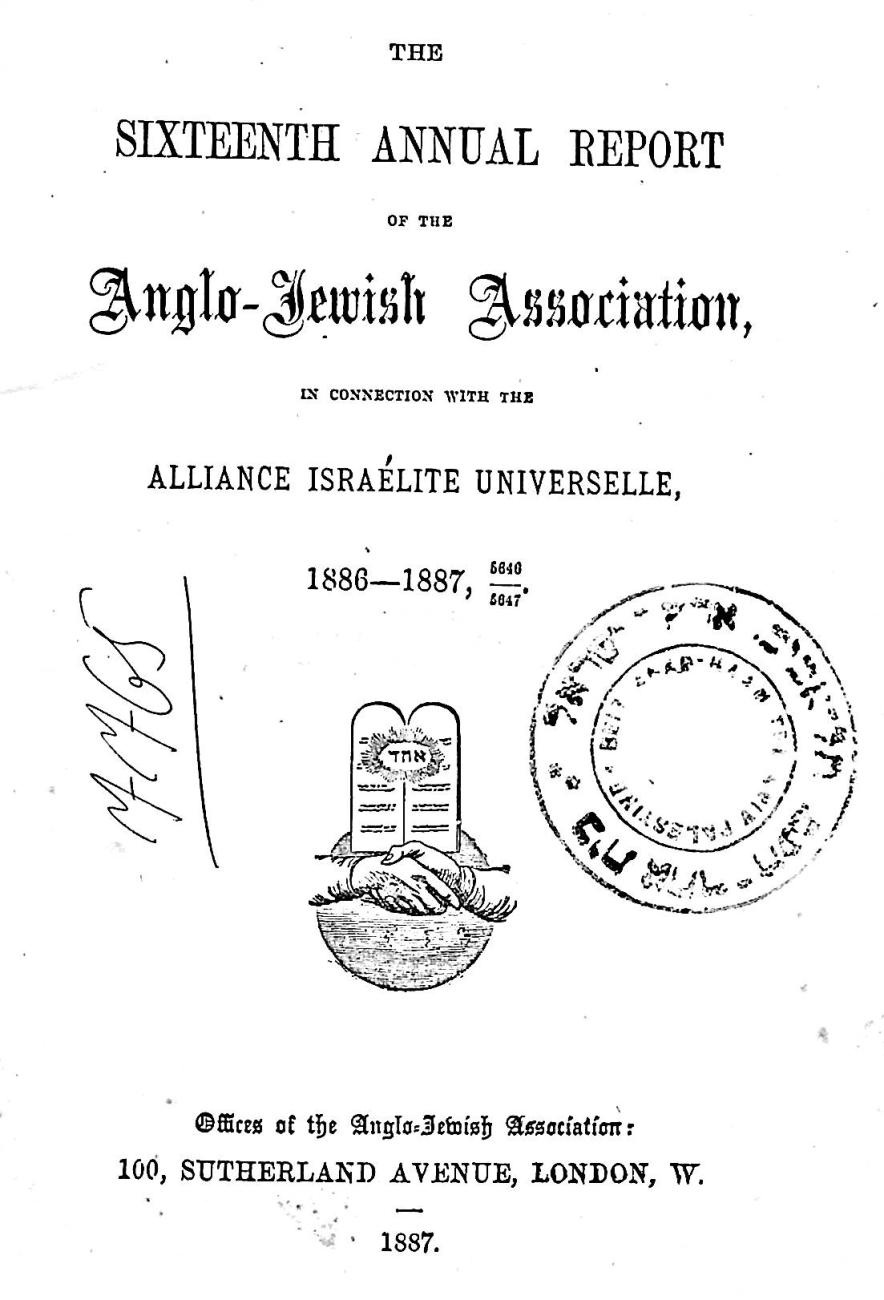
The Anglo-Jewish Association Annual Report, 1886-1887
Eventually, the Rothschilds fully absorbed and backed the AJA. The leadership of the organisation was later taken over by figures like Claude Montefiore (a close maternal relative of the Rothschilds), and the Rothschilds became major financial donors to the AJA’s global refugee relief funds. Among the AJA’s educational work, the organisation ran the Evelina de Rothschild School for Girls in Jerusalem. In 1893, Baron Maurice de Hirsch founded the Jewish Colonization Association along with Baron Edmond De Rothschild and others. The JCA partnered with the AJA, granting them thousands of JCA corporate shares to manage global Jewish agricultural settlements. This trust was managed in tandem with Baron Edmond de Rothschild’s massive independent funding of colonies in Palestine, uniting the old Die Einheit dream of land settlement with elite European banking capital.
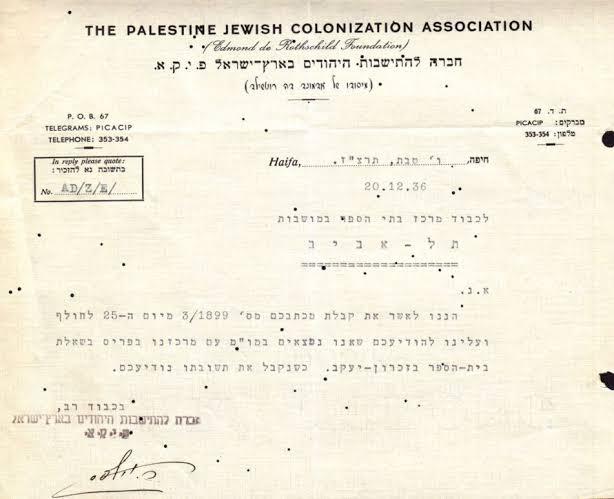
The Jewish Colonization Association’s branch in what it called ‘Palestine’
Prior to this, in the late 1850s, David Sassoon personally commissioned Steinschneider to produce an edition of Mussar Haskel (a classical, medieval primer of Jewish ethics and moral philosophy attributed to Hai Gaon) to be used to indoctrinate Jewish kids in the Sassoon School of the Bene Israel in what was then called Bombay, India.
So, in the end, we can say that the invention of the term ‘antisemitism’ was down to a Zionist activist whose milieu over succeeding decades was well-integrated into elite Jewish communal politics and Zionist-related activism.
How the Incorrect Version of the Emergence of ‘Antisemitism’ Became Embedded
Steinschneider’s contribution to the claim that the Ashkenazim were Semites and that Reman’s critique of the Semitic ‘race’ was a mask for Judeophobia was evidently significant, though it predated the popularisation of the term by the Judeophobic writer Wilhelm Marr in 1879. Other Zionists would subsequently seize on the term. I summarise the various treatments below with the number of citations for the work as Google Scholar had found as of July 2026.
Pinsker and Herzl
In Auto-Emancipation (1882, 93 citations), proto Zionist Leon Pinsker rejected ‘anti-Semitism’ as inaccurate. He preferred ‘Judeophobia’, describing it as “a psychic disorder. As a psychic disorder, it is hereditary, and as a disease transmitted for two thousand years it is incurable”. Pinsker viewed hatred of Jews as a universal, incurable ‘ghost-fear’, not a scientific racial term against all Semites. Pinsker was, therefore, an eternalist, believing there is no way out of Judeophobia — except the creation of a Jewish state.
Pinsker’s best known work: Auto-Emancipation
Theodor Herzl, one of the founders of the Zionist movement, first used ‘anti-Semitism’ in his mid-1895 diary and made it central in 1896’s Der Judenstaat. As a well-known work, the 2012 English translation has 1145 citations. He saw ‘anti-Semitism’ as a permanent, incurable prejudice caused by Jewish presence among Gentiles, rendering assimilation futile. Only a Jewish state would solve it. Herzl wrote in his diary on 12 June 1895: “The anti-Semites will become our most dependable friends, the anti-Semitic countries our allies”. Herzl treated Ashkenazi Jews as Semites in this racialised framework, which echoes Marr.
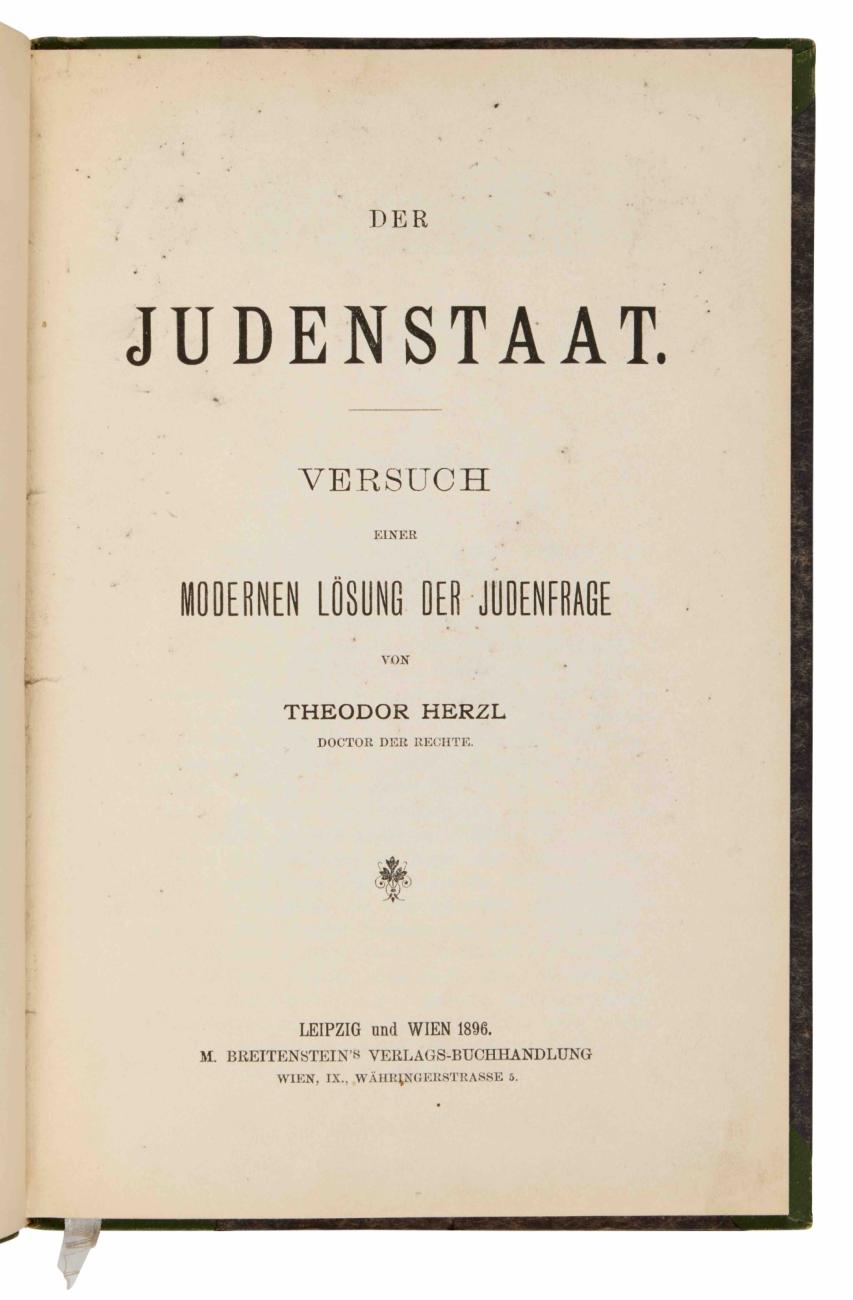
The Jewish State adopted the term ‘antisemitism’
As we saw above, the doyen of the field was Bernard Lewis, and he maintained that the term ‘antisemitism’ had never been used to include Arabs/Palestinians. His view has been adopted recently by the International Holocaust Remembrance Alliance (IHRA). In 2015, the IHRA issued a ‘Memo on the Spelling of Antisemitism’, which stated: “The term has, however, since its inception referred to prejudice against Jews alone”. As is widely known, the IHRA is effectively a cut-out for Zionist foreign policy objectives, and its intervention in this matter is unsurprisingly incorrect.
I am not the first person to notice that the term ‘antisemitism’ or ‘anti-Semitism’ has gone through varying interpretations. In 1970, a Sudanese academic, Ibrahim al-Hardallo, produced a short work on the topic called Anti-Semitism: A Changing Concept. This was denounced as ‘anti-Semitic’ by Bernard Lewis as follows:
Perhaps the prize for this kind of imagination should go to the author of a monograph on anti-Semitism, published by Khartoum University Press, which asserts that anti-Semitism is a Jewish invention, and that the term, which ‘was in use a long time before Wilhelm Marr used it’ in 1879, was coined by ‘the Zionists.’ It is not clear what propaganda point is served by such stories, except perhaps the general one, common in anti-Semitic writings; not only are all Jews evil but all evil is Jewish.
As is now clear, Ibrahim al-Hardallo was quite correct. Lewis, by contrast, was incorrect. Unsurprisingly, al-Hardello’s accurate account was turned by Lewis into yet another of the Judeophobic remarks allegedly aimed at the Jews throughout history. And, of course, it’s no surprise that Lewis, the militant Zionist and Islamophobe, was keen to criticise and defame a Muslim writer.
The misinterpretation of Renan is so wide-ranging that even the Palestinian intellectual Edward Said appears to have been misled. In his famous 1979 essay ‘Zionism from the Standpoint of Its Victims’, which has 587 citations, he wrote: “The French writer Ernest Renan, for instance, was an outright anti-Semite”. This appears in a discussion of European colonialism and the victimisation of Jews by Christian Europe.
The Systematic Distortion in Academic Commentary
As we saw above, Bernard Lewis simply omits Steinschneider from his narrative, all the better to insist that ‘antisemitism’ has always been just about the Jews. Many others have followed in his footsteps. I note the number of citations attributed to each publication by Google Scholar as a rough guide to how influential they have been in the academy.
Settler colonist, biographer of Herzl and director of the Central Zionist Archives, Alex Bein was the author of The Jewish Parasite: Notes on the Semantics of the Jewish Problem, with Special Reference to Germany (1964, 71 citations) and of an extended German version the year after (178 citations). Bein cites neither Moritz Steinschneider nor Ernest Renan. He does cite Marr.
- In From Prejudice to Destruction: Anti-Semitism, 1700-1933 (1980, 679 citations), Jacob Katz analyses the secularisation of Jew hatred in Germany. He focuses extensively on Marr's 1879 movement and critiques what he describes as Renan's philological racism. Katz became a settler colonist in ‘Tel Aviv’ in the 1930s, and he was described in a New York Times obituary as “one of this century's greatest and most influential historians of the Jews” by Yosef Hayim Yerushalmi, a professor of Jewish history, culture, and society at Columbia University. Despite this, he does not cite Steinschneider at all.
- Robert Wistrich, born in the Kazakh Soviet Socialist Republic to Zionist Polish parents, became a British citizen and then later a settler in occupied Palestine. In Antisemitism: The Longest Hatred (1991, 709 citations), he treats Marr as the foundational populariser of modern political antisemitism. He uses Renan to explain the scientific scaffolding of 19th century racial theory. He declares both that Renan was “by no means” an antisemite, and that his view of contemporary Jewry was “riddled with antisemitic clichés”. He also says that the concept of antisemitism “was never at any time intended to apply to Arabs”, which, as we have noted, is false. Despite, as a New York Times obituary stated, devoting “his four decade scholarly career to dissecting anti-Semitism”, he did not cite Steinschneider, in what the obituary referred to as this “encyclopedic” work.
- Walter Laqueur was born in German Poland in 1921, and, at 17, left Germany to become a settler colonist in Palestine. Moving to London in 1955, he took a role editing a magazine called Soviet Survey, a publication of the CIA front group The Congress for Cultural Freedom. He later moved to the US and maintained close connections with Zionist/neoconservative institutes such as the Center for Strategic and International Studies. In The Changing Face of Antisemitism: From Ancient Times to the Present Day (2006, 402 citations), he follows the classic narrative. He details Marr's 1879 pamphlet ‘Der Weg zum Siege des Germanenthums über das Judenthum’ (‘The Way to Victory of Germanism over Judaism’) and the Marr-founded League of Antisemites, though it is clear that antisemitism as a term existed before Marr. He notes Renan's ‘Aryan vs. Semite’ dichotomy. He leaves Steinschneider uncited.
- David Feldman, in his American Historical Review Roundtable article ‘Toward a History of the Term “Anti-Semitism”', (2018, 52 citations), deliberately works to expand the traditional narrative. He tracks the explicit genealogy of the word, citing Marr's 1879 work, to outline how the word shifted over time. He fails to even mention Renan and, unsurprisingly, therefore, also Steinschneider. It’s as if none of it ever happened. Though he opposes eternalism, he remains a devotee of the settler colony, being one of the core authors of the Jerusalem Declaration, the liberal Zionist attempted panacea for the IHRA definition. Feldman claims it is ‘sophistry’ to say, as I have, that student groups bound by the constitution of their organisation to be Zionist are, in fact, Zionist. Of course, the real sophistry is to pretend that actual Zionist groups are not Zionist and thus that the reason for criticism of them is just that they are innocent ‘Jewish’ groups.
- James Renton and Ben Gidley (Eds.) Antisemitism and Islamophobia in Europe: A Shared Story? (2017, 123 citations). Gidley has collaborated with David Feldman on numerous publications. He is also a part-time Zionist “internet troll”, as the Grayzone put it, operating an anonymous X account under the pseudonym ‘Bob from Brockley’. Renton is a professor of history who “spent the final year” of his doctoral studies at the Hebrew University of Jerusalem. He was later a Hanadiv postdoctoral fellow at UCL. Hanadiv is one of the foundations run and funded by the Rothschild family. In Chapter 4, Renton isolates Renan's role in constructing the ‘Semite’ as a distinct racial-imperial category. To be fair to Renton, he does attempt to give a more nuanced account of Renan than have some others. Overall, though, in both Renton’s chapter and the rest of the book, Steinschneider is not cited at all.
Overall, there is a marked pattern in the works discussed (and in a wide range of others that there is no space to discuss), which is that many of them misinterpret Renan imagining, along with Steinschneider, that he was a Judeophobe. At the same time, almost all of them simply ignore that Steinschneider used the term 'antisemitic’ nearly 20 years before Marr. There is an almost universal failure to acknowledge Renan’s vicious Islamophobia as well as his Judeophilia. As a result, the travesty that is the views of Bernard Lewis (and his successors) has been allowed to stand virtually unmolested in academic debate.
Conclusions
Ashkenazi Jews are not Semites. They cannot, therefore, properly be the victims of ‘antisemitism’, But, of course, the use of the term to refer to the Jews, and the Jews alone, was always a racist trick to conjure the Jews as a race or ethnicity. The trick was beloved of racists including, obviously, followers of the Nazi Party in Germany. Naturally enough, key Zionists were also happy to buy in to the term, since it enabled them to bolster the incorrect idea that they had some historical, genealogical, biological or ‘racial’ connection to Palestine. They don’t. There is, in other words, a deeper sense to Herzl’s famous proclamation that “The anti-Semites will become our most dependable friends, the anti-Semitic countries our allies”. It was not just about the need to encourage reluctant Jews to seize Palestine and carry out the Nakba, or to influence colonial powers to turn a blind eye to it. It was also about bolstering the case for the Nakba, since it made it seem that the Jews were actually Semitic, and therefore had some kind of claim to the land. It was a racist view then, and it is now.
Is there such as thing as Judeophobia? Yes. The Odessa based early Zionist Leon Pinsker was correct in his preference for this term, set out in his 1882 classic work Auto-Emancipation. Pinsker was wrong, however, to read this back into history forever — to see it as an eternal phenomenon.
But a dislike, a critique, a hatred of Judaism or even of Jews, while it may amount to a form of prejudice, is not necessarily a matter of racism. For prejudice to be racism, the Jews would need to be conceived as a ‘race’ and then those conceptions would need to be turned into material racialising processes which have the effect of institutionalising Judeophobia. This arguably happened under Nazi rule in Germany. But, it can’t be read back into all history before 1933 to bolster a so-called ‘eternalist’ case on the ‘longest hatred’. There was no ‘racism’ before ‘race’ was invented. Though I am critical of many of the articles in the 2018 American Historical Review Roundtable: Rethinking Anti-Semitism, it is clear that most of them — even including Zionists like David Feldman — are sceptical about the ‘eternalist’ case, which is a good thing. In his introductory overview speaking for all contributors to the Roundtable, Jonathan Judaken, states: “In short, we argue against exceptionalism, eternalism, teleology, apologetics, and theoretical naïveté in how scholars approach anti-Semitism”.
Semites as a race (or a group of races) don’t exist either. To the extent that it refers to ‘peoplehood’ or ‘race’, it is a nonsense concept dreamt up by Islamophobes like Ernest Renan (and the Göttingen School, before him) which was useful in bolstering the power and prestige of the white ‘race’ (and of the economic and geopolitical power which imperial projects were attempting to wield). A language family is not the same as a race. Races don’t exist. Palestinians don’t need to be Semites to be indigenous to the Levant. They already are.
In other words, ‘antisemitism’ does not exist. Do we need some other words or terms to understand the place of the Jews in the modern world? Certainly. But they will need to improve — a lot — on the term ‘antisemitism’.
Cover image: Bernard Lewis, former British intelligence officer, fanatical Zionist, and Islamophobe, with Benjamin Netanyahu and Henry Kissinger