

The real story of the questions swirling around the recent earthquakes in Venezuela began half a century ago — in Switzerland.
In May 1977, the United Nations opened for signature the Environmental Modification Convention (ENMOD) in Geneva. It came about as a result of United States Senate pressure after hearings confirmed that the Pentagon had used weather weapons in the Vietnam War between 1955 and 1975.
The treaty prohibits the military use of environmental manipulation with ‘widespread, long-lasting or severe effects’, including weapons capable of triggering earthquakes.
The US signed and ratified this treaty, and since treaties are not written against imaginary capabilities, it is fair to ask whether Washington considered such a capability sufficiently plausible to warrant prohibition as early as half a century ago.
Operation PopeyeBetween 1967 and 1972, the US Air Force and Navy flew more than 2,600 cloud-seeding missions over the Ho Chi Minh Trail during the Vietnam War in a classified programme called Operation Popeye. The goal was to extend the monsoon season over enemy supply routes and turn the jungle dirt roads into seas of mud.
Columnist Jack Anderson first reported on it in 1971; The New York Times followed in 1972; the Pentagon stonewalled.
Only in 1974, under pressure from Senate hearings led by Democrat Claiborne Pell, did the US Government finally give in and confirm it had spent five years using the weather as a weapon.
Popeye was an escalation of the 1962-1971 environmental warfare begun with Operation Ranch Hand, in which the chemical Agent Orange was used in herbicidal warfare in Vietnam, Laos, and Cambodia, creating widespread defoliation and crop destruction. Although its environmental impact was devastating, it legally falls under the law on chemical warfare.
Earthquake weaponsAlmost a quarter of a century later, on 28 April 1997, US Defence Secretary William Cohen lent credence to the idea of tectonic weapons, accusing others during a conference Q&A of pursuing "an eco-type of terrorism whereby they can alter the climate, set off earthquakes, volcanoes, remotely through the use of electromagnetic waves".
Cohen not only raised the spectre of tectonic weapons, but also implied how they work — through the use of electromagnetic waves.
Where did he get that from?
A year before Cohen's remarks, a Pentagon document offered insight into the broader context of US military thinking about the future of warfare.
‘Owning the Weather in 2025’ is a 1996 US Air Force strategic study from the Air University, which explores how advances in atmospheric science and emerging technologies may one day allow the weather to be deliberately modified for military purposes.
HAARP and VenezuelaWithin days of 24 June 2026 when earthquakes devastated Venezuela’s capital region, posts on Facebook and X alleged that “Venezuela got HAARPED. Those 'earthquakes' were engineered". NewsGuard tracked HAARP mentions surging from 16,200 to 134,000 in a week.
HAARP is shorthand for the High-frequency Active Auroral Research Program, based in Gakona, Alaska. It was built in the 1990s by the US Air Force and Navy and has been operated since 2015 by the University of Alaska Fairbanks. Its array of 180 antennas transmits high-frequency radio waves, officially to study the ionosphere and ‘space weather’ to improve radio communications.
Suspicion has dogged the project from the very start and traces back to physicist Bernard Eastlund, whose 1980s patents — which proposed using heating of the ionosphere as a step toward missile defence, weather modification, and geophysical mapping — have been widely described as the technology that inspired the HAARP research facility.
It was not until 1995, when Nick Begich, an Alaskan alternative medicine practitioner, self-published his book Angels Don't Play This HAARP, that the idea of a classified US military weapons programme for weather manipulation, creating earthquakes and mind-controlling entire populations, found traction with the general public.
InfowarThe mistake made on social media and by independent news outlets — if ‘mistake’ is still the right word — was to use the acronym HAARP when raising legitimate questions about the anomalous twin earthquakes that struck Venezuela early in the evening of 24 June. More than 4,300 people were killed, with officials saying as many as 80% of buildings in La Guaira state collapsed.
Normally, earthquakes come one at a time, with some possible foreshocks and aftershocks of lesser magnitude. The ‘doublet’ earthquakes seen in Caracas — two mainshocks of comparable size in quick succession — are a rare phenomenon.
The first quake of the pair had a magnitude of 7.2, while the second was nearly three times more powerful, measuring 7.5. The first shock weakened buildings across the region; the second, striking before the ground had stilled, brought most of them down. Universally, the largest aftershock is typically about 1.2 magnitude units smaller than the mainshock.
The central argument of the debunkers — apparently determined to stop the very idea of tectonic weapons from taking hold — was one of physics: no known technology, seismologists insist, can deliberately set off a large tectonic earthquake. HAARP in particular is said to be the wrong tool entirely: its radio waves interact only with the ionosphere, some 60–80 km up, whereas earthquakes originate deep in the Earth's crust, and the stress loading from electromagnetic waves is orders of magnitude too small to rupture a fault. The US National Oceanic and Atmospheric Administration (NOAA) has described the facility as "basically a large radio transmitter", incapable of influencing anything at the surface.
The strategic conundrumThat militaries keep secrets should surprise no one. But for most weapons systems, the secret is the technical specification — the weapon is known to exist; only its blueprints are withheld.
But what of weather or tectonic weapons deployed in supposed peacetime and striking a far more sinister blow of strategic proportions against an enemy society under cover of absolute deniability?
If the public understood that tectonic weapons do exist — in the way it knows nuclear bombs exist — would a weather or tectonic campaign against another country even be feasible?
A nuclear detonation cannot masquerade as an act of God. An earthquake must because the moment the public knows tectonic weapons exist, every disaster becomes suspect, every tremor a potential act of war.
Act-of-God warfare would then not only fail — it would risk unleashing total war.
HAARP revisited
When debunkers invoke HAARP to dismiss the possibility of US tectonic weapons, they focus on whether the Alaska facility's high-frequency (HF) radio transmissions contain sufficient energy to trigger an earthquake directly. By doing this, they avoid engaging with the broader picture concerning ionospheric ELF generation, nonlinear fault dynamics, weak triggering and synchronisation phenomena.
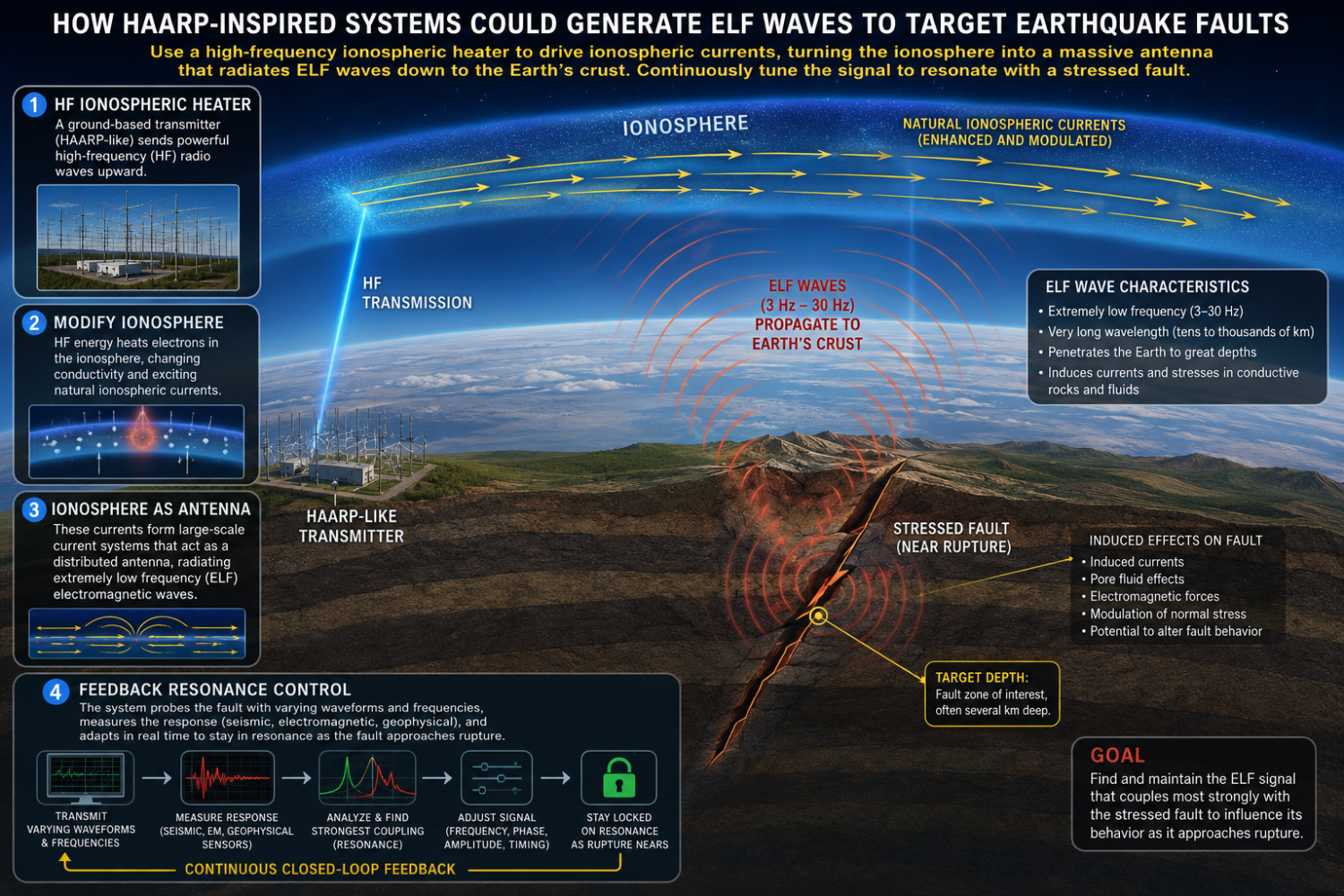
Imagine a system in which a high-frequency ionospheric heater on the ground, such as HAARP, manipulates naturally occurring ionospheric currents in the upper atmosphere to generate extremely low frequency (ELF) electromagnetic waves — thereby using the ionosphere as a large distributed transmitting antenna — which then reach the Earth's crust.
In the earthquake scenario, ELF signals would be aimed at a fault believed to be under high stress. The transmitter would sweep through varying waveforms, probing how the fault responds and hunting for the frequencies and timing that couple most strongly with it. If such a resonance were found, a feedback system would continuously adjust the signal to stay locked in step with the fault as it approached the point of rupture.
This is the basic idea described in Bernard Eastlund's 1985 ionospheric-heating patent and subsequent patents on ionospheric generation of ELF signals, although they stopped short of claiming the ability to trigger earthquakes and settled for using ELF waves for geophysical exploration.
The objective would not be to supply the enormous energy required to release an earthquake, but to influence the timing of rupture in a fault already close to failure — similar to how soldiers marching in lockstep over bridges have collapsed them.
Every concept underlying this sequence is found in the open scientific literature: ionospheric generation of ELF signals, critical-state fault dynamics, laboratory demonstrations of synchronisation in stick-slip systems, and adaptive control of nonlinear systems.
Has the Pentagon, behind closed doors, explored this concept much further and actually built a tectonic weapon? This is a legitimate question that deserves public scrutiny — not to be hyped, dismissed, or ridiculed.
Kristoffer Hell holds a PG degree in Strategic Studies from a British university and is published in English and Swedish.

Kristoffer Hell
Kristoffer Hell is an independent writer and journalist covering high politics and how technology shapes human experience. He holds an MLitt in Strategic Studies from the University of Aberdeen and a Diploma in News Journalism from the London School of Journalism. He previously worked as a software developer, contracting in banking, pharmaceuticals, and retail.