For generations, the autumn olive harvest has defined life, culture, and survival across south Lebanon’s hillsides. Today, beneath the shadow of Israeli attacks, gathering this ancestral fruit has become a deadly act of resilience.
In October, as the cool breeze begins to clear the oppressive heat of summer, a quiet transformation touches the craggy hillsides south of the Litani River. From the terraced slopes of Bint Jbeil and Yater, to the border villages of Kfar Shuba, Blida, and Froun, the landscape shifts. The start of autumn signals the start of the annual olive harvest, an event that forms the economic and cultural heartbeat of south Lebanon. Generations of Lebanese families gather under ancient canopies, spreading out coarse tarps over the dry ground as hands, dark with oil, gather the bitter fruit. The yield of these groves will sustain entire households, cover children’s school fees, and fill heavy glass jars with fresh oil that will last through the harsh winter months.
Across southern Lebanon, the olive tree represents far more than an agricultural staple; the olive tree stands as an enduring monument to permanence and survival. Many of the thick, twisted tree trunks anchored in the south’s limestone soil were planted centuries ago by ancestors who navigated Ottoman taxation, French occupation and administrative decrees, and Israeli invasion. To tend an olive grove along the southern frontier is to maintain an unbroken historical covenant, and a quiet assertion that regardless of who controls the skies above, the land will always belong to those who nurture it from below.
For decades, this essential season has been targeted directly by the Israeli military. Because the olive tree embodies continuity and deep roots, Israeli forces have long sought to sever the connection between southern villagers and their native terrain. During the 18 years of military occupation leading up to the south’s liberation in 2000, reaching ancestral groves near the border meant braving army checkpoints, sniper fire, and razor-wire blockades. In the subsequent years after 7 October, the deliberate Israeli targeting of the landscape has continued uninterrupted. Whenever Israeli forces launch attacks across the border, the objective remains unyielding: turn the harvest into a killing field.
The physical scale of this destruction has reached catastrophic levels. The Israeli military's widespread deployment of incendiary rounds and white phosphorus shelling across agricultural areas in the south has burned entire harvests and poisoned the surrounding soil. White phosphorus ignites upon contact with air, consuming dense foliage, burning centuries-old tree trunks into hollow columns of ash, and seeping heavy metals into the earth. Thousands of dunams of productive, ancient trees, and groves that endured through generations of historical turmoil, have been reduced to grey ash in minutes, wiping out the primary livelihood of entire villages.
Venturing into the fields to gather olives today means facing direct deadly force.
Farmers step onto their land fully aware that a routine day of labour carries the constant danger of Israeli artillery shells, armed surveillance drones, and unexploded munitions hidden beneath the fallen leaves. The human cost was tragically underscored this October.
In the Bint Jbeil district, as the olives ripened from green to dark purple, families returned to their family plots. On 12 October, Israel killed Ali Abdel Hassan Sweidan (Abu al-Abed), a retired First Warrant Officer in the Lebanese Army, after shelling him with artillery while he was inspecting his land during the olive harvest in the Roumieh area of the town of Yater, south Lebanon.

On the very same day in nearby Froun, an engineer who had travelled down from Beirut to assist his family with the seasonal harvest, Hassan Ali Ramadan, was killed when an unexploded ordnance dropped from a previous Israeli strike detonated in the field.
These deaths are part of a systematic campaign meant to enforce an uninhabitable strip along the border and empty the region of its native inhabitants. Further east, in the border terrain surrounding Kfar Shuba, Israeli forces confronted local farmers attempting to access fields in Azrael and Bastara, forcing them off their inherited plots under threat of direct fire when they refused to accept imposed restrictions. When a farmer is killed holding a hand rake or with olive oil on his sleeves, the message delivered to the surrounding villages is plain: your presence on your land is forbidden, and remaining on your ancestral soil carries a death sentence.
The destruction of the harvest causes damage that extends far beyond immediate grief. A single mature olive tree requires decades of continuous care before it yields a reliable crop. When a grove is incinerated or blocked off, a family loses both immediate seasonal earnings and a long-term capital investment passed down through generations. Furthermore, the toxic chemical residues left in the earth by Israeli incendiary weapons prevent replanting for years, ruin the soil, and threaten vital groundwater sources.
Depriving rural regions of their agricultural yields drives economic ruin, turning self-reliant farming families into forcibly displaced refugees that are made to abandon what has long kept food on their tables and their children in school. Yet, despite the constant threat of fire and steel, the villagers of the South return to their trees every autumn. The impulse to harvest is a basic economic necessity and an unyielding duty to the land itself.
Leaving the branches laden with unpicked fruit would mean surrendering the hillsides to a brutal occupier that seeks to forcibly depopulate them. Even as Israeli drones hum in the sky and artillery shells echo through the valleys, farmers spread their tarps, climb their wooden ladders, and comb the branches. Every jar of oil pressed in southern Lebanon carries the taste of that endurance, both bitter and rich, tied to a soil that endures, just as its people.
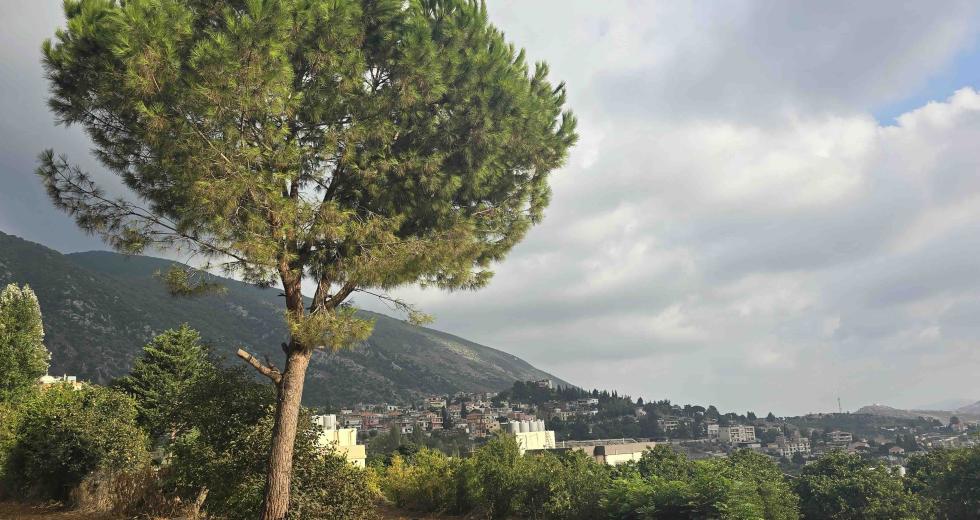
Cover image: Arab Salim, southern Lebanon. Source: Roqayah Chamseddine