
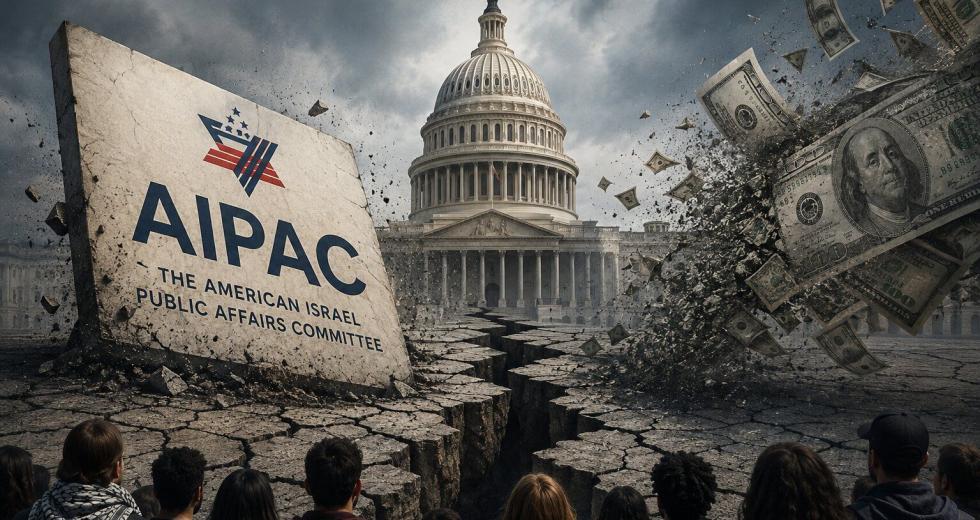
From having enjoyed a bipartisan monopoly in US politics for decades, the American Israel Public Affairs Committee (AIPAC) has begun to lose the aura that once distinguished it from other Washington power brokers, even as it remains an influential one.
The shift could prove tectonic.
The question facing future candidates in US elections is no longer: Must I make friends with AIPAC, or it will make sure my opponents win?
It is becoming: Do I dare take AIPAC money, or will that damage my political profile in the public's eye?
AIPAC may have more money at its disposal than ever, yet it appears to buy less and less of what made the organisation so formidable in the first place: fear.
The Guardian recently summarised the changing perception in Washington: “AIPAC has rapidly become the most toxic brand on Capitol Hill”.
Michigan
On 5 August, in the State of Michigan, Abdul El-Sayed — a Muslim physician who was born and raised in Michigan to Egyptian immigrant parents — defeated fellow Democrat Haley Stevens for an open US Senate seat. Stevens is a three-term congresswoman from Rochester Hills, Michigan, and a former Obama Administration official who has been a prominent supporter of Israel.
The pro-Israel camp poured more than $30 million into the race, hoping to decide who would face Republican Mike Rogers on 3 November for the Senate seat being vacated by retiring Democrat Gary Peters.
El-Sayed won, and quipped: “That is the pro quo that comes with the quid of $30 million spent by AIPAC”.
The outcome demonstrated that a politician can survive an enormous financial assault from AIPAC, openly challenge the deeply embedded conventional Democratic position on Israel, and still emerge victoriously.
Coincidentally, $30 million was the amount South Korea allocated to humanitarian assistance in Gaza in 2025. According to UNICEF, this funding helped provide food assistance to approximately 500,000 severely food-insecure people, healthcare to 150,000 displaced people, and improved access to water and sanitation for another 200,000 people.
For roughly $28 million, NASA's successful ST-5 mission sent three spacecraft into orbit in 2006, testing new technologies in the harsh environment of Earth's magnetosphere.
California
In the US, a super PAC can raise and use unlimited money, unlike standard political action committees (PACs). On 21 August, AIPAC's super PAC, United Democracy Project, spent roughly $2.5 million in the final two weeks of a campaign, trying to defeat Aisha Wahab, a State of California senator and an Afghan-American Muslim, in a special election run-off for a northern California House of Representatives seat. United Democracy Project lost. Wahab had been on track for a double-digit win before the AIPAC money arrived.
In the days that followed, Republican Senate nominee Mike Rogers' team reportedly asked AIPAC not to run an already-produced advertisement on his behalf. The day after Rogers spoke with AIPAC chair Michael Tuchin, AIPAC duly shelved a video ad targeting El-Sayed.
AIPAC, it seems, is no longer automatically perceived as an asset and a source of protection, but a potential liability that needs to be managed.
A Generational Shift
Behind these electoral contests lies a larger transformation in American public opinion: a ground shift to which the Democratic Party appears far more attuned than the Republican Party.
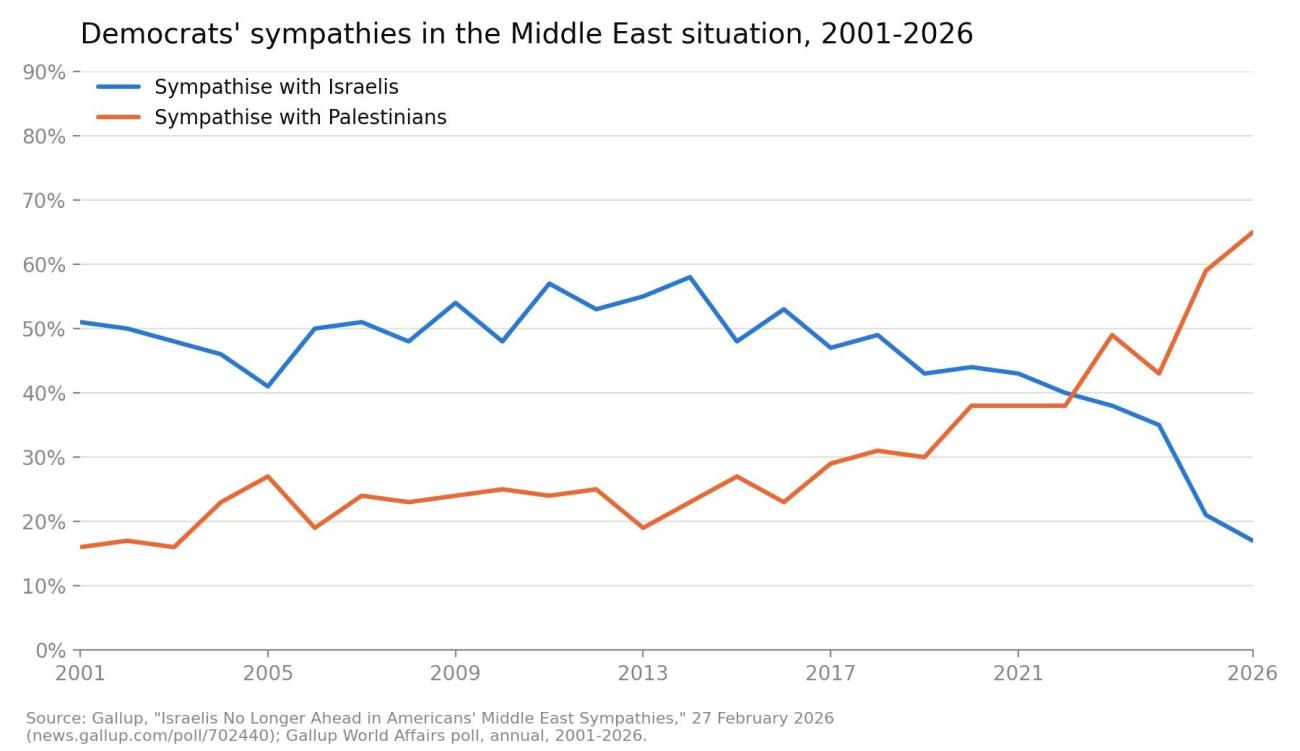
According to Pew Research Center, only 32 per cent of Americans under 30 view Israelis favourably, compared with 58 per cent who view Palestinians favourably. Among young Democrats, the gap is wider still: 26 per cent versus 72 per cent.
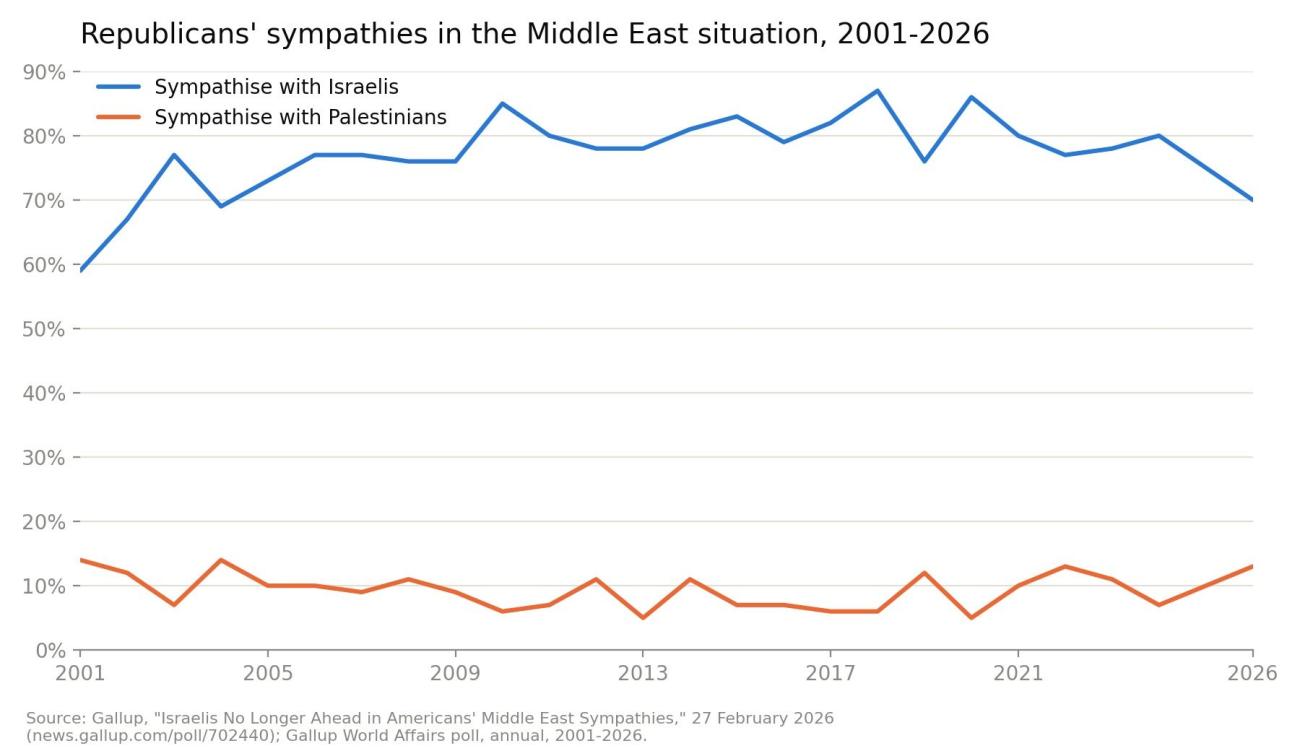
Spending money to defeat an opposing candidate is one thing. Burning resources in an attempt to freeze and reverse a generational shift is quite another.
The political environment in which AIPAC rose to become the undisputed doyen of lobbying organisations depended on Israel being broadly accepted as a bipartisan cause – a cause that had long benefitted from the historical weight of the Holocaust.
That bipartisan consensus has fractured, particularly within the Democratic coalition, and the timing points to a link with the horrendous Hamas terrorist attack inside Israel against civilians on 7 October 2023, and the way Israel — under the stewardship of Prime Minister Benjamin Netanyahu — has since managed the aftermath, squandering much of the goodwill Israel received in the attack's immediate wake.
The Disappearing AIPAC Label
The Washington Post and The American Prospect have documented a network of newly formed super PACs tied to AIPAC that carry generic or unrelated names, letting money enter races without the AIPAC label attached.
The Brennan Center for Justice at New York University’s School of Law found the mechanics at work in Illinois. AIPAC funnelled over $5 million through anodyne-sounding groups shortly before primaries, running adverts on immigration and affordability rather than Israel, and timing donations so that disclosure was not required until after votes were cast. Michigan saw the same playbook; a group called the Center for Democratic Priorities, incorporated in Delaware with no track record in the state, spent $5 million boosting Stevens weeks before the primary. The Intercept and The Nation reported that AIPAC-tied groups now operate alongside crypto and AI super PACs, and have been part of a broader network of groups spending heavily against progressive candidates this cycle.
Inside the Tribe
Having lost its bipartisan monopoly, AIPAC is today just one voice in the American Jewish landscape.
A March 2026 Jewish Electorate Institute poll found AIPAC's favourability among Jewish voters themselves at just 39 per cent, which is ahead of the centrist Democratic Majority for Israel (32 per cent) and J Street (18 per cent), but far short of the commanding, unifying position the group projects publicly.
Netanyahu fares worse still: a July 2026 AP–NORC poll put his favourability among American Jews at 32 per cent, with 59 per cent viewing him unfavourably. These figures echo the wider souring among Americans aged 18 to 34.
The same poll found Jewish voters rating New York mayor Zohran Mamdani, a Muslim with no ties to Israel's current government, more favourably than the Israeli prime minister.
The starkest split runs along denominational lines.
Polling by AP–NORC and others consistently finds Orthodox Jews — roughly a tenth of the US Jewish population — approving of Netanyahu by wide margins (as high as 83 per cent in some surveys) and holding the most hawkish views on Gaza policy. Reform Jews (the largest denomination, around 40 per cent of US Jews), Conservative Jews, and the growing share of Jews who claim no denomination lean sharply toward a more critical, disapproving view of Netanyahu's leadership. Secular and non-affiliated Jews are more critical still.
When reflecting on the future of AIPAC, it might be useful to see it as a triad:
- The old AIPAC: the bipartisan Washington institution whose central proposition was that support for Israel was part of the American political mainstream. That version of AIPAC is apparently weakening.
- The electoral AIPAC: the super PAC operation capable of deploying millions of dollars into a primary. This version remains extremely powerful, and may be financially stronger than ever.
- The institutional AIPAC: the network of congressional relationships, donors, policy advocates, staff connections, and organisations built up over decades. That infrastructure does not disappear because a handful of progressive candidates win primaries.
Perhaps the third or second AIPAC will outlive the first one.
When the Rubber Meets the Road
Three tests will show whether Michigan and California were turning points or one-offs.
- The 3 November 2026 general election: El-Sayed faces Republican nominee Mike Rogers. A win for AIPAC here lets it argue that Michigan and California did not signal a tectonic shift in US politics.
- A suite of dormant campaign finance reform bills. So far, none of these bills have had a realistic path to a vote in a Republican-controlled Congress. AIPAC has now offered itself up as a face and a number.
- The DISCLOSE Act, which would require PAC donor disclosure for political advertisements
- The Abolish Super PACs Act by Rep. Summer Lee and Sen. Bernie Sanders, with AIPAC directly targeted
- The Campaign Transparency Act and the Stop the Super PAC-Candidate Coordination Act
- Legislation designed to stop “pop-up” super PACs
- The 2028 presidential election: can a Democratic nominee reject the old AIPAC consensus and have it help rather than hurt? If so, one of the most enduring assumptions in American foreign policy politics could be broken for good.
Will AIPAC become the trigger that allows for an overhaul of how political campaigns are financed in the US, and will the El-Sayed and Wahab wins prove prophetic, signalling a tectonic shift in US policy towards Israel? For now, AIPAC has certainly become the poster child for money in politics: a monolithic, well-heeled villain with a scoreboard.

Kristoffer Hell
Kristoffer Hell is an independent writer and journalist covering high politics and how technology shapes human experience. He holds an MLitt in Strategic Studies from the University of Aberdeen and a Diploma in News Journalism from the London School of Journalism. He previously worked as a software developer, contracting in banking, pharmaceuticals, and retail.