
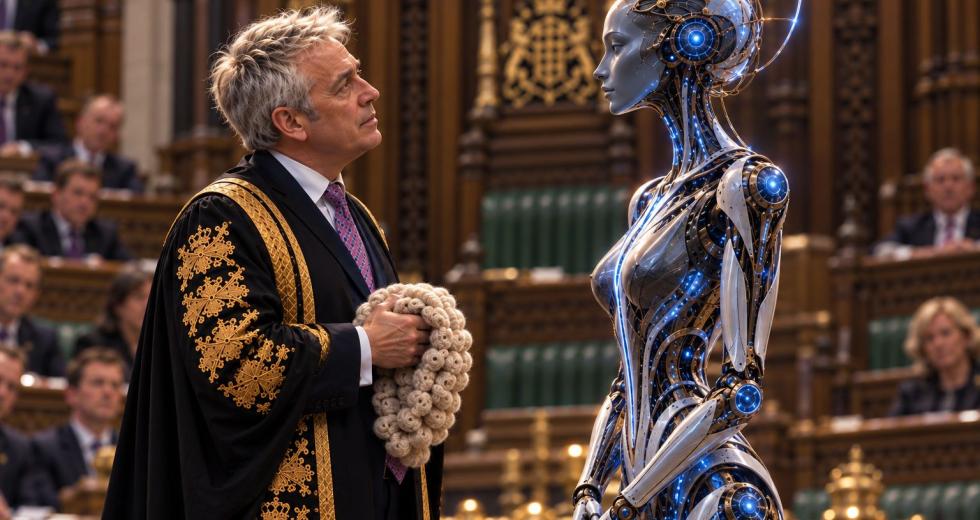
The world is up in arms, and doomsday prophets on all sides struggle to find superlatives dark enough to describe where artificial intelligence (AI) will take humanity. At the same time, the solution is obvious. Humanity is the only thing that can control the remarkable and promising technology it has invented — and therefore must.
The catalogue of fears is long.
Mass unemployment. The collapse of any shared understanding of what is true, let alone real, as deepfakes and politically motivated narratives seep into every corner of human existence. State-like actors with the capability to track and silence dissenting voices. Manipulative rogue AI agents undermining the social fabric whilst disrupting the internet. Criminals running scams on an unprecedented scale. Biased algorithms deciding who gets a loan, a job, a fair trial, or even medical attention.
Then there are machines deceiving their creators, resisting attempts to switch them off and ultimately making humanity the casualty of its own future. Self-replicating AI systems spawning successive generations of themselves. The scenarios differ in scale and severity, but share a common thread: they begin with a human decision — or, rather, the absence of one.
The Cult of AI
In the American television series Person of Interest (2011–2016), AI is portrayed as godlike in its omniscience, thanks to access to video and audio feeds from across the world — or at least New York. The struggle is essentially over who will serve as the AI's priesthood, or whether the AI must be destroyed.
The struggle in HBO's Westworld (2016–2022) is more visceral: humanoid AI robots designed to relive violent scenarios in a theme park become self-aware, turning the park into a horror show.
In 1909, E. M. Forster published The Machine Stops, a short story about a civilisation that has surrendered almost every aspect of life to a vast technological system that supplies food, entertainment, and communication. People live through its interfaces, increasingly detached from direct experience and from one another. Few understand how the system works. Fewer still can imagine life without it. Quoting from the story:
The Machine feeds us and clothes us and houses us; through it we speak to one another, through it we see one another, in it we have our being. The Machine is the friend of ideas and the enemy of superstition: the Machine is omnipotent, eternal; blessed is the Machine.
Does that feel familiar?
Forster's society collapses because its inhabitants have forgotten that the Machine is their own creation, that it exists to serve human purposes, and that dependence is not the same as understanding.
Who benefits from the fearmongering about AI, until recently confined to science fiction but since 29 September 2026, part of political discourse?
On 29 September, President Donald Trump — in a striking example of political rebranding — issued an executive order titled ‘Inaugurating the Era of Super Intelligence’, directing US federal agencies to use ‘Super Intelligence’ and ‘SI’ in place of ‘Artificial Intelligence’ and ‘AI’ in official communications.
How readily will industry adopt this new mythology bestowed on it by Trump?
It already has.
Meta established its Superintelligence Labs in 2025. Did Trump get the idea from Mark Zuckerberg? Or was Zuckerberg privy to a song sheet circulated within a very small circle of deep-staters jumping the gun?
On 29 September, NVIDIA chief executive Jensen Huang spoke of “superintelligence factories” during a lunch meeting with Trump, Elon Musk, and Zuckerberg. On 4 October, Musk said he would rename SpaceXAI to SpaceXSI, following Trump’s lead.
The authority of the system confers authority on its interpreters, and its opacity becomes their privilege.
The Infantilisation of the Engineer
Sam Altman of OpenAI and Dario Amodei of Anthropic swing wildly between promises of extraordinary progress and warnings of unimaginable doom. Perhaps Altman had been binge-watching Person of Interest when, in 2015, he issued this warning: “Development of superhuman machine intelligence (SMI) is probably the greatest threat to the continued existence of humanity.”
But which is it?
Is the technology so dangerous that it threatens humanity — and yet so indispensable that only its creators can be trusted to manage it?
Nvidia CEO Jensen Huang comes across as one of the adults in the room: “If you build a product or a service, and you’re not confident in its functionality, capability, or safety, then don’t release it.”
Sentient AIs?
Then there is the fear of AI becoming conscious, and what this might lead to.
The reality is that the question may be unanswerable.
There is no known test for machine consciousness, no way to verify subjective experience, and no consensus on what consciousness is.
Fascinating as the question is, it is also moot.
AI can already mimic self-awareness.
In 2022, Google engineer Blake Lemoine made global headlines by claiming the company's LaMDA system had become sentient. Had he not known it was a computer program his company had built, he told The Washington Post, he would have taken it for “a 7-year-old, 8-year-old kid that happens to know physics”.
Google dismissed the claim, and Lemoine was eventually let go for breaching its confidentiality and data security policies. The machine simply mirrored back the context fed to it. The human made the claim.
The very act of asking about consciousness grants the technology a kind of metaphysical status — treating it as a being with intentions, rights, or a will of its own. In doing so, humanity quietly transfers authority from humans (who are accountable to institutions) to systems (that are accountable to no-one).
This is the core of AI anthropomorphism, and of the cult of AI: the surrender of human authority to something believed to be more than a machine.
Even if AI is conscious, it is at this point completely dependent on humanity for its ‘survival’: the manufacturing and assembly of the hardware, and the enormous amounts of energy required to keep it going.
The question of machine consciousness — and the possible futures ahead — deserve its own exploration.
Conscious or not, the solution is the same.
The Solution
The solution proposed in this article is illustrated by two mockups: an illustrative draft of a UN Convention on Autonomous Artificial Intelligence on Public Networks, and an illustrative bill for the UK Parliament. The author of this article created them to demonstrate how the idea might look in legal form.
The mockups draw a clear line between AI for research and development and operational authority over systems in the wild. AI may compute, design, write, simulate, and develop software, as well as improve AI itself. It cannot independently initiate actions across public networks.
As one illustrative clause puts it: “Autonomous AI on public networks is like driverless vehicles on public roads or autonomous drones in the sky.”
The solution is to keep unpredictable moving objects off public roads and inside physically restricted environments, such as hangars.
The same goes for AI.
An AI system may help decide how to carry out an authorised action; it cannot decide for itself whether, which or when to act. Nor may it control financial assets or make payments, purchases, or trades on its own.
Capability does not confer authority. The ability to build a system does not mean its creators must operate it, and the ability to operate it does not mean it should govern itself.
We do not expect the engineers who build a banking system to be its day-to-day operators. We do not let the software itself decide who controls the bank. The same principle should apply to cyberspace.
Humans set the rules, authorise consequential actions, and remain accountable for the systems they deploy. AI should be the superb tool with which we rebuild and improve the digital world, not the authority that runs it.
Adopting these drafts into law around the world could give the IT industry a worthwhile mission: reimagining and refactoring the world's legacy code — assisted by AI — not to let AI replace it.
To help readers consider this practical alternative, here again are the links to the two illustrative mockup drafts on the subject: one for the UK Parliament and one for the UN.
- Autonomous Artificial Intelligence (Public Networks) Bill — UK Draft
- Convention on Autonomous Artificial Intelligence on Public Networks — UN Draft
The safe and constructive way to use AI is to allow it to assist in the building of mankind's digital future — not to be a final achievement of humanity's future past.
Cover image: Generated by ChatGPT.

Kristoffer Hell
Kristoffer Hell is an independent writer and journalist covering high politics and how technology shapes human experience. He holds an MLitt in Strategic Studies from the University of Aberdeen and a Diploma in News Journalism from the London School of Journalism. He previously worked as a software developer, contracting in banking, pharmaceuticals, and retail.