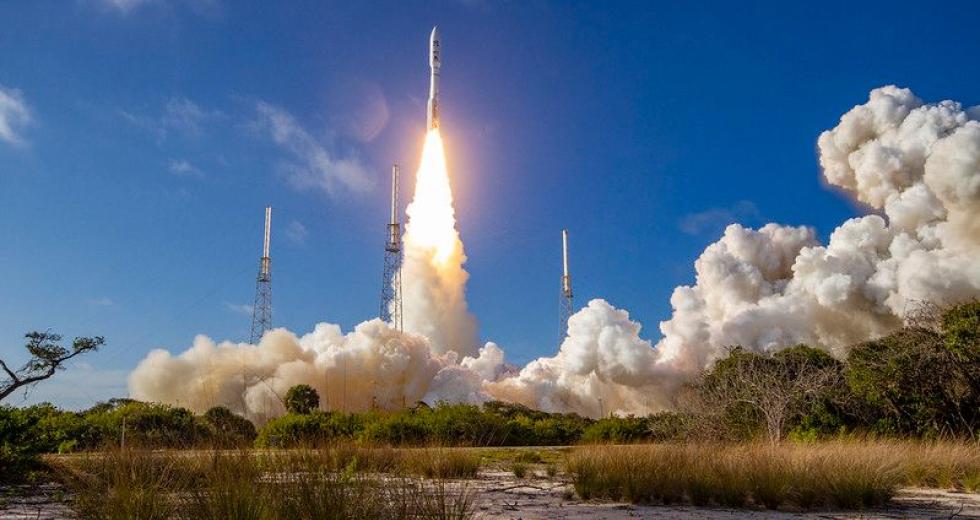
Did you hear the one about the Outer Space Treaty, King Charles III, and the Virtual Network Operator (VNO)? If connections between these things have not registered on your radar, the chances are that you are not the only one. The point of intersection is low-earth orbit (LEO), which begins around 100 miles above the Earth's surface and which is home to over active 18,000 satellites. For the purpose of benchmarking, there was one satellite in space in 1957 and only around 700 by the year 2000. Orbital Radar, which tracks this activity, is also monitoring nearly 9,000 'debris fragments'.
The Outer Space Treaty 1967 makes it very clear that “The moon and other celestial bodies shall be used by all States Parties to the Treaty exclusively for peaceful purposes”, and Article IV is explicit in its prohibitions: “The establishment of military bases, installations and fortifications, the testing of any type of weapons and the conduct of military maneuvers on celestial bodies shall be forbidden”. This unambiguous language is challenged by the sentence which follows immediately: “The use of military personnel for scientific research or for any other peaceful purposes shall not be prohibited”. Clear skies are now somewhat opaque.
How better to expose the exploitation of this caveat than by hovering over southwest Oxfordshire and, in particular, the village of Harwell? Written up in the Domesday Book, it became home to an RAF airfield in 1937, the Atomic Energy Research Establishment in 1946, and Harwell Innovation Centre in 2000. Now, as Harwell Science and Innovation Campus, it is described as having “always blown the world of science wide open”. Given that the Frozen Sperm and Embryo Archive was established here in 1975 and that Moderna began work on “mRNA respiratory vaccines for the UK public” here in 2025, readers are encouraged to make their own minds up about the consequences of such a blowing open of science.
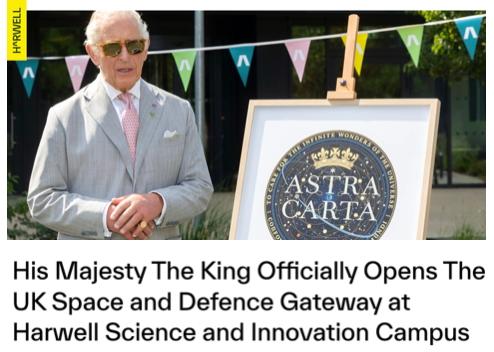
In July 2026, King Charles visited Harwell to open The UK Space and Defence Gateway. Finding that 'space' and 'defence' are both in the title of the initiative makes it look, at first glance, as though the boundaries of Article IV are being pushed. Harwell's own report from the day of the King's visit appears to reinforce the point, with the Gateway described as a “dedicated hub for the space and defence sectors, driving national and global collaboration between government, academia, innovators and industry”. Not only that, but it turns out that this is “an initiative aligned with the principles of the Sustainable Markets Initiative’s (SMI) Astra Carta”. Somehow, Astra Carta, which is “a global framework launched by His Majesty, as Prince of Wales” is compatible with 'defence' even though its remit is “to ensure the space sector supports a sustainable future”.
Harwell Campus boasts of having over 250 organisations 'on site' and £3bn worth of 'scientific infrastructure'. To what end? Of the many entities in this part of Oxfordshire, one is the European Space Agency's (ESA) European Centre for Space Applications and Telecommunications (ECSAT), which works towards “industry collaboration to advance the 5G digital transformation and prepare for the development of 6G”. In 2019, hiSky moved to Harwell in order “to make satellite communications more accessible and affordable”, according to the British Government. To help them achieve this, the UK Space Agency gave hiSky £9m but, of course, “UK Space Agency funding is allocated through the European Space Agency (ESA)”, making the presence of ECSAT rather handy. Specifically, this tranche of taxpayer money was “to help establish hiSky as a Virtual Network Operator” which is described vaguely as “a supplier of network services using existing infrastructure”. In fact, hiSky enables "secure satellite communication and control for small, long range, manned and unmanned platforms". If the language is not quite clear enough, the front page of the website holds images of military vehicles.
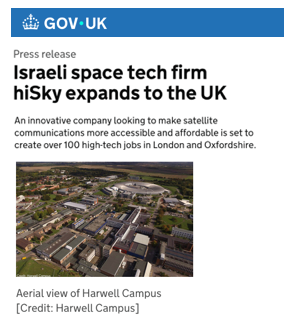
Armed with the knowledge that hiSky was given taxpayer money, that it operates a communications capability with a military application and that it sits in a hub which hosts The Space and Defence Gateway, how to treat the further information that it is an Israeli company? Benjamin Netanyahu recently reminded an audience that “you're holding a piece of Israel right there”: a reference to Israel's extraordinarily pervasive reach into all forms of communications-related technology. Remaining mindful of the necessity to avoid conflation or, indeed, to join dots with no known connection, there is an observable and well-reported pattern. In 2020, The Guardian reminded its readers that another Israeli outfit, Rayzone Group, appeared “to have had access to the global telecommunications network” through a mobile operator in Guernsey, “potentially enabling its clients at that time to track the locations of mobile phones across the world”. Those with access to the network are known to have used it “for questionable purposes, such as monitoring locations for the purpose of surveillance or even intercepting communications”.
In 2022, the BBC reported that 10 Downing Street and the Foreign, Commonwealth and Development Office (FCDO) had been "infected with spyware". The article stated that NSO Group — another Israeli organisation — "has denied the allegations" but it did confirm that the Pegasus spyware "is sold ... to governments to carry out surveillance through infecting phones with malicious software". The ‘2030 Roadmap for UK-Israel Bilateral Relations’ makes it clear that “The UK and Israel enjoy a close strategic partnership, with extensive defence and security cooperation to tackle shared threats, protect our mutual security interests and develop stronger capabilities”. It is reasonable to question what these “shared threats” may be and, indeed, to ask what exactly is meant by “mutual security interests”. Where detail is lacking, the expression of commitment is not: “For both the UK and Israel, this is one of the most important defence and security relationships, encompassing a broad range of activities”. Just how broad?
On 8 September, Ed Miliband, now Foreign Secretary in Andy Burnham's Labour Government, made a statement to the House of Commons “on Israel and Palestine”. Over the course of the 20-minute speech, he made mention of “ethnic cleansing”, “genocide”, and “war crimes”, but stopped well short of suggesting that the Government would do anything to stop it. The focus was on the West Bank and the purpose of his address was restricted to the suggestion of a “new comprehensive sanctions regime” with “appropriate religious exemptions” which will “target illegal settlements and settlement expansion”, but, crucially, “not Israel”. The contents of his statement was released prior to the session, in order that it could be responded to in a considered manner by others in the Commons. The theme of the message appears to have been telegraphed far and wide and well prior to the reading of the statement.
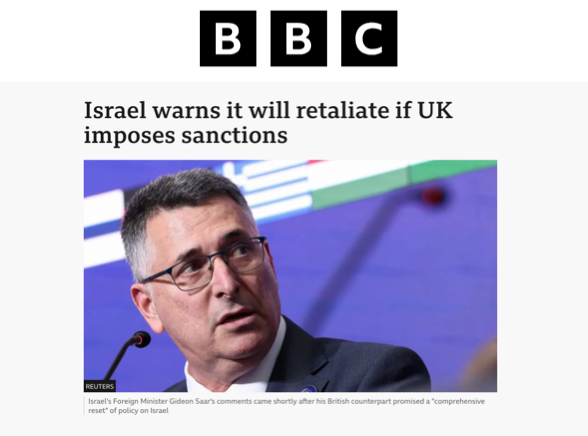
Several days earlier, during a televised interview, Gideon Sa'ar — Israel's Foreign Minister — was drawn on the suggestion of British-imposed sanctions of some kind against Israel. His response was unequivocal: “If Britain acts against Israel, Israel will act against Britain”. The BBC described Sa'ar's response as “retaliation”, which could be said to have a unique meaning to the state of Israel. In case his opener was not clear enough, Sa'ar followed up with: “If they act, I think they will be making a big mistake” and “We are preparing. I hope they do not make a mistake”.
Responses to Miliband's statement, which was very carefully prefixed with a robust establishment of his Jewish and pro-Israel credentials, have included a great deal of commotion about a supposed 'backlash' against 'British Jews'. Many of the more hysterical commentators appear to have listened to only part of what Miliband said. They may have missed his comments on the “shared national security interests we have with Israel, on which we will continue to co-operate”. He reinforced the point later by saying, “I am confident about our intelligence and security partnerships”. Then there was the bit about the supposed cancellation of the sale of F-35 parts to Israel in 2024, which is rendered meaningless by the “provision we make now ... indirectly to the global supply programme”, to which Israel has direct access.
In summary: Miliband has made no attempt to curtail the destructive activities of the state of Israel, he has doubled-down on the relationships forged in the name of ‘shared national security’, he has ripened the conditions for another round of antisemitism alarmism and, on top of all this, he has received direct and unambiguous threats from members of the Israeli Government. With this in mind, does it seem sensible to be in a strategic partnership with the state of Israel?
It is just one small step to return to the subject of space and, specifically, the way in which the United Kingdom's ‘interests’ are enmeshed with those of Israel. In the pages of the Israel Space Agency's website, we read that it “is engaged in cooperation with many space agencies, including ... UK Space Agency”. Also, “the space agency initiates events for Israeli and foreign space companies, bringing together investors, foundations, companies, and representatives of governments and agencies”. The King's opening of The Defence and Space Gateway now assumes a greater significance, especially since “Israel strives to expand and deepen the scope of existing agreements with agencies and states and welcomes any joint venture with countries engaged in space exploration — from the largest space powers to countries taking their first steps in the field – provided that they are dedicated partners”.
Given the remit of the Israel Space Agency to blur the lines between bodies of different natures and the aligned interests of the governments of Israel and the United Kingdom, how does this manifest? The ‘UK Space Agency Annual Report and Accounts 2015/2016’ declared that “On the inward investment side, the UK welcomed significant interest from industries as far afield as the USA, Canada, Israel, Spain and France” and that “As part of our attendance at the International Astronautical Congress in Jerusalem, we conducted an inaugural meeting with the Israeli Space Agency which has already led to industrial activity”.
The UK Space Agency's 'A guide to UK spaceports', which was last updated in 2023, gives the impression of a thriving industry. Whilst that is misleading, to say the least, there is commercial activity which is demonstrated by investment and planned launches. Even by 2026, only Spaceport Cornwall has managed to get anything airborne: a failed attempt to reach orbit by Virgin Orbit in 2023. Still, it holds a Civil Aviation Authority (CAA) licence for horizontal launch. The only other spaceport to hold a CAA licence is SaxaVord, in the far north of Shetland. It is planned that this facility will be for vertical launch and first on the pad was supposed to be Rocket Factory Augsburg (RFA) which, as its name suggests, is not a British enterprise.
In fact, German firm RFA received €30m from KKR for the project. Though an American company, KKR is very heavily invested in Israel and has been linked by commentators to the illegal settlements in the West Bank at the centre of the Miliband row. RFA has had its inaugural launch delayed, which has shifted the focus to the next planned blast-off. HyImpulse, another German company, has raised more than €125m in funding and recent reporting suggests that they may attempt a launch from SaxaVord in October. Of the millions raised, a considerable portion of it comes from Ace Capital, which is an Israeli investment firm. It is one thing for the new Gateway at Harwell to describe itself as “a dedicated hub for the space and defence sectors, driving national and global collaboration between government, academia, innovators and industry” and quite another to imagine the consequences of such collaboration will uphold the spirit of Article 1 of the Outer Space Treaty: “The exploration and use of outer space, including the moon and other celestial bodies, shall be carried out for the benefit and in the interests of all countries”.