
On 4 August 2026, Russia's president, Vladimir Putin, signed a law called On Digital Currency and Digital Rights which makes crypto part of the Federation's financial system. The law formalises a market that has expanded since 2022, when Western sanctions pushed Russian trade towards crypto rails, as detailed by Bitcoin Magazine's coverage of the new legislation. With Russia being Europe’s largest crypto market, does this mean the end of the West's sanctions strategy?
Before going into the details, let us first provide two relevant definitions: CBDC and private stablecoin. Central Bank Digital Currency (CBDC) is the digital version of a country's official currency. It is issued and controlled directly by a country's central bank and technically enables full state visibility into and control over the currency — such as recording, tracing, freezing, and seizing assets, as well as setting expiry dates on money or blocking the purchase of certain goods and services.
Conversely, private stablecoin is a digital currency issued by a private company whose value is usually tied to a traditional fiat currency; for example, the euro. Unlike CBDCs, they are not issued directly by the state, although they may be subject to regulation.
Crypto is now recognised as property in Russia. From 1 September, Russian citizens will be able to invest in it through licensed domestic platforms, and send crypto to one another under the protection of the law. Domestic payments for goods and services using cryptocurrency remain illegal.
The new law's main purpose appears to be facilitating foreign trade: exporters and importers can now carry out transactions in crypto through state-protected channels.
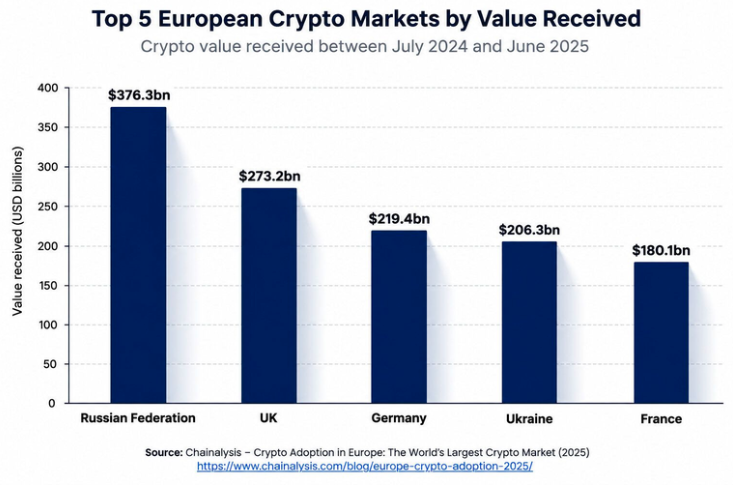
Russia was already Europe's largest digital currency market by volume before the law took effect.
Crypto and Western Sanctions
The West curbed Russian crypto transactions not by stopping flows directly, but by targeting the on- and off-ramps around the world where crypto is converted into and out of recognised fiat currencies such as the euro. This was possible because most crypto runs on public blockchains, where every transaction is permanently recorded and visible — letting analytics firms trace the flow of funds and identify the exchanges acting as choke points, even when the people behind the wallets may attempt to remain anonymous.
A case in point: the Russian rouble-pegged stablecoin ‘A7A5’ processed more than $100 billion within a year of launch, before Western action against its main off-ramps — the Estonia-registered Garantex, seized by US authorities in 2025, and its Kyrgyzstan-based successor Grinex — cut daily volumes by about two-thirds.
The EU's 20th sanctions package, adopted in April 2026, means EU-licensed crypto exchanges risk sanctions if they accept transactions with Russian providers. This makes the new law the first direct test of Western sanctions against a state-regulated and licensed crypto system. Switzerland, though not an EU member, moved to align itself with this approach — partially implementing the 20th EU sanctions package domestically.
Three months later, as the EU was adopting its 21st sanctions package amid chaotic negotiations that exposed cracks in the European front against Russia, EU High Representative Kaja Kallas insisted the strategy was working, saying: “We are hitting Putin where it hurts most: cutting off the financial lifelines he relies on to sustain his war.”
The New Legislation vs. the Sanctions Regime
Once a Russian exporter can legally cash out crypto through a domestic exchange, the rouble side of a trade becomes untouchable to Western enforcement; there is no offshore registration to revoke or foreign domain to seize.
An example: suppose a Chinese refinery wants to buy Russian oil. It converts yuan into crypto on an on-ramp inside China — untouchable by the West. It then transfers that crypto to the Russian oil exporter.
The Russian exporter can now convert this crypto into roubles inside Russia, through the country's newly licensed domestic exchange — equally untouchable. This closes the specific vulnerability that undid off-ramp networks like Garantex and Grinex.
The lingering threat is secondary sanctions: the tool behind the EU's 20th sanctions package. Here, the West, reminiscent of a character out of The Sopranos, leans on smaller players — such as a bank or exchange in Mumbai, Hong Kong, São Paulo, or even Zürich — that help settle Russian payments, threatening them with sanctions in an attempt to scare them away from associating with Russia.
The West's leverage is continued access to the euro and the dollar systems.
Not everyone is convinced this ‘sanctions’ regime is as watertight as politicians in Brussels want to believe.
Even months before Putin's law, when the EU was still finalising its 20th sanctions package against Russian crypto activity, Lex Fisun, co-founder and CEO of the blockchain analytics firm Global Ledger, raised an eyebrow:
At this stage, distinguishing these funds from legitimate market activity becomes a technical impossibility … For European exchanges to enforce such a ban, they would essentially have to block all flows from major global trading hubs, a move that would paralyze the legitimate crypto market.
The warning looks prescient.
The EU's 21st package, adopted 23 July 2026, allows Brussels to ban an entire country's crypto sector if just one single platform inside the country is found to be associated with Russian sanctions avoidance.
Russia's Crypto Law in Context
Russia's new law places Moscow among a small group of major economies with a dedicated legal framework for crypto — alongside the EU, Japan, UAE, and Singapore — while larger markets like the US and India continue to regulate crypto through existing tax and securities law rather than crypto-specific legislation.
What sets Russia apart is purpose: its framework looks entirely built to facilitate foreign trade rather than domestic payments for goods and services.
Countries with Dedicated Crypto Legislation
- EU (approximately 450 million inhabitants) — the world's most comprehensive regulatory framework for crypto. Licensed exchanges and private stablecoins are permitted without general purchase limits.
- Russia (approximately 145 million inhabitants) — cryptocurrencies institutionalised through a state licensing system focused on foreign trade. Crypto payments for goods and services within the country remain prohibited.
- Japan (approximately 123 million inhabitants) – a pioneer in regulated crypto. Bitcoin was recognised early in Japan as a legal digital asset. The country is set to upgrade crypto from a means of payment to a financial product.
- United Arab Emirates (approximately 10 million inhabitants) — one of the world's most crypto-friendly jurisdictions, where Dubai and Abu Dhabi actively court crypto firms.
- Singapore (approximately 6 million inhabitants) — a global hub for institutional crypto. Activity is heavily regulated, with a focus on financial stability.
Countries without Crypto-specific Law
- US (approximately 340 million inhabitants) – the world's largest crypto market by transaction volume. Stablecoins are federally regulated, while the broader market-structure legislation remains unfinished. The market is open in practice.
- India (approximately 1.45 billion inhabitants) – the world's leading market for grassroots crypto adoption (Chainalysis's population-weighted index), though smaller than the US in raw transaction volume. Although crypto is not legal tender, trading is still legal and even heavily taxed (30% flat rate on gains), and exchanges must register under anti-money-laundering rules.
Countries where Private Cryptos are Banned
- China (approximately 1.4 billion inhabitants) – a total ban on private cryptocurrencies, extended to stablecoins and asset tokenisation. The state CBDC, the e-CNY, is the only officially permitted digital currency. Hong Kong is the exception, pressing ahead with its own licensing system for stablecoins despite Beijing's resistance.
If Moscow's state-licensed exchanges can keep trading, other economies sanctioned or semi-isolated by the West will have a template to copy. If they cannot, the West will have shown that squeezing the on- and off-ramps works even against a fully regulated, state-backed counterparty — and that a licence is no sanctions-killer.

Kristoffer Hell
Kristoffer Hell is an independent writer and journalist covering high politics and how technology shapes human experience. He holds an MLitt in Strategic Studies from the University of Aberdeen and a Diploma in News Journalism from the London School of Journalism. He previously worked as a software developer, contracting in banking, pharmaceuticals, and retail.