
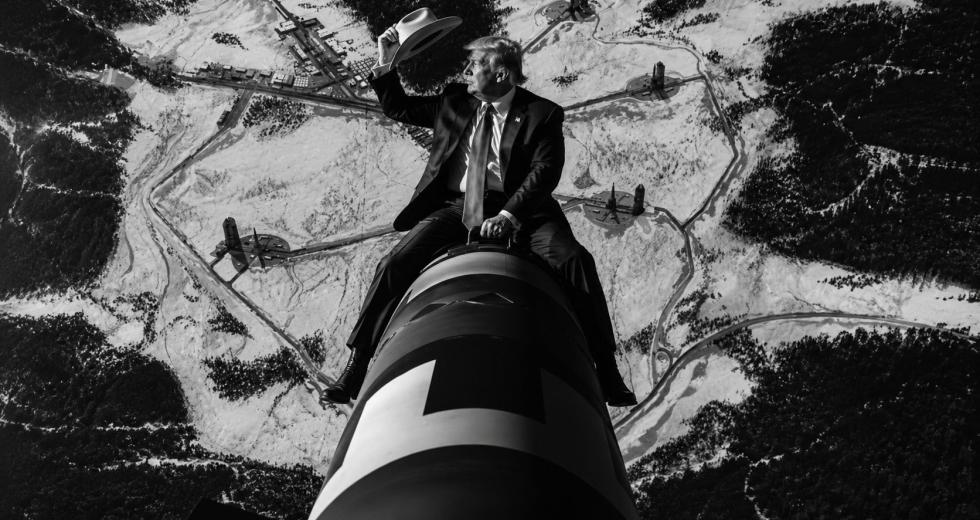
On Friday, 31 July 2026, Secretary of War Pete Hegseth faced a Camp David confrontation with President Trump, who accused him of having been less than forthcoming about serious shortcomings in US munitions stockpiles. Nevertheless, Trump approved a new round of strikes on Iran, just to change his mind a few hours later.
Trump reversed course after his generals warned that going ahead risked a munitions shortfall, with Iranian retaliation against US allies in the region expected.
When The Washington Post broke this story, the White House branded it “100 per cent fake news” whilst Trump threatened to prosecute the leakers.
At the same time, the Pentagon found the moment opportune to deliver a statement that oozed with confidence: “America's military is the most powerful in the world and has everything it needs to execute at the time and place of the President's choosing”.
Not everyone on The Hill is feeling the enthusiasm.
On 21 July, Republican Senator Susan Collins of Maine said during a Congressional hearing with Hegseth on the issue of munitions shortages: “While these munition shortfalls have been years in the making, they are growing increasingly urgent”.
Former Marine Corps intelligence officer and UN weapons inspector Scott Ritter explained the seriousness of the lack of magazine depth for high-end defensive weapons systems for the US and its regional allies, had the attack gone ahead and unleashed an Iranian response: “Kuwait was about two or three concerted Iranian missile strikes away from extinction”.
Following is a list of the most serious shortages reported.
- ATACMS: ground-launched short-range ballistic missile (HIMARS/M270); near-total depletion; production halted; no rebuild
- THAAD: ground-based terminal-phase interceptor, no substitute; 38–80% depleted (disputed); 53-month rebuild
- Patriot (PAC-3/MSE): ground-based point-defence interceptor, most widely fielded allied system; 50–65% depleted; 42-month rebuild
- PrSM: ATACMS's replacement, ground-launched precision strike missile; 44–78% depleted; 46-month rebuild, but with a new estimate of approximately 8 months
- SM-3: ship-launched exo-atmospheric interceptor; only system that can hit a ballistic missile in space; 32–61% depleted; 64-month rebuild
- SM-6: ship-launched multirole interceptor against aircraft, cruise missiles, and terminal-phase ballistic missiles; 16–32% depleted; 53-month rebuild (CSIS)
- Tomahawk: ship/sub-launched land-attack cruise missile; ~32% depleted; 47-month rebuild
- JASSM: air-launched stealth cruise missile for strikes outside contested air defences; ~25% depleted; 48-month rebuild
The Verdict
Ritter's conclusions after the failed US-Israel five-month war against Iran leading up to the aborted attack were that the US doesn’t have any cards and that Iran is now a new regional superpower.
He is not alone in his assessment.
John Mearsheimer, a University of Chicago political scientist, said that President Trump has lost the war in a devastating defeat for the US.
Robert Kagan, Brookings Institution Senior Fellow, said that “Iran controls access to the Strait of Hormuz, which means they control access to a major portion of the world's energy supply which has completely reversed the power situation in the region so it's pretty much a disaster”.
Look no further than the defence pact formed on 7 August 2026 between Türkiye, Saudi Arabia, and Pakistan for evidence that the relevance of Washington is waning in the face of the continued challenge posed by Iran and its network of client states around the Greater Middle East.
The British International Institute for Strategic Studies (IISS) published its assessment on 14 August. The following is from its analysis:
Although Iran may prefer not to see its regional competitors close ranks, it is nonetheless likely to view the emergence of regional security arrangements of which the US is not a member as a successful outcome of its wartime strategy of driving a wedge between Washington and its regional partners.
The Wrong Bet
The US high-end munitions shortage of 2026 traces back to a decision presented at a 1993 dinner at the Pentagon now known as ‘The Last Supper’, where then-Defense Secretary Les Aspin sat Lockheed's Norman Augustine down and told him to brace himself: “In about 15 minutes, you're going to find out. You probably aren't going to like it”.
The message: consolidate or die. The industry obliged. Within a decade, 51 prime defence producers had merged to five. Today, the US military munitions market is owned by just three companies.
It was a deliberate gamble, made by both parties, that scaled down peacetime efficiency mattered more than wartime surge capacity.
Of course, internal warnings came but went unheeded: 1998, the Government Accountability Office (GAO); 1999, the Department of Justice; and in 2008, a GAO report confirming that single-source suppliers with no other backup on the market was now the pattern across the industry for critical parts.
At the same time, history was making some points of its own in parallel.
In 1999, NATO started to expand geographically towards Russia whilst embracing ‘humanitarian intervention’ as the code word for out-of-area operations — a concept later formalised, in 2005, as R2P: the Responsibility to Protect. Serbia was bombed without a UN authorisation.
By 2007, at the Munich Security Conference, Putin labelled NATO's eastward expansion “a serious provocation that reduces the level of mutual trust” and demanded to know whom it was aimed at.
Against this backdrop, American defence-related employment continued to fall — from 3 million workers in 1985 to 1.1 million in 2021 — and the US share of global defence spending dropped while China's rose.
Then 9/11 came, and defence spending soared to $8 trillion over the next two decades. In the first post-9/11 decade alone, military spending rose 50 per cent and included a roughly $900 billion permanent increase to the Pentagon's baseline budget on top of the war itself.
However, the architects of the 9/11 wars went all in on the bet that counterinsurgency (COIN) — guerrilla-style population-centric ground war and nation building with small-arms rifles supported by blanket population surveillance — was the name of the game in the future, making these the two most iconic categories of military hardware to come out of these decades:
- Expensive HALE and MALE unmanned aerial vehicles (UAVs): High-Altitude, Long-Endurance (the RQ-4 Global Hawk), and Medium-Altitude, Long-Endurance (the MQ-1 Predator, the MQ-9 Reaper). Both are only effective in friendly or uncontested airspace.
- The Mine-Resistant Ambush Protected vehicle (MRAP): heavily armoured trucks rushed into mass production in Iraq and Afghanistan to survive guerrilla-style home-made roadside bombs (IEDs). They are mostly useless against a conventional army.
The much-toted USA PATRIOT Act of 2001 was not a military but a domestic surveillance legislation that set the tone for the era's blanket approach to population monitoring: the bulk phone records programme, the ‘roving wiretap’ authority, and the ‘lone wolf’ surveillance of citizens under suspicion. This is still going on, but now it is running under Section 702 of the Foreign Intelligence Surveillance Act (FISA) instead of the retired Patriot Act.
Today, the US is opening munitions factories for the first time since the Second World War.
1942: The Myth of Instant Mobilisation
Contrary to popular belief, the Second World War ramp-up was not instant. It took three years to bring production up to war-winning levels. Something that is often not remembered today is that a year was shaved off this process by quiet government interwar inventorying in which 90 per cent of the US manufacturers that would flip to wartime production had already been identified, in preparation for the moment when Pearl Harbor changed everything on 7 December 1941.
The scale of intervention was staggering.
Federal spending peaked at 44 per cent of GNP, with $196 billion in military contracts and another $31 billion — roughly $3.2 trillion today — poured into new production facilities from scratch.
Nothing close to that commitment exists in 2026, and the reason for it is obvious to many.
For America, the Second World War was a war of necessity: the US was attacked and it had to defend itself.
The wars in the 21st century are wars of choice, driven by imperial design, many would argue.
With Pearl Harbor came a near-unanimous public backing.
Trump's 2026 Iran war wasn't even authorised by Congress, and — a growing chorus of voices claim — was not America's war at all, but Israel's.
From Assembly Lines to Silicon Cleanrooms
The M1 Garand, the Second World War's most prolific rifle, was a mechanical object that a retooled car plant could adapt to build in months. Today's precision-guided munitions are electronic systems built on rare-earth components which rely on supply chains that are narrow, global, often single-sourced, and technically unforgiving.
In 1940, the median American adult had 8.4 years of schooling. The ‘dilution of skill’ was the official doctrine: break the work down until an eighth grader could do it in weeks.
Today's equivalent worker needs a bachelor's degree at a minimum, or at least years of cleared, specialised certification.
Where is the shortcut for that? Is there a coming generation of humanoid or general purpose AI robots? This might happen in 10–25 years, depending on which industry pundit one listens to.
The China Syndrome
China mines 60 per cent of the world's rare earths, processes 90 per cent, and makes 94 per cent of the magnets built from them. These are the materials behind guided munitions, radar, and jet engines.
Beijing has already shown it will use that leverage, and Washington is fighting back on multiple fronts with an executive order phasing out adversary-sourced materials by 2027, over $2 billion pledged to domestic mining, and a $1.4 billion award for battery and munitions-grade materials.
In 1943, America's enemies did not have a stranglehold on the supply lines of the nation's weapons manufacturing the way Beijing alone does today. Although the US was dependent on imports of tin, rubber, tungsten, and manganese, these were available from multiple sources such as Bolivia, Canada, Brazil, and the Belgian Congo. Washington built massive stockpiles, developed substitutes (most famously, synthetic rubber), and secured alternate supply routes to keep production lines moving.
The Exception
There is one weapon category that lives in a different space altogether: nuclear.
Since most nuclear weapons are designed to act as a deterrent and never be used — or be used only once — no-one seems to have arranged for mass-producing them during an ongoing war.
So, whereas the conventional side of the US military has been treated as an abused stepchild, the US atomic arsenal remained the favoured child, closely monitored, maintained, and kept in parity with Russia's nuclear stance.
Even the post-Cold War draw down from 22,217 warheads to some 3,750 was a carefully choreographed ballet with Moscow. There was no unilateral drawdown, and no gap opened for anyone to exploit. And what remained stayed lean and combat-ready.
And every year since 1994, labs have certified the US nuclear stance remains credible, even through recessions, 9/11 and the wars that followed it, and decades that gutted the American conventional munitions industry.
In 2017, during Donald Trump's first presidency, something changed: the US committed $946 billion to modernise the nation’s nuclear forces with new missiles, new submarines, and a new bomber.
Moreover, Trump's initial 2018 Nuclear Posture Review pushed the arsenal in a new direction: expanding downward, into smaller, more ‘usable’ weapons. The result was the W76-2, a low-yield submarine warhead built specifically to give the President a tactical battlefield nuclear ‘option’ below the strategic war level.
The strongest objection to this came from inside the administration that built the weapon. James Mattis, the retired Marine general known as the ‘Warrior Monk’ or ‘Mad Dog’, a career war fighter who was serving as Trump's own Secretary of Defense at the time, said back in 2018, “I don't think there's any such thing as a 'tactical nuclear weapon'. Any nuclear weapon used at any time is a strategic game changer”.
Eight years later, in 2026, the second Trump Administration is pushing the nuclear envelope further by adding two more tactical nukes to its list of ‘options’:
- The ‘dial-a-yield’ B61-13, which is a higher-yield gravity bomb for hard and buried targets, already in production.
- A new nuclear-capable sea-launched cruise missile, SLCM-N, clearly aimed at a future China contingency.
Unlike the B61-12, which sits across six NATO bases in Europe and Türkiye, the B61-13 is planned to be based in the continental US, for delivery by the B-2 and, eventually, the B-21 bomber.
Two Trump Administrations, #45 and #47, with one recurring fallback: when the conventional arsenal runs dry, the nuclear one is right there — pristine, lean, ready, and just waiting.
From Theory to Practice
The possibility of the US under President Donald Trump, 81 years after Hiroshima and Nagasaki, once again resorting to nuclear weapons is no longer confined to the realm of strategic theory.
In May 2026, the Bulletin of the Atomic Scientists warned that Trump could come to see atomic weapons as a “nuclear escape” from a war that had become a humiliation, a stalemate, and a threat to his political standing.
The Bulletin did this as it cited Pentagon plans for a possible final blow against Iran.
Then there is Trump's unique style of rhetoric. In April 2026, he blasted on social media that unless Iran agreed to his terms, “a whole civilization will die tonight”.
The Bulletin viewed the statement as pure and simple “nuclear blackmail,” arguing that the threat carried a nuclear dimension, although Trump never used the words nuclear or atomic.
Less than a year before that, in June 2025, The Guardian reported that Pentagon officials had been briefed on how conventional weapons might not be enough to destroy Iran's deeply buried Fordow enrichment facility, and that tactical nuclear weapons might be required.
And on Sunday, 16 August 2026, former Republican congresswoman and once close Trump ally Marjorie Taylor Greene published this on X: “They are discussing using nuclear weapons on Iran in strategy meetings. Yes you read that correctly. It’s real. I’m not speculating, I know. And it’s pure evil”.
The same day Greene made her allegation, Trump said that his “number one Goal [sic]” with Iran was, and always would be, to prevent it from having a nuclear weapon.
As he said that, he explicitly contradicted his own Vice President, JD Vance, who had identified keeping oil prices down as America's top priority.
Just hours before Greene published her claim, Under Secretary of War for Policy, Elbridge Colby, said he feared a regional conventional war involving the local use of nuclear weapons and the possibility of escalation, and that the Pentagon was reviewing “nuclear employment guidance” – with officials describing the purpose as expanding the President's “options” and “decision space” in an escalation scenario.
Is this the image now consolidating in front of the world?
If the US eventually uses a nuclear weapon against Iran, would the justification be that Iran, indeed, has acquired a nuclear weapon of its own, and that, therefore, “a whole civilization” must die, before Tehran can use it?

Kristoffer Hell
Kristoffer Hell is an independent writer and journalist covering high politics and how technology shapes human experience. He holds an MLitt in Strategic Studies from the University of Aberdeen and a Diploma in News Journalism from the London School of Journalism. He previously worked as a software developer, contracting in banking, pharmaceuticals, and retail.