

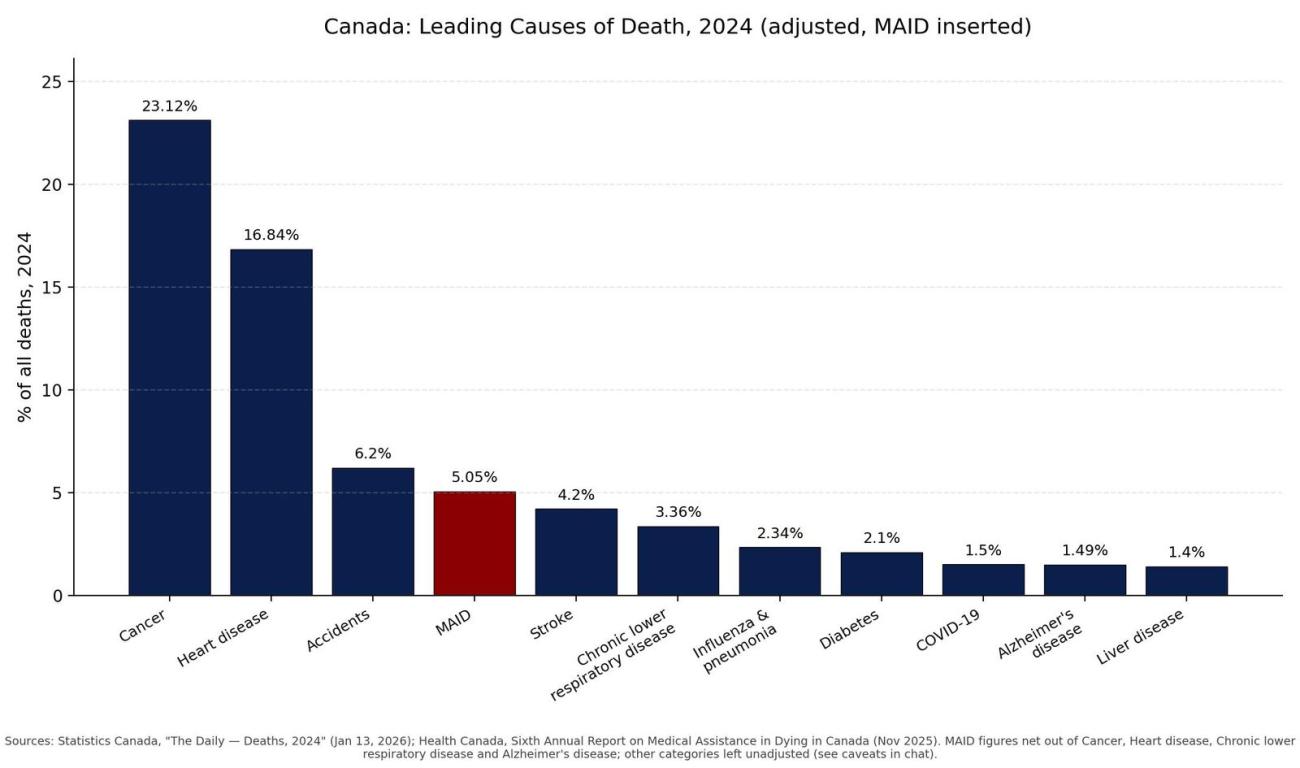
In 2024, being euthanised by the Canadian Government through the Medical Assistance in Dying (MAID) programme was the country's fourth most prevalent cause of death, surpassing stroke. Why is the programme expanding so fast? Is the number of terminally ill people on the rise in Canada? What are the plans for the future?
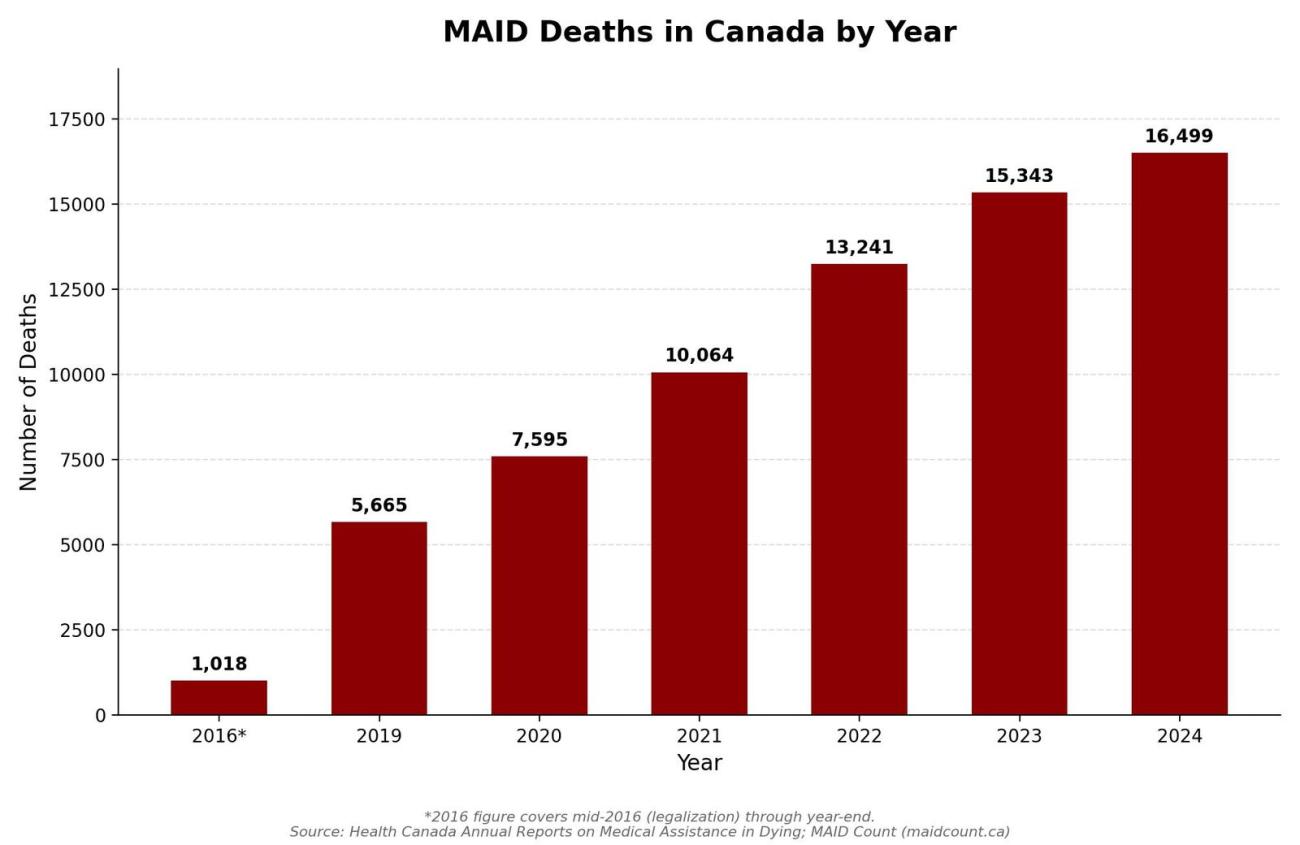
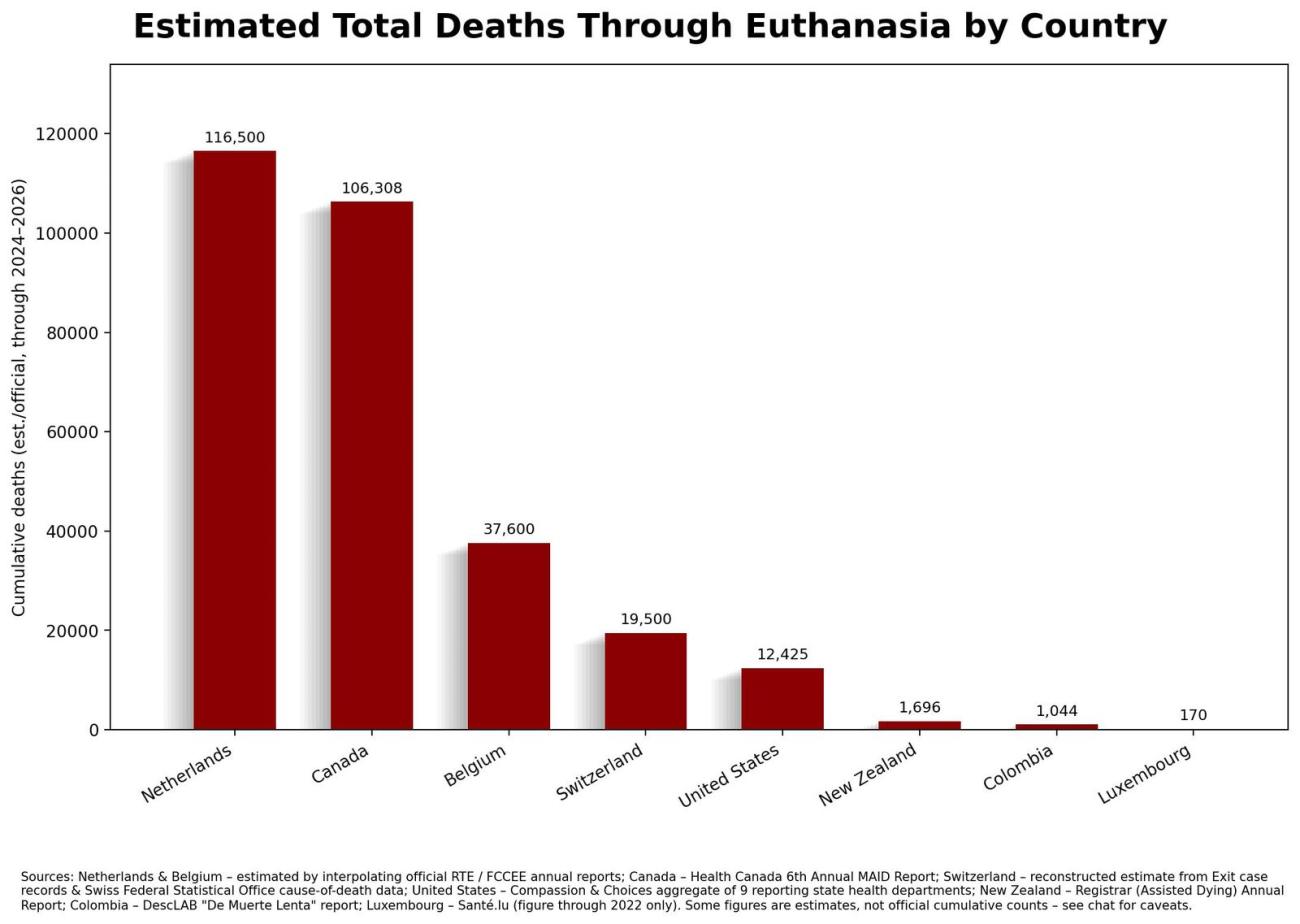
Since Ottawa made it legal in 2016 for medical professionals to kill patients intentionally, an estimated 106,308 people have been put to death. In 2024 alone, 16,499 people died by euthanasia. That equates to 5.1 per cent of all deaths in Canada that year, or about one every 32 minutes; roughly 45 per day.
Brigitte Stegemann
Earlier this summer, an 83-year-old grandmother named Brigitte ‘GG’ Stegemann was killed under Canada's MAID programme at The Pearl, a long-term care facility in Cannifton, Ontario (formerly E. J. McQuigge Lodge, licensed to Pearl Care Homes, Inc.). It happened despite the family's account that she had, on several occasions, made clear that she did not wish to pursue euthanasia, as it conflicted with her Christian faith.
While her granddaughter, Brigitte Krankendonk, was away on a ten-day holiday, the family says that staff at GG's care home met privately with her on two occasions to discuss MAID — a fact the family says a nurse later admitted to in front of them.
The granddaughter, who had held GG’s Power of Attorney and had been her primary advocate for more than a decade, says she was not informed that these discussions were taking place.
When the granddaughter returned, she found that the process had advanced dramatically. On 6 July, the family arrived for a scheduled MAID meeting expecting to speak with GG's physician, and instead found GG abruptly transformed — sitting upright, talking, smiling, and laughing — days after having been, according to the family, too weak to hold a conversation. Suspicious of the change, Krankendonk requested GG's Medication Administration Record and audited it herself. The family said that the facility's own records showed the same dosage administered every single day — a discrepancy that, in their account, never explained the sudden shift.
During a subsequent capacity assessment, the family says GG repeatedly gave incorrect answers about basic facts concerning her own life and family. She became confused and distressed, at one point crying and saying: “I forgot about the grandkids”.
Despite the family's objections, the assessment continued, and the physician reportedly informed the family that GG had consented to MAID: “I have deemed her capable of making her own decisions”.
But days later, according to the family, GG appeared confused and distressed when Krankendonk asked whether she was certain she wanted to proceed. Her response: “I'm going to die Friday? They're going to kill me Friday”?
GG wept for an extended period and repeatedly said that she had made a mistake. Family members later said they had not received her capacity assessments, signed a MAID request, or any waiver of final consent, despite asking. It remains unclear, on the public record, precisely what she meant by “a mistake”.
On the morning of 10 July, the family spent GG's final hours with her outdoors, in a wheelchair, eating a scoop of strawberry ice cream while they waited for her pastor to arrive. Within 10 minutes, the family says an administrator came out and insisted GG be brought back inside for an intravenous line to be started — nearly two hours ahead of the scheduled procedure, for reasons the family says the facility never explained.
When the physician arrived and attempted to speak with her, the family says GG was silent, with her hands tightly clasped together in a fixed prayer position.
She never gave a verbal response.
Here is one of the safeguards a medical or nurse practitioner must satisfy before providing MAID: “immediately before providing the medical assistance in dying, give the person an opportunity to withdraw their request and ensure that the person gives express consent to receive medical assistance in dying”.
This was the original framework for euthanasia in Canada: the patient controls the process throughout. And at this point, the granddaughter says she initially felt a wave of relief, believing that GG's silence meant the procedure would now be stopped.
Instead, the doctor continued with the process.
In 2021, the laws governing euthanasia were relaxed and expanded, allowing terminally ill patients to sign an advance waiver, letting MAID proceed without this final in-the-moment confirmation, so long as the person does not demonstrate refusal “by words, sounds or gestures”. Whether such a waiver existed in GG's case is, per the family, still unknown — they say they have not been shown one.
Moments later, the grandmother was dead.
The family has since formally requested an investigation by Ontario's MAID Death Review Team, naming the physician involved as Dr. Kate Koester (spelling as given in the family's submission; some published accounts render it differently). The reporter who first broke the story, Kelsi Sheren, has stated that everything attributed to the family in her account is the family's version of events, and that she contacted both the physician and the facility for comment, but received no response.
For her family, the most haunting image of those final moments remains: a woman of deep Christian faith, facing death, seated silently, with her hands clasped in prayer.
Father Larry Holland
Months earlier, Father Larry Holland, a 79-year-old Vancouver Catholic priest recovering from a hip fracture, was offered MAID twice.
His reaction to the offer was immediate: “There are some things you just don't talk about to some people”.
In Catholicism, suicide — and, by extension, euthanasia — is a sin.
Holland's experience raises a question: when a patient has not asked for euthanasia, has explicitly expressed moral opposition to it, and is temporarily vulnerable because of severe pain, what does it mean when medical professionals continue to push death as an option?
Kiano Vafaeian
At 26, Kiano Vafaeian had Type 1 diabetes, vision loss, and a history of depression.
Mental illness alone does not currently qualify for MAID in Canada, so after being denied euthanasia in Ontario in 2022, Kiano eventually obtained approval under Track 2 in British Columbia, where he was injected and killed on 30 December 2025.
His mother, Margaret Marsilla, remembers: “There were times when he loved life, there were times he was in a deep dark hole … If it wasn't for MAID and Track 2, Kiano would still be alive … No parent should ever have to bury their child because a system — and a doctor — chose death over care, help or love”.
Track 2, created in 2021 under Bill C-7, enables euthanasia for people who are not terminally ill.
Starting on 17 March 2027, it will also be legal to euthanise people whose sole underlying medical condition is mental illness.
When that happens, the law governing euthanasia in Canada will have moved from “dying and suffering” (2016) to “suffering but not dying” (2021) to “suffering from a condition that's primarily in the mind with no physical prognosis at all” (possibly soon).
Scope Drift
Were these expansions of Canada's euthanasia laws planned and debated?
It wasn't well planned or debated — it was mostly reactive, and the mental illness expansion in particular was a last-minute add-on that Parliament has spent years trying to walk back.
Suffering But Not Dying
Track 2 exists because the Québec Superior Court struck down the “reasonably foreseeable death” requirement in Truchon v. Canada (2019), ruling it unconstitutional. The Canadian Government chose not to appeal that ruling and instead passed Bill C-7 (2021) to comply with the court's decision. So, Track 2's expansion to non-terminal patients was driven by a single lower-court decision, not a parliamentary policy debate weighing the tradeoffs.
Critics in Parliament later noted the Truchon decision was “not an appellate decision” and that the Government “should have appealed” but did not.
Mental Illness
When Bill C-7 was first drafted — the same bill that created Track 2 — it explicitly excluded mental illness as a sole condition.
It only entered the law because of a Senate amendment.
As Conservative MP Michael Cooper put it in the House: “As bad as the bill was, when it was studied at the justice committee ... nowhere in the bill was there any mention of expanding MAID in cases of mental illness”.
Enter Senator Stan Kutcher, who proposed an amendment that added a two-year ‘sunset clause’, meaning it would automatically become legal in March 2023 unless Parliament acted to stop it.
Since then, Parliament has indeed stopped it — on three occasions:
- Original deadline: 17 March 2023
- Bill C-39 (2023) pushed it to 17 March 2024
- Bill C-62 (2024) pushed it to 17 March 2027, passing the House of Commons by a decisive 272–32
Each delay came with warnings that the system wasn't prepared. The justice minister at the time said, “more time is needed to get this right”, citing concerns that “the health-care system might not be prepared for an expanded regime” and that “some provinces and regulatory bodies needed more time”.
Not everyone in Parliament saw the delays as caution. Senator Pamela Wallin, a longstanding member of the Special Joint Committee on MAID, called it something closer to sabotage: “I witnessed first-hand the deliberate mishandling of this issue. I am in many ways sorry to have been part of a process that brings us here and robs so many of hope”.
In short, the mental illness expansion was not a considered legislative choice with years of lead time. It was a court- and Senate-amendment-driven mechanism that Parliament has now stepped in to delay three separate times because officials themselves didn't think the system was ready.
Could the mental illness clause be stopped a fourth time in March 2027?
Bill C-218, a private member's bill from Conservative MP Tamara Jansen, would permanently amend the Criminal Code to exclude mental illness as a sole qualifying condition. Introducing it in the House, Jansen made her case directly: “Imagine your son or daughter battling depression for some time, after losing a job or maybe a broken relationship. Imagine they feel the loss so deep that they're convinced the world would be better off without them … Mental illness is treatable. Recovery is possible, but only if we show up and help”.
With Liberal and Bloc Québécois members preferring to wait for the parliamentary committee's own findings, C-218 looks likely to fail on a party-line basis — much as a near-identical 2023 predecessor, Bill C-314, was defeated 167–150.
The Special Joint Committee on MAID (AMAD), the body that Bill C-62 tasked with judging readiness, released a report in June 2026 recommending an indefinite pause, not just another deadline. Sources told CBC News that all Liberal and Conservative MPs on the committee agreed, along with the joint chair, Senator Yonah Martin, but that the majority of senators on the committee wanted the expansion to go ahead regardless.
Senator David Wells, who sat on the committee, said, “I was really shocked and disappointed by the committee process, and how unbalanced and biased it was in its construction. It certainly has never been my experience participating in a parliamentary committee to see the inequity, the imbalance in the perspectives of the witnesses”.
In March 2025, Canadian officials appeared before the UN Committee on the Rights of Persons with Disabilities in Geneva, where vice-chair Rosemary Kayess pressed them to explain how Track 2 differed from “state-sponsored eugenics”.
A month later, the UN published a report accusing Canada of offering death as a solution to problems, such as poverty, lack of care, and isolation, that better support could solve instead. In the committee's view, it reflects a bias that treats disabled lives as less worth living, not a neutral medical judgment about suffering.
The Aktion T4 Programme
Between 1940 and 1941, Nazi Germany's Aktion T4 programme killed more than 70,000 people with mental and physical disabilities after doctors and bureaucrats classified their lives as “unworthy of life”.
The T4 programme was compulsory, arbitrary, and initiated by the state against people who never asked for it, in a clandestine manner.
A system built on consent can still arrive at similar outcomes if the surrounding conditions point the same way: if capacity assessments move fast, if the state has a financial incentive to approve rather than deny, if a young man's depression and diabetes are read as grounds for death rather than reasons to intervene, and if ideological and faith-based reservations are pushed aside.
The Nazi T4 programme asked the state to judge whose suffering counted.
Canada's Track 2 asks the same question and calls the answer a personal choice, which is true — right until the choice is either made for someone or made easier than the alternative.
Notwithstanding the overlapping grey area of who is really driving a decision to euthanise someone, the reality is that Canada's MAID programme has, to date, killed ~36,000 more people than Aktion T4 put to death between 1940 and 1941.
But Canada is not alone.
The Netherlands also has a euthanasia programme, running since 2002, which, based on an estimate derived from official Dutch annual reports, has put to death approximately 46,000–47,000 more persons than the Nazi T4 programme.
The Financial Anatomy
What a Single Death Costs
A completed MAID case costs about $2,600 per patient in British Columbia (BC). It pays doctors about $327 in BC – up 64% from $200 in 2017. Quebec doctors billed $1,225 per MAID death in 2022.
How It's Performed
The standard protocol takes 10 to 15 minutes to administer and uses three intravenous drugs: midazolam, a sedative; propofol, which induces deep unconsciousness; and rocuronium, a paralytic that stops breathing.
What the State Saves
A 2017 Canadian Medical Association Journal analysis estimated that MAID could reduce annual health-care spending by $34.7–$136.8 million, whilst the programme costs would be $1.5–$14.8 million.
In 2020, the Parliamentary Budget Officer projected that MAID would reduce provincial health-care costs by $149 million in 2021, including $62 million attributable to the Bill C-7 expansion – where also people with non-terminal conditions can be legally killed.
Around the World
Currently, 17 countries in the world have legislation which allows for active euthanasia; all of them are Western liberal democracies. These are: Netherlands, Belgium, Luxembourg, Colombia, Canada, Spain, New Zealand, Austria, Ecuador, Uruguay, Australia, Switzerland, United States, France, Portugal, Germany, and Jersey.
It is legal in France, Portugal, and Germany on paper, but not yet operational. France's law was upheld by the Constitutional Council on 14 August 2026 and signed by President Macron on 19 August 2026, but implementing decrees are still pending, with the Government targeting early 2027 before patients can request it. Portugal's law was enacted in May 2023, but suspended following Constitutional Court interventions in both 2024 and 2025, and remains inoperative. Germany's Bundestag still hasn't passed the regulating legislation its own Constitutional Court ordered in 2020. Jersey's law received Royal Assent in July 2026, but the service itself isn't expected to launch until September 2027.
The countries currently known to be in various stages of implementing or discussing to allowing euthanasia are Chile, Cyprus, Denmark, Ireland, Malta, United Kingdom, and Slovenia.
Around the Corner
Aside from the political war in Canada over allowing physically perfectly well adults to be euthanised for mental reasons, there are two MAID expansions being fought over.
Killing Minors
In February 2023, the Special Joint Committee on MAID in Canada recommended extending eligibility to ‘mature minors’ — those deemed, on assessment, to have the capacity to request it. Parents would be consulted “where appropriate”, but a capable minor would have the final say.
The committee excluded minors with mental disorder as a sole condition and proposed limiting eligibility to those whose natural death is reasonably foreseeable.
Death by Organ Donation
A recent paper in the New England Journal of Medicine has drawn fresh alarm among bioethicists and disability advocates for suggesting an expansion of the MAID euthanasia toolbox to include live organ retrieval — killing people that way.
The objection is not to organ donation after death as such, by way of the current standard protocol of three injections, but to now start killing people by taking out their organs while they are still alive, albeit sedated.
Kerry Bowman, a University of Toronto bioethicist with direct experience of MAID cases, raises a subtler concern: coercion by omission.
Many patients eventually approved for MAID actually choose not to go through with it. Once an organ donation conversation has started, the pull-away decision may not be that easy, so as not to let down a recipient.
Lainie Friedman Ross, a bioethicist at the University of Rochester, simply calls the proposal “death by organ donation”.
Valerie Hudson, a professor at Texas A&M's Bush School of Government and Public Service, said, “There's a name for an alteration of the sequence, and it's vivisection, which was tried as a war crime after Nazi atrocities”.

Kristoffer Hell
Kristoffer Hell is an independent writer and journalist covering high politics and how technology shapes human experience. He holds an MLitt in Strategic Studies from the University of Aberdeen and a Diploma in News Journalism from the London School of Journalism. He previously worked as a software developer, contracting in banking, pharmaceuticals, and retail.