
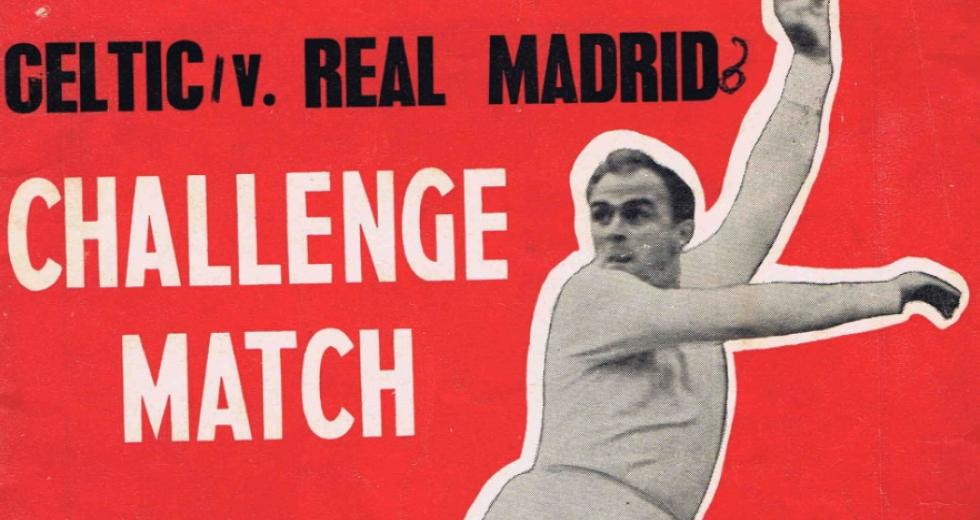
In May 2025, wildfires scorched parts of Occupied Palestine when a series of tree-planting projects by the Jewish National Fund (JNF) burnt down. These fires brought international attention to the JNF’s decades-long campaign of green colonialism in the region. But long before these headlines, Celtic Football Club was quietly funding the same settler projects now burning across Palestine. This is the story of a football board that backed Zionist colonialism behind terraces fighting for Palestinian liberation.
Celtic was built on charity, anti-colonialism, and the resistance of the Irish diaspora. For decades, the Palestinian flag has flown in its stands; it is a symbol of solidarity forged through shared struggle that has become part of the Club’s identity. This is perhaps the last place one would expect Zionism to take root. And yet, as we show in this article, it did.
Zionism is a movement dedicated to the establishment of a supreme Jewish state in Palestine, and pursuant to this, the belief that Palestinians can be violently removed from their land. Zionist influence likely infiltrated Celtic through Masonic channels, an entanglement we will explore in a future article. For now, we begin with a 1930s meeting between Club representatives and the Glasgow Jewish Institute, which was a prominent cultural and political hub for Zionist activities in Scotland at the time.
Celtic Connections with Zionism in the 1930s-1950sThe 1930s were likely a safe haven for Zionists in Scottish football, boosted with the election of Hearts Chairman Elias Furst. He was a Zionist and Freemason, as was reported in the Edinburgh Evening News on 24 December 1896. He was also President of the Scottish Football League in 1930 and Vice-President of the Scottish Football Association (SFA) in 1932.
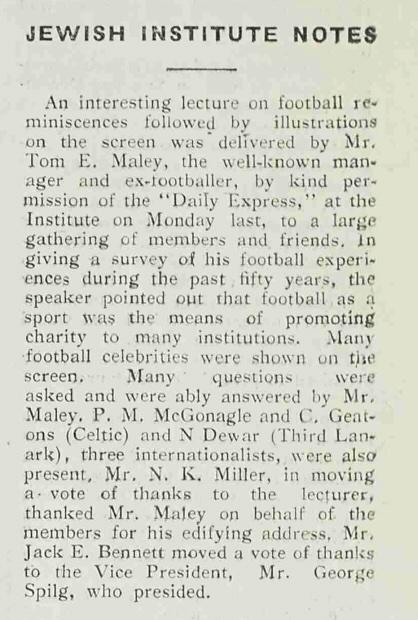
That very same year, Celtic players Peter McGonagle and Charles Geatons, as well as Neil Dewar of Third Lanark, attended a lecture on “football reminiscences” and charity, hosted by the Glasgow Jewish Institute (see above). Former Celtic player Tom Maley delivered the lecture. He was no stranger to charity; Tom was the brother of Celtic’s first and longest ever serving manager, Willie Maley (in charge from 1897-1940), and both had mingled closely with its founding fathers.
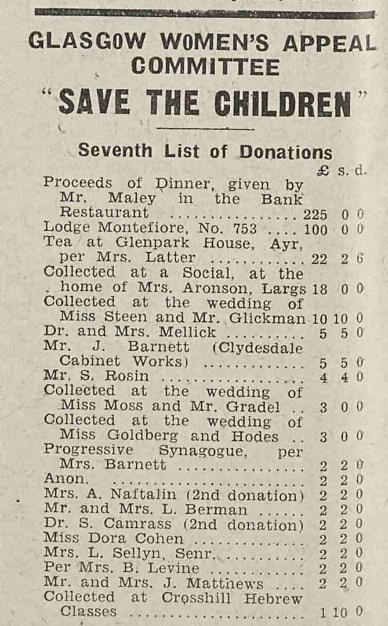
In 1943, three years after retiring, Willie Maley would host a ‘Save the Children’ fundraiser in his restaurant, The Bank, on Glasgow’s Queen Street. Maley reported hearing about the appeal “through some of his Jewish friends”, as reported in the Jewish Echo on 12 March 1943 (see above). It was being promoted by the Zionist Glasgow Women’s Appeal Committee with the goal of “rescuing youngsters from the darkness of Europe and giving them a fresh start in Erez Yisrael”, as reported in the Jewish Echo on 22 January 1943; this was a direct reference to recruiting settler colonists for stealing Palestinian land. Donors included members of the Sellyn, Barnett, and Goldberg families, all of which have been involved over many generations at the centre of the Scottish Zionist movement as part of the Caledonian Cousinhood. This is the elite network of Zionist families who comprise around 10% of the Scottish Jewish population today. Their names will pop up again later in this tale. Also donating was Lodge Montefiore, which was one of two Jewish Masonic Lodges in Glasgow.
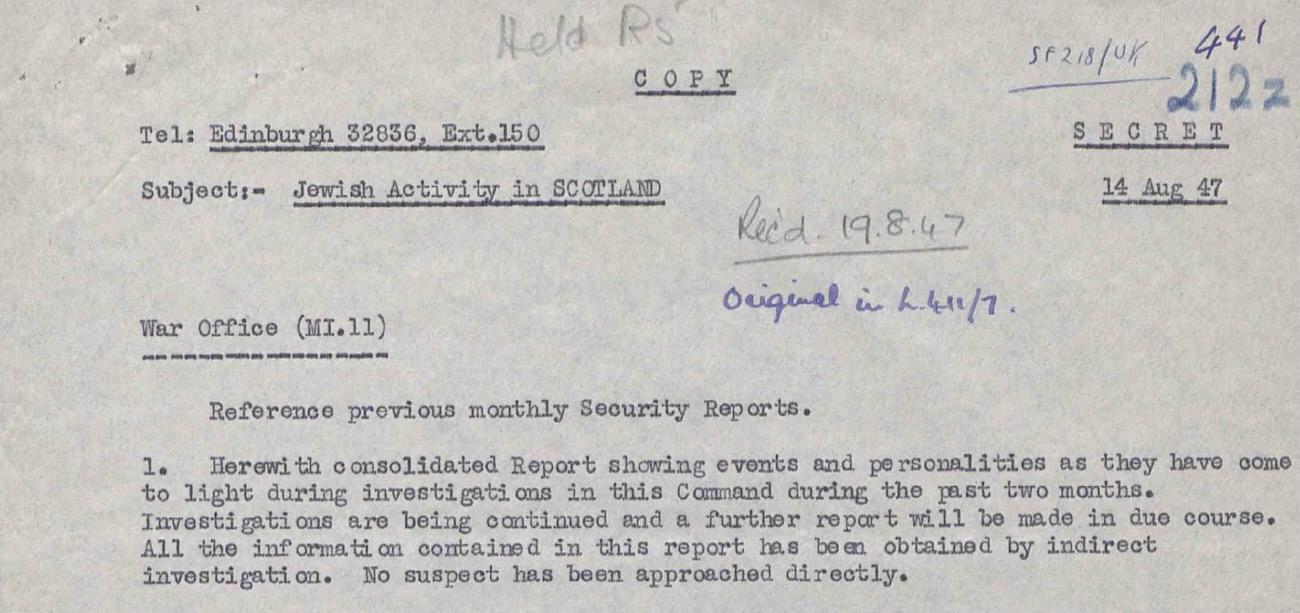
By August 1947, the Glasgow Jewish Institute was seen by MI5 as a nest of Irgun terrorists. It was one of three terror groups which merged to form the Israeli Defence Forces. In now declassified MI5 files, there is discussion of members of the Institute becoming “increasingly bitter and resentful on the Palestine question” and a warning about them “losing their patience and their tempers shortly unless some decision satisfactory to themselves is arrived at fairly soon”. According to MI5, there was an actual Irgun cell in operation at the Institute. It was the last place you would expect a football team — let alone Celtic — to congregate.

Yet, just a decade later, Celtic attended a Glasgow Jewish Institute dinner and dance with Hapoel Tel Aviv, a team with which they would host a ‘charity’ game as part of Hapoel’s European Tour. This was reported in The Scotsman on 17 September 1957. While the official charitable cause is unclear (no official match programme was produced), one might speculate as to the destination of the funds, given that attending the event that night was Maurice Benzion Links, then-Chairman of the Glasgow Commission of the Jewish National Fund (JNF) — to which we will come. Leslie Diamond, President of the Glasgow Jewish Representative Council — an organisation which has been key to regulating Celtic’s stance on Palestine — joined them. Representing Celtic was Chairman Robert Kelly, several of his players, and manager James McGrory. It wasn’t the last time McGrory and Kelly would be involved in a charitable fixture with the JNF or its Glasgow branch.
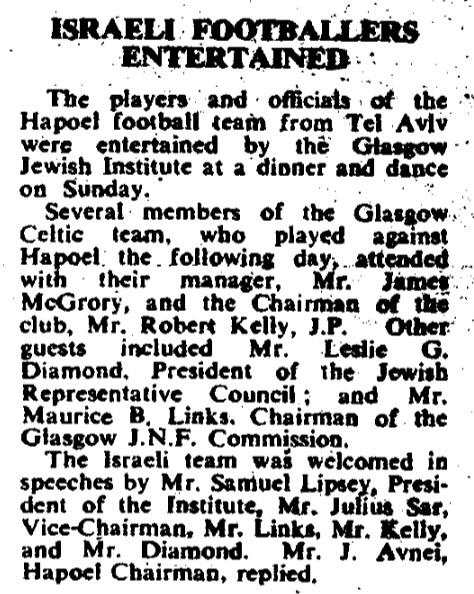
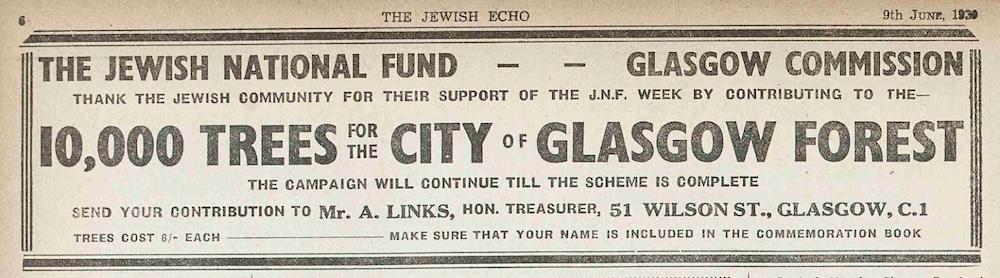
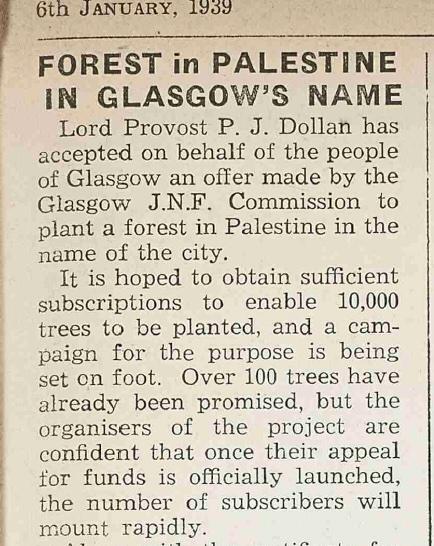
Glasgow’s Zionist community has played a key role in supporting the JNF’s efforts to erase Palestinian landscapes and histories, as can be seen in the above images.
Greenwashing Genocide: Celtic v Real Madrid Fundraiser for the Jewish National Fund in the 1960sSo how exactly did a colonisers’ project in Occupied Palestine become intertwined with a football club in the East End of Glasgow? In 1961, the JNF signed a covenant with the Israeli Government, allowing it to ‘fundraise’ for its colonial activities while receiving state support to spread propaganda in both Israel and abroad, and in doing so, opening the door to new lucrative fundraising channels such as football.
This was also around the time of the collapse of the forgotten third force in Scottish football: Third Lanark. Around a quarter of its supporters were reportedly Jewish in the 1960s, but its financial demise triggered a mass exodus of fans. Between 1960 and its dissolution in 1967, the Club lost 90% of its paying customers. Many jumped ship to support one of the larger Clubs in Glasgow, namely Celtic, which was on the cusp of the most successful period in its history.
One man who capitalised on this exodus was a Glasgow businessman and Celtic fan named Max Benjamin. Benjamin was a Jewish immigrant to Glasgow who worked as a tailor and bookmaker. He was also a Zionist and the Entertainments Officer for the aforementioned Glasgow Blue and White Committee of the JNF, as reported in the Daily Record on 20 December 1962.
Seizing his opportunity, Benjamin tried to organise a JNF fundraiser between Celtic and Eintracht Frankfurt, but faced fierce opposition from members of Glasgow’s Jewish community, which objected to hosting a German side so soon after World War II. The opportunity to bankroll Israel’s campaign of genocide in Palestine, however, was met with less resistance. So, together with Glasgow Evening News’ football correspondent, Gair Henderson, the two men “sent cables across the Bay of Biscay to Spain and eventually Real Madrid agreed to come to Glasgow”, as the Glasgow Evening News reported on 23 November 1962.
On 10 September 1962, Benjamin’s wish came true: Celtic hosted Real Madrid in the ‘Blue and White Trophy Challenge Match’ for the JNF. The match was praised for raising £11,000 for “the rehabilitation of refugee women and children from Europe and North Africa”, which of course was code for its ethnic cleansing project in Palestine.
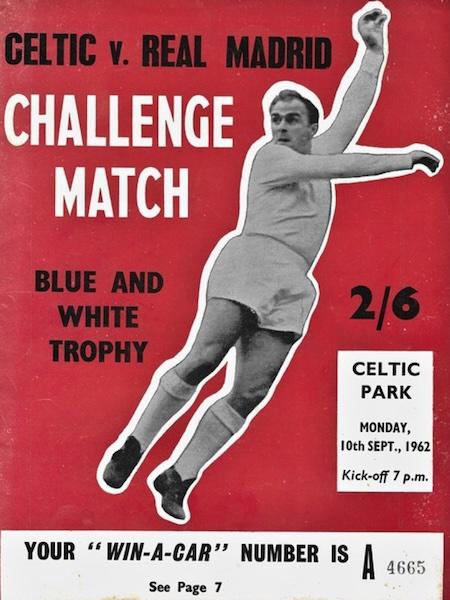
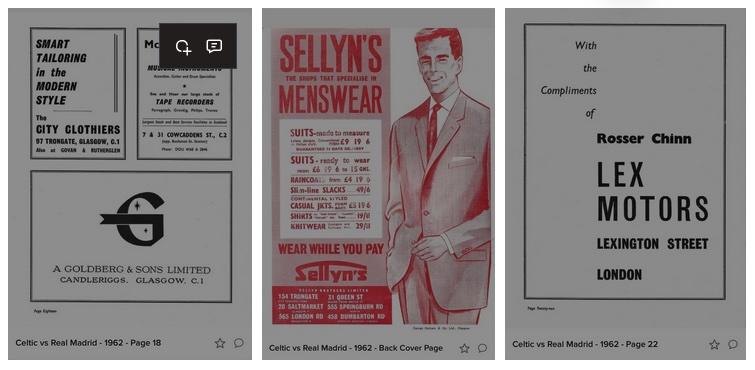
A brief scan of the 1962 Celtic v. Real Madrid match programme reveals the game was sponsored by a number of key players from the Caledonian Cousinhood, the elite network of Zionist families in Glasgow, which also forms the central nexus of Zionism in Scotland today. Among them were the Goldberg family (via their firm A. Goldberg and Sons Limited, which ran iconic department stores in Scotland. The Goldbergs supported Willie Maley’s 1930s ‘fundraiser’, who remain central players in the Zionist movement today, having intermarried with other key families. Since its founding in 1963, just a year after the Real Madrid match, the Glasgow Jewish Community Trust (GJCT), a key Zionist ‘charity’ supporting the movement and its political aims, has counted at least five members of the Goldberg family as trustees.
Also taking out an ad were Sellyn’s Menswear, run by the Sellyn family. As of April 2024, Larry Sellyn, scion of the Sellyn family, remained a trustee of the GJCT. His nephew, David Sellyn, is a patron of Celtic today, and the family remains well-connected to the Club.
A third advertiser was Lex Motors, which was run by the well-known Zionist Rosser Chinn of London. At the time, Chinn was President of the Jewish National Fund in London. A year later, in 1963, he and his wife were ‘honored’ at a London dinner “tendered in connection with the planting of a forest in Israel to bear their names”. He was the father of Trevor Chinn who is effectively the leader of the British Zionist movement today and famously made a key donation to the campaign of Keir Starmer for Labour Party leader, which was not disclosed until five days after Starmer won the election, though it had been received two months earlier.
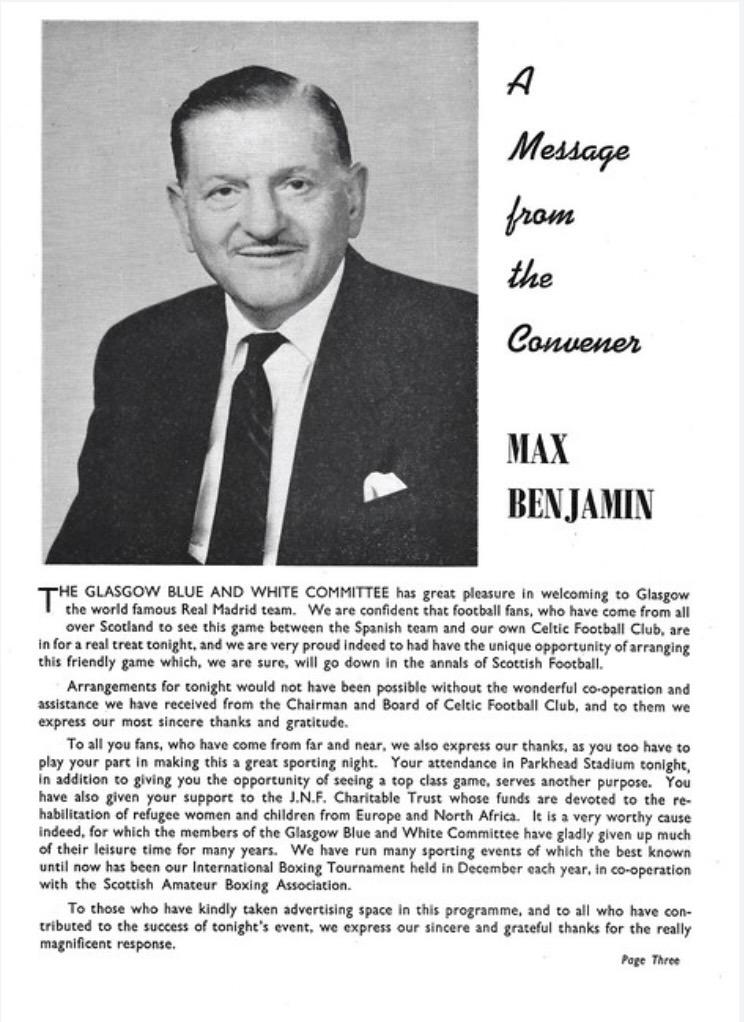
Addressing the attendees as Convenor of the game in the match programme, Benjamin welcomed the team (managed by McGrory) and paid homage to Chairman Robert Kelly and the Celtic Board for their role in organising a game which he hoped would “go down in the annals of Scottish football”.
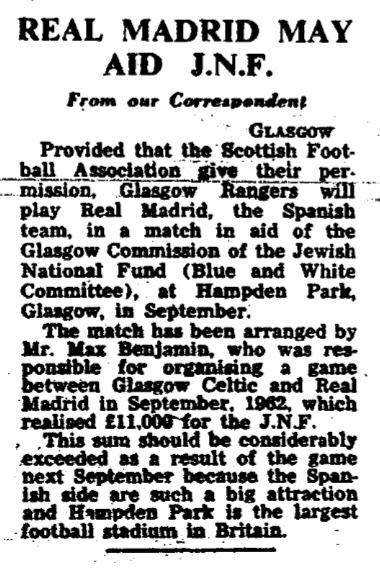
Zionist Links with Celtic: 1960s-1990sAfter unsuccessfully floating a follow-up JNF game against Rangers with Scottish football bosses, Benjamin’s fundraising drive found other arenas in the 1960s, channelling proceeds from boxing and wrestling into Zionist causes, as reported in the Evening Times on 22 February 1964.
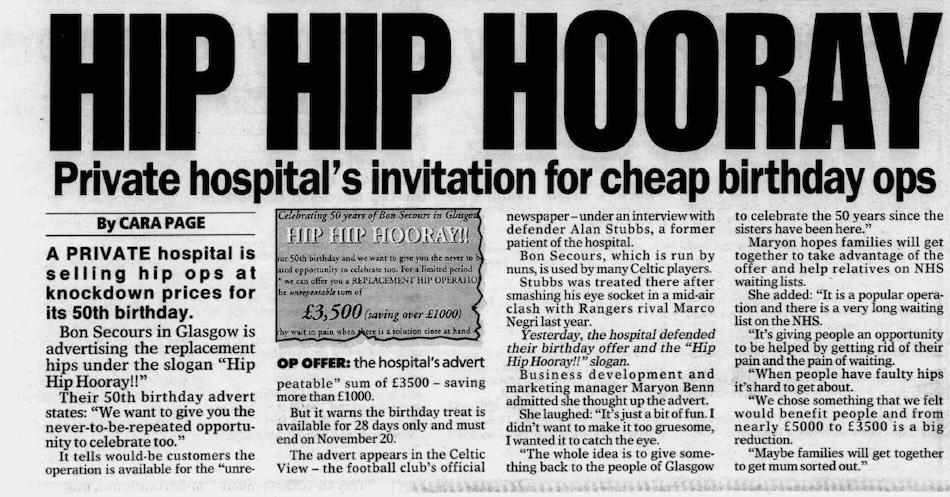
Eventually, the mantle passed to his daughter, Maryon Benn, who inherited not only her father’s Zionist ideology but also his Celtic connections. A prominent figure in the Scottish Women’s International Zionist Organisation and Jewish Care Scotland, Benn would go on to become the Business Development and Marketing Manager of Scotland’s first privately built hospital, the Bon Secours. According to the Daily Record on 1 November 1968, the hospital was run by Catholic nuns, but said to be “a favourite with the Jewish community”. Perhaps this was because it was situated in Glasgow’s Langside district, where many members of the Cousinhood were located at the time. Perhaps this was also because it was funded by key Cousinhood players like multi-millionaire and “hard-line Zionist” Isidore Walton, and his son David, as repayment for “the many family kindnesses” the hospital had given them over the years, as reported in the Daily Record on 23 February 1972. This unlikely two-story villa was the place where Maryon was born, and said to be the death place of Celtic’s Willie Maley in the Glasgow Times on 27 March 2022. It was also “a familiar port of call for footballers and other sporting personalities", which included Celtic players Henrik Larsson, Stéphane Mahé, and Alan Stubbs, who arrived at the Club in the 1990s.
Celtic Football Club has the most pro-Palestinian supporters of any club in the UK. This is due to the multi-generational experience of displacement, loss, and oppression borne of their Irish heritage. It is all the more extraordinary to learn that Zionists have been infiltrating the Club since at least the 1950s.
In Part 2 of this investigation, we examine the even more intense infiltration of the Club from the 1990s to the present day.
This article is part of a series on the rise and fall of Scottish Zionism. Previous articles have been:
‘The Rise and Fall of Zionism in Scotland, Part 1’, Al Mayadeen English, 23 February 2025
‘The Caledonian Cousinhood: How the Zionist Movement Embedded Itself in Scottish Life’, Mintpress, 18 June 2025
‘Scottish Zionism’s Inner Circle: The Caledonian Cousinhood That Bankrolls Occupation and Genocide’, Mintpress, 21 July 2025
‘Neighbours: Inside the Tight-knit Caledonian Cousinhood of Scottish Zionism’, PressTV, 19 July 2025
Professor David Miller
Professor David Miller is a non-resident Senior Research Fellow at the Centre for Islam and Global Affairs at Istanbul Zaim University and a former Professor of Political Sociology at the University of Bristol.
Jill Thomson
Jill Thomson is a campaigner from Scottish Sport for Palestine, dedicated to eradicating Zionism from sport. She has led efforts to push for Israel’s sanctioning in international competitions, exposed the complicity of Scottish sport, and built global campaigns, including bringing the Palestinian Red Card Israel movement to stadiums worldwide.