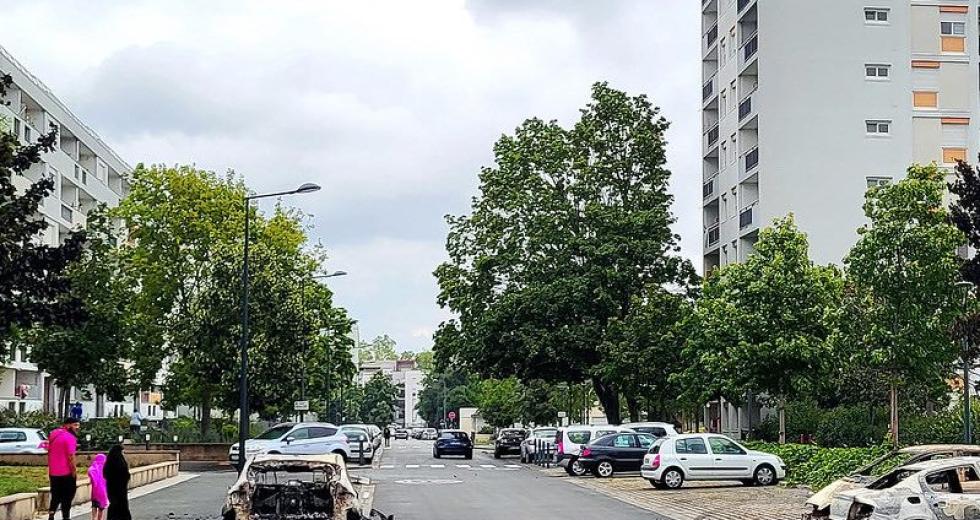
Recent days have witnessed fiery exchanges on the streets of Paris, in the media and in our private lives. Information and accusations flared in all directions.
The Left saw in the events the ultimate proof of embedded discrimination in the state repressive machine, police brutality and the suppression of minority rights, triggering a natural reaction of rebellion against social injustice and generalised lack of opportunity for the underprivileged groups. The Islamists, and any country at odds with France’s foreign policy and colonial past, rushed to share their view.
The right-wingers saw a confirmation that an accelerated and unrestrained immigration of large populations of heterogeneous background could only lead to a crumbling of social order and of the state. Obviously, the perpetrators could only be ungrateful newcomers of doubtful background, incapable of understanding the civilisational objectives of law and order.
The anarchists blamed it on the organised government, which inescapably ends as a Leviathan devouring its subjects. The anti-war camp blamed it on the irrational support for Ukraine, the anti-establishment on the globalist élites and a Macron sold out to the big corporations.
The Eurosceptics blamed it on the euro, the loss of sovereignty by France, and EU’s imposition of demented migration policies. The disenchanted saw this as another facet of Macron’s diabolical nature, while the anti-anti-establishment saw the hand of external forces meddling in France’s internal affairs with no other purpose than to create chaos and destabilise the country as a punishment for seeking a sovereigntist position on the world arena.
All these verdicts are true and false at the same time.
In the fog of media war, only one thing is certain: the 17-year-old Nahel Merzouk is dead, shot through his heart. There is no rationalisation possible on any moral or ethical grounds to justify this summary execution and the heartbreak of a mother who lost her only child.
Who was Nahel Merzouk?
Nahel has been described by most as a ‘Franco-Algerian’ teenager who never knew his father and was raised by his mother alone. Neighbours described him as nice and obliging.
The ‘Algerian’ label has been hastily affixed by a media that never bothered to research the formal identity of the boy, in order to drag the discussion into the emotional and thus easily manipulable realm of racist bias. Jumping at the opportunity to fuel its grudge against the French, the Algerian Government rushed to release a statement demanding clarifications in this case concerning one of its ‘nationals’. However, no evidence has ever been presented to suggest that the boy was not born and raised in France.
Nahel and his mother lived in a barre—a huge, long-lined building in a part of town infamously known in France as la cité or la zone. Despite the Greek resonance suggesting a megalopolis, a barre is actually an overcrowded mass of low-income residents, most of them from a migratory background. That alone tells any person with an average knowledge of France’s sociological realities where the boy likely stood on the social scale and what his daily preoccupations might have been.
Nahel had recently dropped out of school and was earning his keep as a pizza delivery boy. This characterisation is meant to raise our sympathy, while not a word is whispered in the polite media about Nahel’s delinquent past and his flirting with the world of drugs and gangs at only 17 years old.
Nahel was shot dead by a police officer during a traffic check following a car chase and a refusal to comply. For the overseas reader, it must be pointed out that the driving age in France is 18. He was driving a Mercedes A-class, and no-one seems to wonder how a 17-year old from a low-income family gets to drive a Mercedes. It was borrowed, we are told.
The known facts stop here, but we can still ask some questions and make some assumptions about the interplay of identities, perceptions and resentments within French society. Was Nahel more French than Algerian, and does that matter to what happened next? Did living in France mean anything to him, other than probably that this was the only place he ever knew? Is it even relevant for the events whether he was French or Algerian—or was this a social class conflict?
Algerian immigration to France: then and now
To anyone remotely familiar with the nature and depths of the battered Franco-Algerian relationship, the events of the last few weeks come as no surprise. They are merely the continuation of a pattern of behaviour which sees, time and again, the less powerful rip through the dictates of social norms, sometimes with incredible violence, in a desperate attempt to compensate for their self-perceived powerlessness and end injustice. That, of course, presupposes that the mob has a plan, a shared purpose, and a common will.
On the other side, we have an oppressor that does not perceive itself as such, and that assimilated for generations the bitterness, violence, misapprehension and fear of the ‘other’, whose motives and means it does not fully comprehend.
Challenging the view that President Macron’s globalist policies and recent authoritarianism created this crisis, or that it is somehow the result of social inequalities specific to post-pandemic times, facts indicate a repetitive and persistent pattern of social unrest in France over time. The turmoil always ignites in the poorer neighbourhoods of big cities and always involves a significant percentage of the migration-born population, although not limited to it.
Looking at the rebellion landscape of twenty-first-century France, we find:
- The October–November 2005 uprising, involving youths in violent attacks burning cars and public buildings. The trigger was the accidental death by electrocution of two boys—Zyed Benna and Bouna Traoré—fleeing police attempting an identity check. Interviewed by Associated Press, protesters declared that the unrest was an expression of frustration with high unemployment, police harassment and brutality. “People are joining together to say we've had enough,” said one protester. “We live in ghettos. Everyone lives in fear.”
- The 2007 riots ignited in the Val-d’Oise département (another Paris suburb inhabited by a mostly migrant population) following the deaths of two teenagers (Moushin S., 15, and Larami S., 16), whose motorcycle collided with a police vehicle. Both victims and most rioters were of North African descent. Cars and buildings were burned, including a library, two schools, a police station, and several shops.
- In 2009, a series of riots took place on Bastille Day in the commune of Montreuil, an eastern suburb of Paris, following the death of a young Algerian man, Mohamed Benmouna, in police custody. French youths set fire to 317 cars and thirteen police officers were injured.
- In July 2013, riots broke out in Trappes, a Parisian suburb, after the police arrested a man who assaulted a police officer who had tried to check the identity of his wife wearing a Muslim veil.
- In July 2014, a pro-Palestinian protest against the Israeli ground invasion of Gaza degenerated into an anti-Semitic riot in Sarcelles, a northern suburb of Paris. Jewish-owned and non-Jewish-owned businesses were attacked and looted by local youths armed with metal bars and wooden clubs.
- In 2017, protests started, following accusations of a police officer having sodomised a young black man with a baton. Anti-police protests continued well into March 2017, when migrants were met with resistance from Parisians.