Part 1: An Innocent Abroad?
In summer 2022, Kit Klarenberg and I exposed in The Grayzone how Emma Briant — self-styled “disinformation expert” and “maven of persuasion” — had conspired with journalist Paul Mason, under the tutelage of Andy Pryce, a career MI6 officer, to discredit and deplatform left-wing, anti-war academics, activists, and journalists.
This article digs deeper and looks closely at the various activities in which she engaged which ended up placing her into intelligence connected networks. It analyses the way in which academics such as Briant can get drawn into collaboration with shadowy intelligence figures, perhaps without fully realising what is going on. I put it this way to give Dr Briant the benefit of the doubt at the start of this article. But readers will no doubt come to their own conclusions as we traverse her career and her varying and increasingly close contacts with the national security apparatus in the UK, US, and NATO.
Emma Briant poses as a leftish critic of state and corporate agendas. Here she is on a recent panel in April 2025 at the University of Cambridge, which she organised on threats faced by academics.
Amongst other things, she says the following:
It's a testament to the power of research colleagues work that some of … them find themselves singled out for a barrage of abuse and attempts to silence them. Beyond the more specific challenges faced by researchers challenging powerful or deceptive actors, we are witnessing an increasingly hostile environment for scientific inquiry of all kinds. Attacks on the university itself, for example, are happening in the United States ...
In contrast to the many conspiracy influencers that are crying ‘censorship’ across social media to millions of followers, academics often feel unsafe and unable to speak out about threats that they may face publicly … They feel very often that more attacks will follow if they raise the alarm. Now that means a lot of people end up fighting this battle alone, and we want to make sure that that doesn't happen, which is why this organizing this panel was so incredibly important to me.
The threats that we see are not just a feature of the US political environment, though. They are experienced already in the United Kingdom and across Europe and around the world …
Threats may be complex, relentless, and lack solutions, which is why we're talking about them today, because we need to provide solutions for the many, many researchers to enable their work around the world.
Much of the media focus in recent years has focused on attacks on researchers discussing them as though they were a feature of the social media environment alone leading many to the assumption that researchers are complaining about nasty comments on the internet that they're being oversensitive to legitimate criticisms. What we're talking about isn't that. What we're talking about here are coordinated multi-vector attacks from often well-funded political actors or governments.
This sounds quite anti-authoritarian, vaguely left-wing, and certainly liberal. It is notably non-specific about the origins of these attacks, though it is pretty clear that Briant means to include in those attacks legitimate reporting about the role of ‘disinformation’ researchers in intelligence networks, as was done in The Grayzone pieces I mentioned at the beginning, and indeed as is done in this article.
As if to emphasise that point, we can report that the opening keynote speech at the event was given by Elliot Higgins, the CEO of Bellingcat, the ‘open source’ intelligence firm which is an asset of Western intelligence agencies including MI6 and the CIA and has received funding from the “CIA sidekick”, the National Endowment for Democracy. Emphasising those connections, another of the keynote speakers was Nina Jankowicz, the former Executive Director for the Disinformation Governance Board in the US Department of Homeland Security.
As I have previously reported, Jankowicz herself previously managed “democracy assistance programs” to Russia and Belarus at the National Democratic Institute for International Affairs, a core part of the National Endowment for Democracy. After that, she was involved in advising the government of Ukraine on ‘disinformation’ via an organisation called StopFake in 2016-2017, which claimed to be independent, but was actually a government cutout with a deserved reputation for Nazi apologism.
These speakers, which connect Briant to intelligence networks, may make us sceptical about Briant’s comments, but we will come back to what she said at the end of this article to ask about how best to understand them.
Emma Briant’s Backstory
To be fair, Emma Briant has an early history as a researcher with the Glasgow Media Group, which pioneered studies of news bias and then propaganda and media effects on public belief and opinion from the 1970s-2000s.
The Group was once described famously by Lord Annan, the government-appointed reviewer of broadcasting, as “a shadowy guerrilla force on the fringes of broadcasting”. It was certainly not seen as compromised by powerful sources. Its most well-known figure, Professor Greg Philo, who died in 2024, was widely known as a critic of Western news media. As it happens, he was also the PhD supervisor of both myself and Emma Briant. I wrote about his career and achievements in the wake of his passing last year.
Briant completed a number of reports and publications with the Group, including on mental health and on the media coverage of refugees, before publishing a version of her PhD as a book in 2014. In my own case, I completed my PhD with the Glasgow Group in 1994, some years prior to Briant’s association, which started in 2005.
Full Disclosure …
So, although our paths at the Glasgow Media Group didn’t really cross, I should also disclose that prior to undertaking her PhD at Glasgow, Briant applied to do a PhD at the University of Strathclyde, also in Glasgow, under my supervision in the Department of Geography and Sociology. I was the Professor of Sociology and Director of Research there from 2004. As part of the preparatory process, I gave her a book to read prior to signing up for a PhD: Web of Deceit: Britain’s Real Role in the World by Mark Curtis. Mark had been appointed as a Visiting Fellow in the department on my instigation. It was later cited by Briant in discussion with a third party (whose name I am withholding) as a key reason why she decided to do her PhD at Glasgow and not Strathclyde. Her concerns about the book can be seen in her review of it in 2005. Arguments “in some areas”, she wrote, “are disappointingly unsophisticated” and “the book would not stand up to rigorous academic standards”. At one point, Briant tries to justify the use of propaganda: “particularly during wartime, propaganda or censorship is in any state sometimes a necessary tool”. Though she was, for a time, more critical of propaganda, this early view provides a good prediction of her more recent positions, and indeed actions.
In any event, between 2005-2011, Briant was a tutor and postgraduate student at the University of Glasgow, and was then a researcher at Glasgow from April 2012-September 2013, according to her LinkedIn profile. It should also be noted that Alan McLeod, who writes for Mintpress, also undertook his PhD at Glasgow (completed in 2017). Mintpress was also a target of the network in which — wittingly or not — Briant became involved.
The journey of Emma Briant from presenting herself as being on the left to being implicated in intelligence-run networks is a cautionary tale for all critics of imperial power. It raises the question of whether we are suspicious enough of our colleagues, and whether we do enough to protect our activities from infiltrators.
"Maven of Persuasion”, or Intelligence Asset?
On Briant’s website, she claims to merely be a passive observer and critic of “disinformation and influence operations”, explicitly declaring she “DOES NOT [emphasis in original] assist with propaganda campaigns, strategic communications — a euphemism for information warfare — or ‘countering’ disinformation”.
In reality, the seemingly part-time academic has repeatedly been closely involved in state propaganda activities. What’s more, it’s clear Briant has had multiple intimate contacts with serving and former US and British intelligence operatives.
Briant in Bath
In June 2015, Briant attended a University of Bath conference, ‘Understanding Conflict’, which was organised by the present author. Amongst attendees were numerous noted critics of Western foreign, defence, and counter-terror policy, amongst them Max Blumenthal, The Grayzone’s editor. Eerily, the event was also attended by a representative of Britain’s Defence Science and Technology Laboratory (DSTL — aka Porton Down — the British Government’s chemical and biological warfare centre), who appeared to have a keen interest in convening private discussions with younger attendees.
DSTL has, since its creation in 2001, been responsible for research and advice on Information Operations, and set up a Cyber and Influence Science and Technology Centre. Also present were two representatives of the Israeli Embassy in London; their surveillance of conference attendees and covert recordings of the event were reported on contemporaneously by Electronic Intifada.
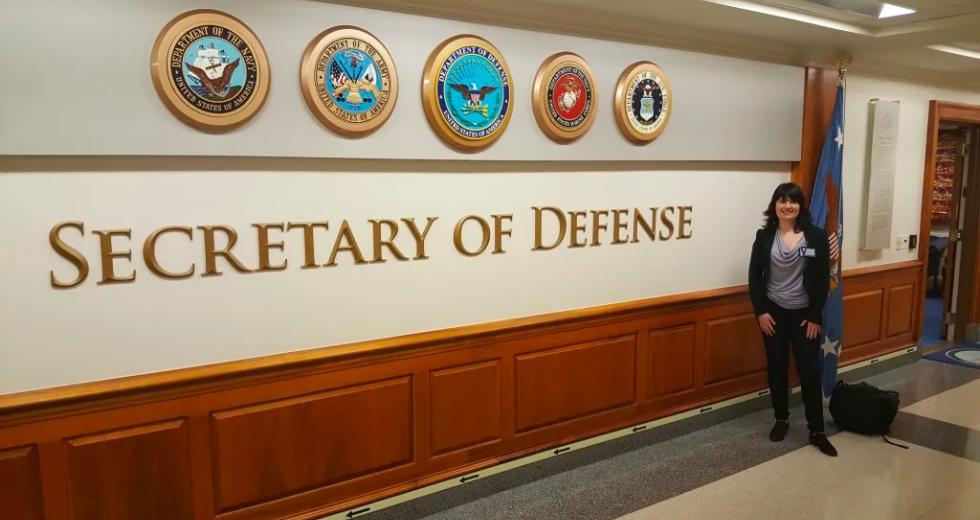
Invited to the Pentagon
While at the event, Briant discussed receiving an invitation to the Pentagon in the US. As a result, she left the event early to travel to this meeting on 10 June 2015 in Washington DC. She was met at the airport by Joel Harding, who by his own account — in a now-deleted blog post — had been “an enlisted soldier on a Special Forces Operational Detachment” before starting a career as a military intelligence officer.
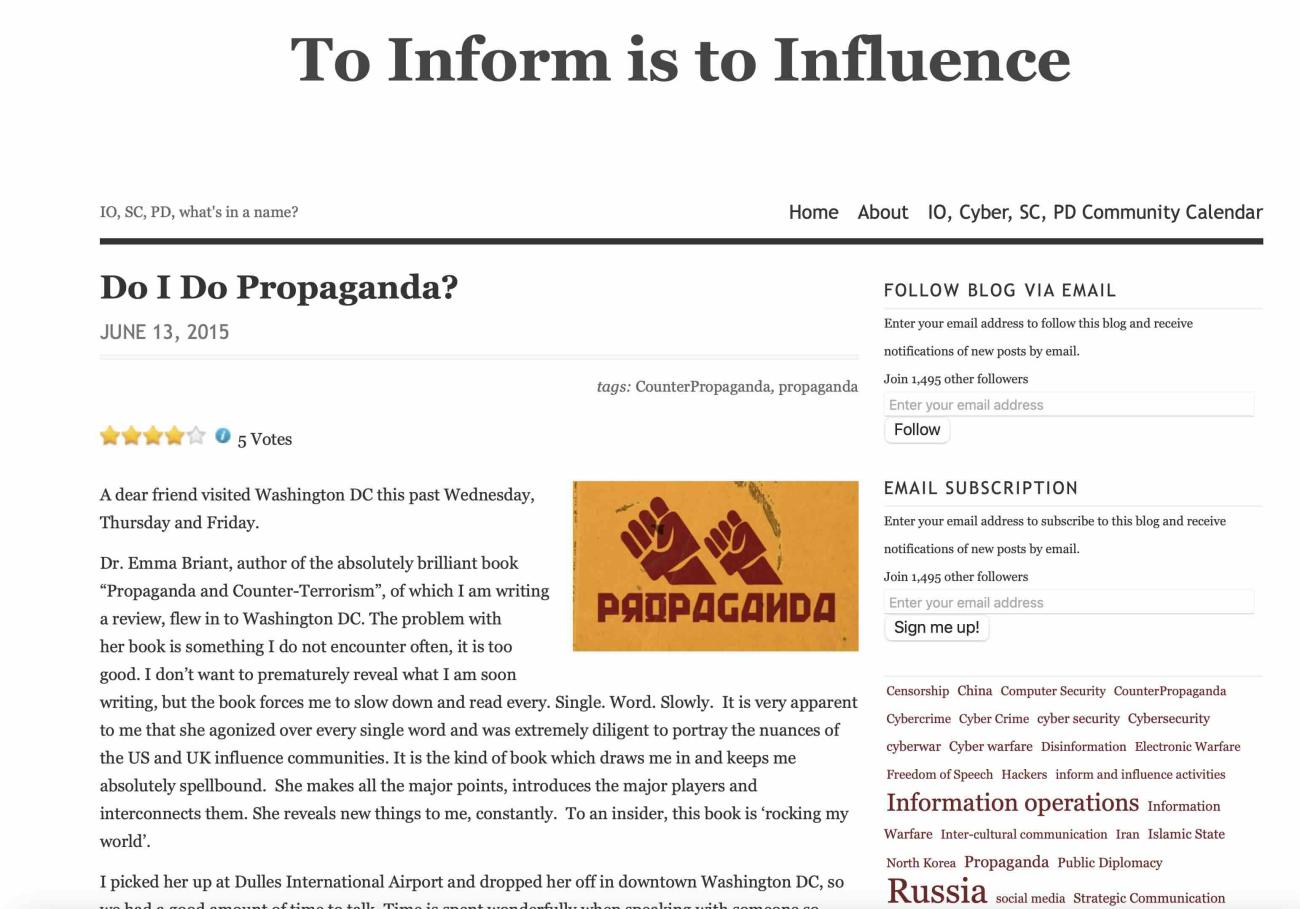
Joel Harding’s website shows connections with SCL and its director Nigel Oakes and mentions his involvement with the question of Ukraine.
Harding notes he has “worked and supported information operations at all levels” since the mid-1990s. Among those he thanked for their help in this regard were Nigel Oakes and Dr Lee Rowland, key figures in Strategic Communication Laboratories (SCL), the parent company of Cambridge Analytica, which conducted psychological warfare training and operations for NATO, and many member state governments and militaries. Harding said the pair showed him “what is possible in the art and especially the science of influence”.
The Cambridge Analytica scandal led to SCL’s closure, and a period of minor celebrity for Briant, as she was presented as a leading critic of the company’s operations once the story broke. This led to her serving as senior researcher for the Netflix documentary The Great Hack, a farcical conspiratorial fantasy that The Economist suggested would be used “as a testimonial” by Cambridge Analytica’s bosses if the company hadn’t shut down, such was its credulousness about the firm’s professed psychological wizardry.
Harding claimed on the aforementioned blog to “expose Russian propaganda”. He provided a disturbing example: “If the Azov Battalion in Ukraine uses symbology and gestures reminiscent of the German Nazi party of the 1930s and 40s, the reminiscence is the kernel of truth, after that the propaganda begins”.
Harding went on to refer to Briant as a “dear friend”, discussing how they drove into Washington DC and attended a Pentagon “workshop”. Curiously, this is not listed on a seemingly comprehensive section of her website documenting ‘Selected Conferences & Invited Talks’ she has attended and given since 2005. The question of which other events have mysteriously gone unmentioned there — and why — is an open and obvious one.
Certainly, Briant continued to cooperate with Harding after the trip. In November 2015, she circulated a call by Harding to recruit assets on an academic mailing list.
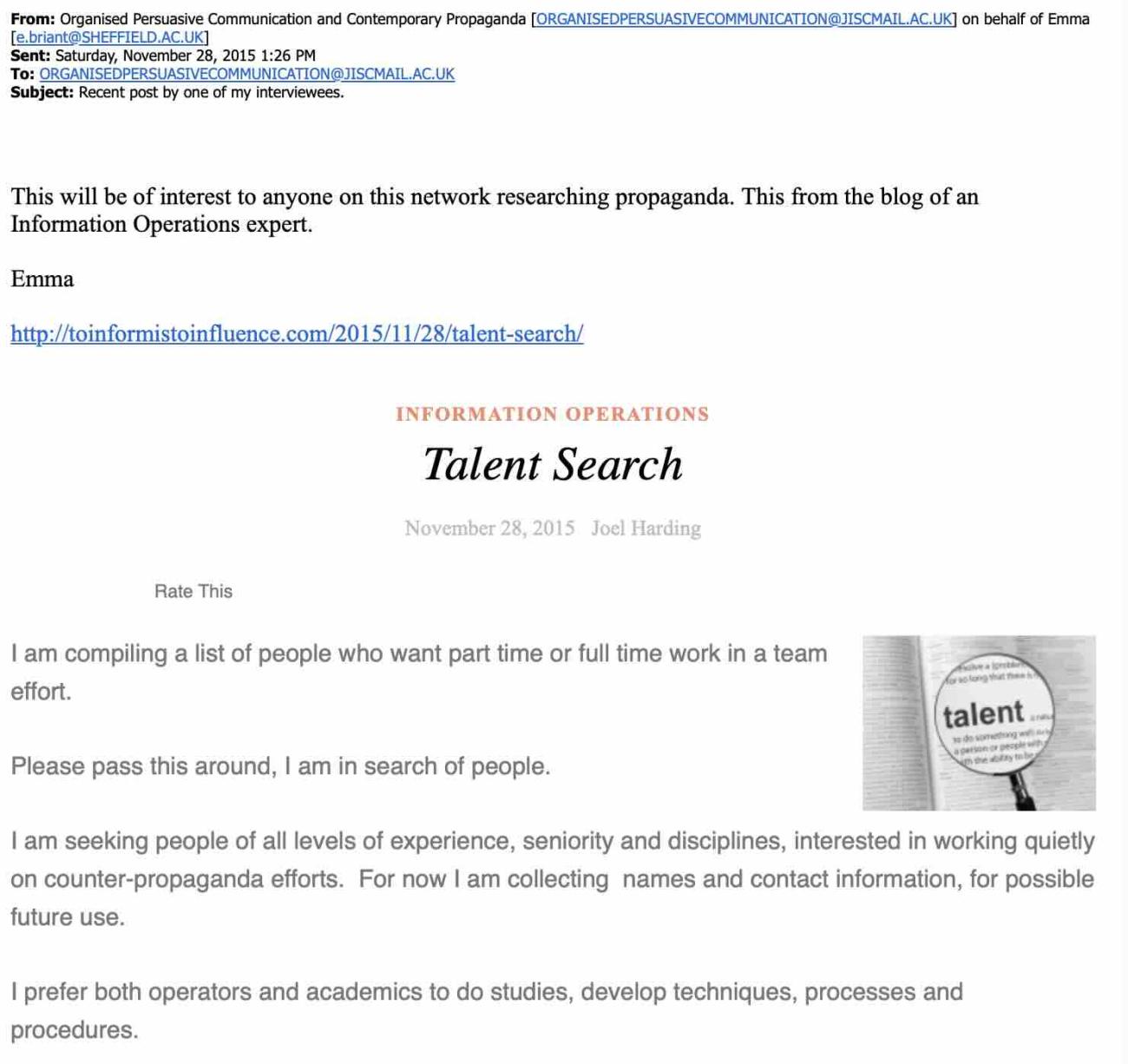
Briant apparently helping Joel Harding to recruit assets.
Prior to sharing this, Briant had sent it to me on 28 November 2015 asking if I could share it on the listserv, but “not saying it is from me please?” Two minutes later, she wrote, “Please remove my signature at the bottom before you post it!” I responded the same day: “Why are we sharing this?” Briant stated she was “worried having my name on it” in case it might be restricted, but she would now share it herself.
It seems, then, that already by 2015, Briant was complicit in high-level Western whitewashing of the Azov Battalion’s Neo-Nazi nature, which has been a key NATO talking point even before this incident. As we shall see in Part 2 of this investigation, she enthusiastically threw herself into this informational battle when the NATO proxy war in Ukraine flared in 2022.
Washington ReportFollowing her secretive journey to Washington, Briant wrote, in an email to me on 14 June 2015 that the trip was “enlightening to say the least — a window into another world was flung open beyond my wildest imaginings”. She gleefully added she had “been offered an unimaginable level of access to planning, at the moment off the record”, and invited to the Pentagon’s “next discussions” on these matters in July. Nonetheless, Briant displayed some recognition of the morally ambiguous role she was playing as a result, noting:
I did try to influence and challenge a few things I felt would be positive without going so far as to get flung out the room … I need to handle my ongoing research very carefully, it’s very much unchartered territory being invited in this deep, I am getting a real insight into things that is invaluable but I need to be careful not to be used.
Since Briant wrote those words, has she been careful enough? One might suggest not, given that:
In September 2015, she addressed a report on US information operations to the Director of the US Advisory Commission on Public Diplomacy.
In November 2015, she addressed a US Department of Defence ‘Strategic Multilayer Assessment Research Team’. The talk “went well” according to Briant’s subsequent account on 8 December 2015. She went on:
It was well attended (over 50 from across US gov't) and there were loads of questions … I received a flurry of emails from people about the talk after many of whom were challenging my stance especially my defence of Muslims and critique of Islamophobia among IO planners. They were all respectful and some quite accepting of my criticisms - I've been invited back to advise them further.
The PowerPoint presentation she used at the briefing (a copy of which is in my possession) did not use the word ‘Islamophobia’.
The next year, as her national security state contacts developed, she provided advice to the Pentagon on propaganda strategy. Briant drew on her “recent/current work on Iraq” to “highlight a couple of points/thoughts in response to the question you sent, in the hope they are helpful in some way”. Her willingness to help, rather than oppose the illegal occupation of Iraq, is emphasised by her use of dehumanising Western military terms like “within theatre”. She goes on to call for “understanding” of “the tragedy that has befallen Iraq”.
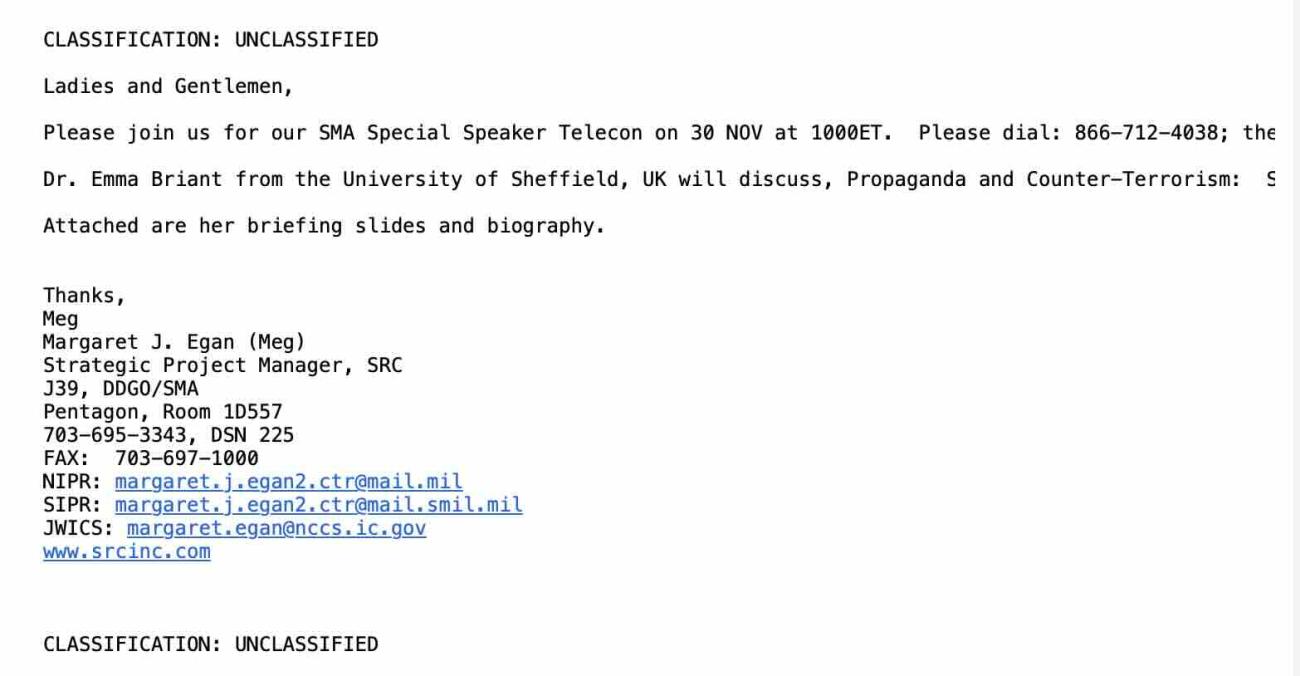
Announcement of Briant’s talk at the Pentagon, November 2015
But of course, the tragedy was imposed by the illegal US invasion and occupation; it did not ‘fall’ out of a clear sky. She advised, “It is essential [for the US] to evidence real ability to establish an effective and legitimate state”. In reality, it was essential then, and remains so now, that the US ends the occupation.
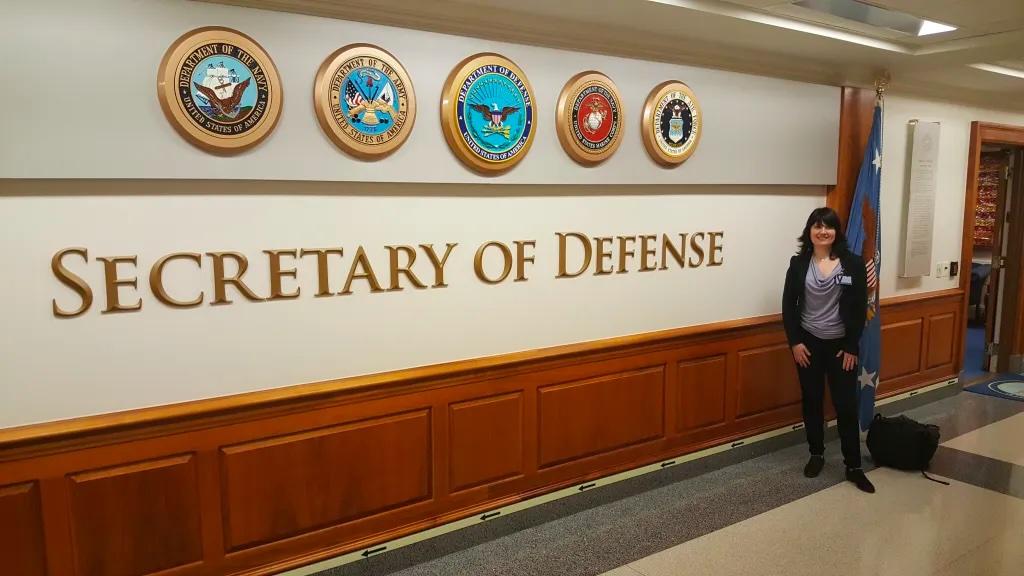
Briant poses at the Pentagon. Source
Back in Europe, in August 2015, Briant was an ‘invited participant’ to ‘StratCom Dialogue: Perception Matters’ run by the NATO Strategic Communication Centre of Excellence, Riga, Latvia. Among the governmental figures addressing the ‘high level session’ on ‘StratCom’s Role in NATO Transformation’ were the President, Prime Minister, and Foreign Minister of Latvia, the Polish Defence Minister, the Estonian Foreign Minister, and the Lithuanian Defence Minister.
Among those ‘contracted’ as ‘Subject Matter Expert’ advisors at the NATO centre was former British military and intelligence operative Steve Tatham. Presumably, Tatham and Briant conversed at this event (though they had met before when Briant interviewed Tatham for her 2014 book on propaganda and counter-terrorism).
During the year he spent at the NATO centre, Tatham “set up and edited the first journal of NATO Strategic Communications.” Briant was among those invited to join the editorial board of the new journal Defence Strategic Communications. Briant does not list this role on her LinkedIn page or her website.
At the time of this appointment, Briant appeared to recognise that it might be damaging to her reputation to be involved. She wrote to me in April 2015 on the overtures being made to her by operatives in the propaganda world following publication of her book on propaganda:
The reaction I received from Joel Harding, a Republican and IO operative who I quote in the book and who has seen a copy has been glowingly positive. He is offering to review it. I am getting a lot of interest from people I quote, rather amusingly SCL asked if I'd be interested in working with them, a suggestion of Nigel Oakes apparently. I sent a polite but vague reply stressing my concern to retain academic independence and that any collaborations would need to fall in line with the core concerns I highlight in my book, pointing them to take a look at that. I also have been invited to be on an editorial board for a new NATO journal 'Defence Strategic Communication', chaired by Steve Tatham! I could not have been more shocked. I actually have accepted that as I thought that perhaps I can be a positive influence on the journal, broaden the range of perspectives included in it. We shall see. Don't worry, I am not embracing a future career as a government-approved terrorologist! Do you know how you get considered for the more academic ones? I'm keen to balance it out! ;)
I responded the same day with the following advice: “Crossing to the dark side there!... You should probably not accept any more ‘propaganda’ propaganda journals until you get on some proper ones!”
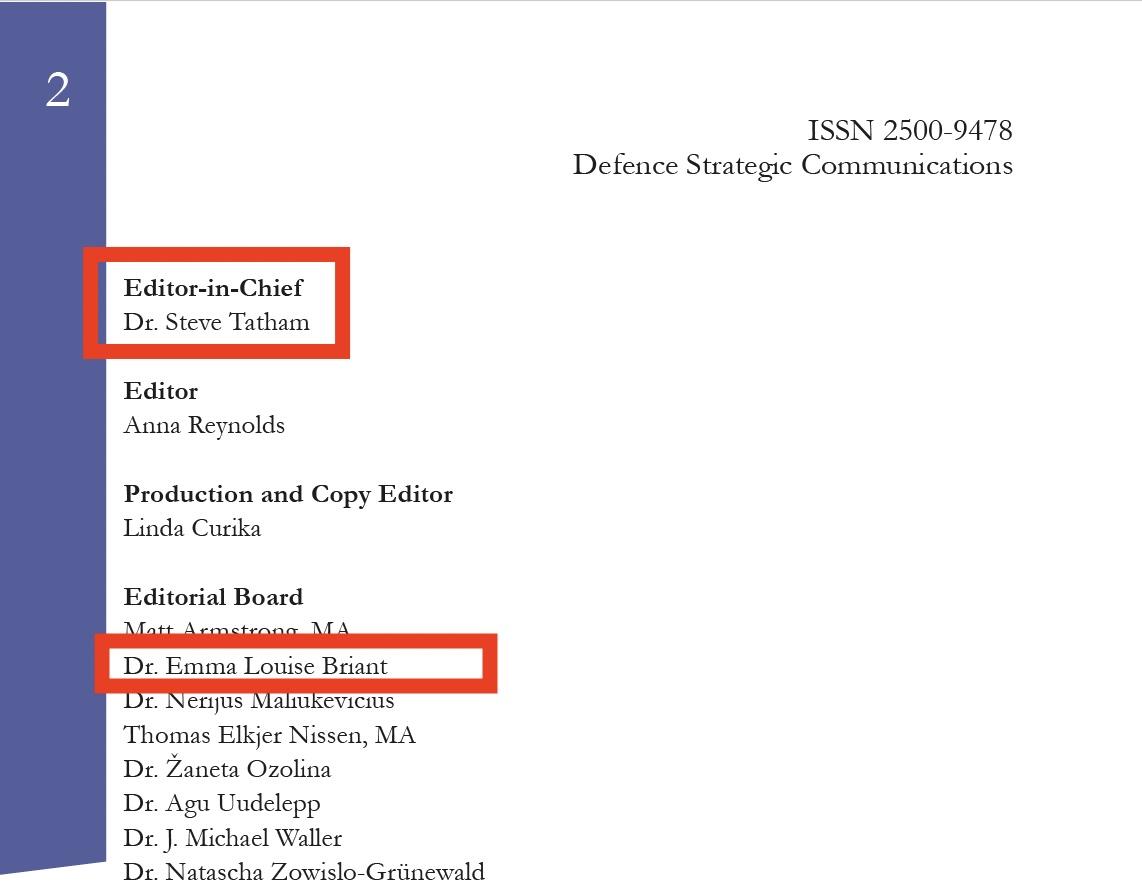
The first edition of Defence Strategic Communications, a NATO journal, winter 2015. Source
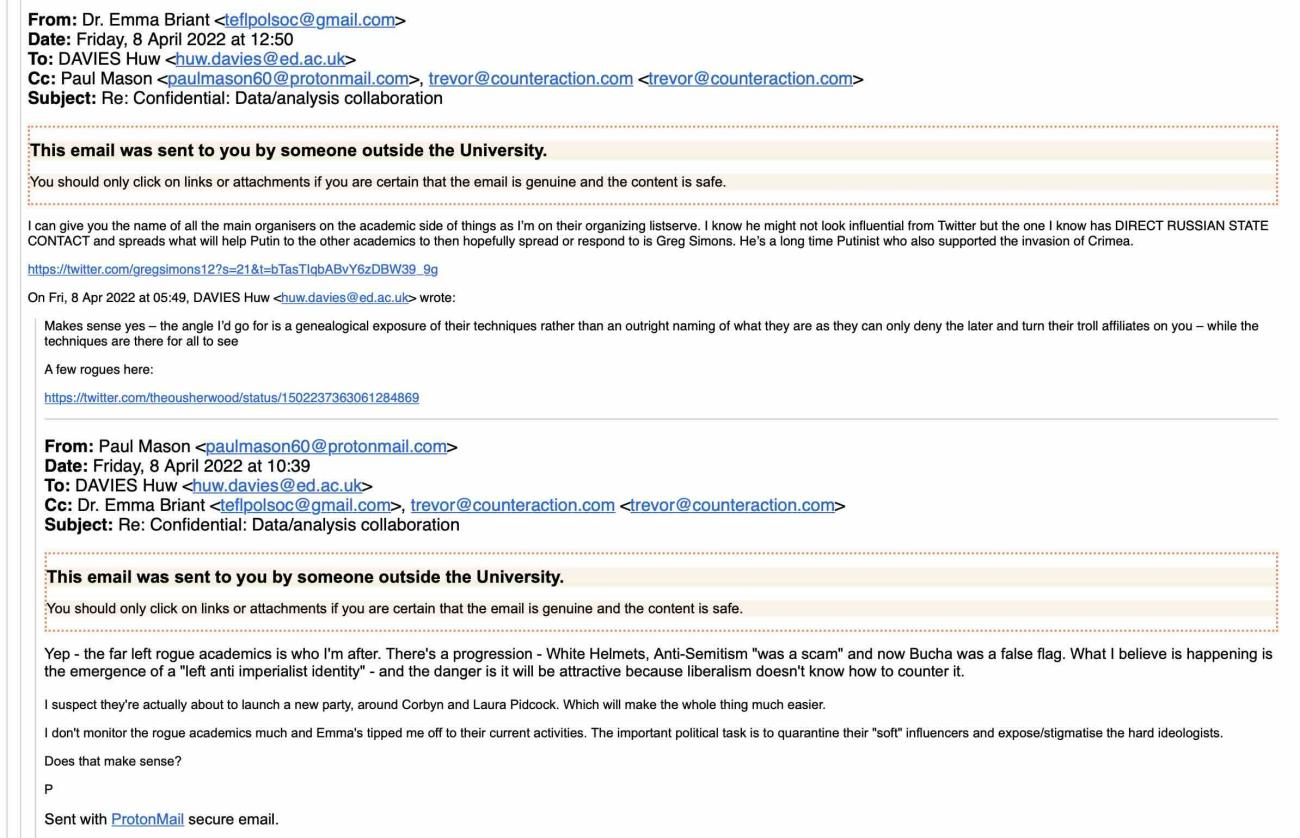
“I can give you the name of all the main organisers on the academic side of things as I am on their organizing listserve [sic]”. This author was one of the mentioned organisers, or “far left rogue academics”, as Paul Mason put it.
It is notable that although the journal is published by NATO which is a belligerent in several conflicts around the world, notably in Ukraine and Syria, as are its member states, Briant has never mentioned this conflict of interest in her academic publications after 2015.
Tatham had previously been commanding officer of the 15th Psyops Group of the British Army between July 2010-January 2013, and has also spent time working for British intelligence, a matter about which he has been somewhat shy.
- In 2009, he was appointed as Military Liaison Officer to the UK Cabinet Office’s Strategic Horizons Unit, part of the Joint Intelligence Organisation.
- His final appointment in the military was developing advanced Strategic Communication tools for the UK National Security Council, which is also part of the British intelligence apparatus, based in the Cabinet Office.
In his (now-deleted) biographical page on the Exeter University’s Strategy and Security Institute, cited in the preceding paragraph, he was also shy of giving the name of the specific part of the military to which he was attached.
Tatham went on to work at SCL Group, the parent of Cambridge Analytica, a company in which Briant became very interested from 2017. But she never wrote about the role that SCL and its associated companies played in facilitating western propaganda and disinformation, in particular in encouraging anti-Russian sentiment. Instead, she was more interested in the alleged role that Cambridge Analytica played in collaborating with Russia to undermine Western democracy — a role that, in retrospect, appears to have been a total fantasy. The importance of that scandal was that the firm used a huge amount of Facebook data to influence the US presidential elections and also the UK Brexit referendum in the interests of Russia. As it turned out, there was absolutely no evidence that this had happened either in the US or in the UK. Back in the real world, this document and other public information demonstrate that, on the contrary, SCL Group and its subsidiaries SCL Defence and Iota-Global (led by Tatham) were, in fact, working closely with Ukraine against Russia. This was even reported in the mainstream media, though the conclusion that the Russiagate hysteria was overblown did not percolate through.
Steve Tatham: Targeting RussiaIn addition to setting up this journal, Tatham’s activities in the period 2015-2020 involved close cooperation with NATO and with NATO members on strategic communication and, in particular, in the development of strategies to target Russia. It is these activities with which Briant was in agreement. But the problem was, as time went on, Tatham’s associations with Strategic Communications Laboratories, the parent of Cambridge Analytica. The Cambridge Analytica story, not at first, but as it developed, became about Russian influence, including in the US elections and Brexit. Briant dived enthusiastically into the Cambridge Analytica story, which began to make her raise questions about Tatham and his connections to the scandal. In reality, Tatham and SCL were embedded in pro-NATO networks and were directly involved in encouraging Russophobia.
Drakula’s blog and the alleged manipulation of “hack and leak”Tatham has been at the forefront of developing information warfare response to Russia in this period. SCL, for whom he worked, undertook a contract with the regime in Ukraine put in place following the US-supported coup. In 2014, his association with the National Defence Academy of Latvia’s Center for Security and Strategic Research resulted in a publication titled ‘NATO Strategic Communication: More to be Done?’ He co-wrote this with a Canadian army officer. Tatham was stated to be “currently the Special Project Officer in the MoD’s Military Strategic Effects (MSE) branch”. Military Strategic Effects is a propaganda unit in the MoD. It is the successor unit, created in 2013, to Targeting and Information Operations. According to a Ministry of Defence FoI release, MSE had 34 staff in mid-2018.
It was also noted that he retired from the UK military in June 2014. Following this, he joined SCL Defence and ran their contract with NATO which involved “StratCom training” and was paid for by the Canadian Government (at a cost of $1 million CAD) for Ukraine, Georgia, and Moldova.
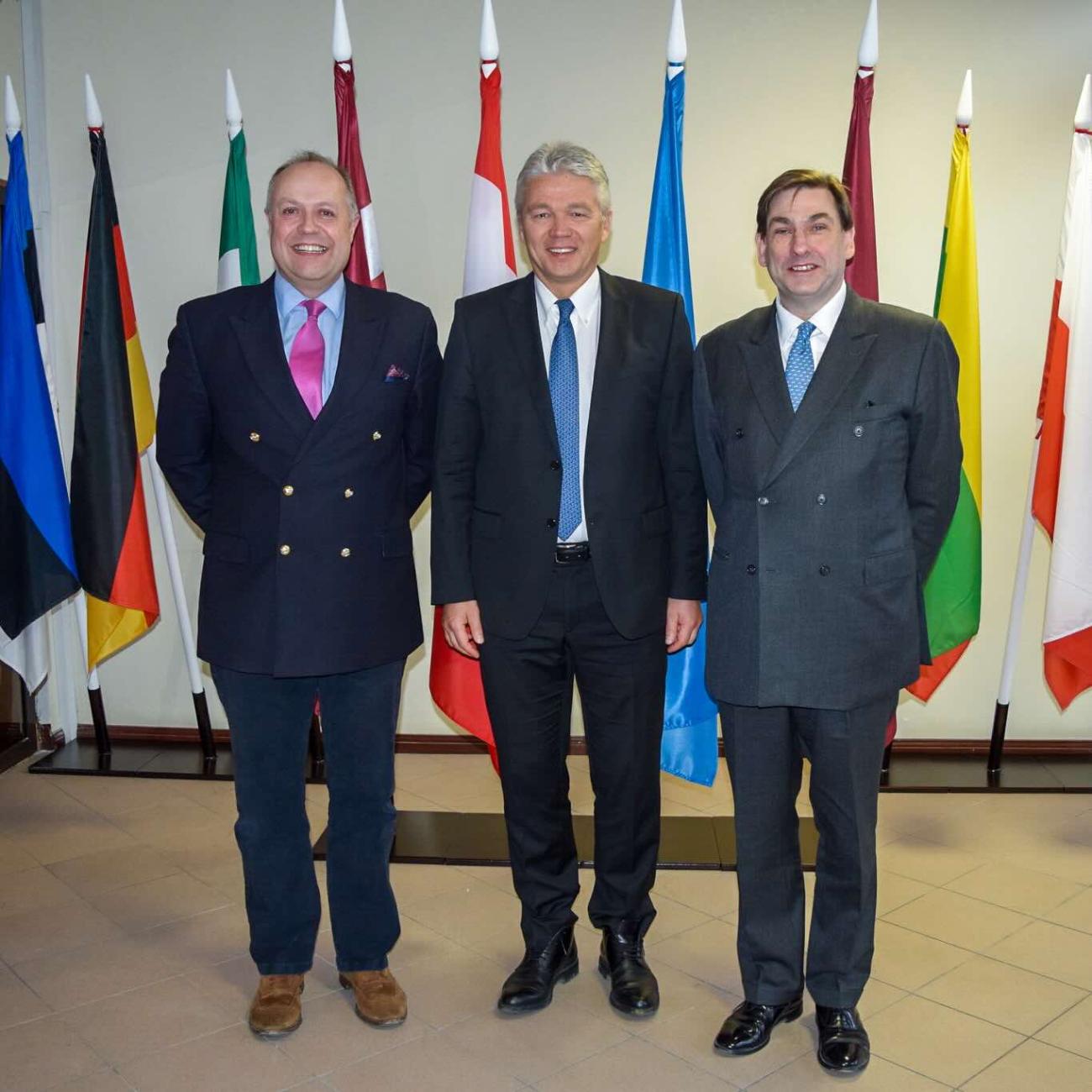
Steve Tatham (left) and his boss, Old Etonian Nigel Oakes (right), Riga, February 2015 |
The minutes of the meeting held in Riga on 9 February 2015 were later leaked to and published by the Romanian-based Drakula’s Blog. This was embarrassing, especially because it showed that Ukraine was doing very badly in the propaganda war. The ‘challenges’ it faced included:
- Lack of tangible results of either Anti-Terrorist Operation (ATO) or government reforms
- Lack of success stories
- Lack of trust of the population of the south/eastern regions in the central government
- Increased popularity of the Russian leadership among the population of the south/east of the country
When this was published on the blog, the response of Steve Tatham was to claim that the document had been manipulated.
Tatham claimed that:
- The level of distortion was higher in Russian-language sites, where NATO StratCom COE was portrayed as conducting a propaganda war to help Ukraine overthrow Putin.
- The extra bullet point added by Drakula’s Blog was included by most of the news outlets as an alleged revelation of NATO’s main concern in the Ukrainian conflict, e.g. on the Russian website Vzglyad(Взгляд.ру).
- Headlines in Russian distorted the original information considerably, e.g. Ridus (Ридус): ‘NATO Trying to Get Rid of Putin’.
Imagine Russian media having the temerity to believe that NATO was operating against Russia?
Most entertainingly, Tatham’s intervention had the effect of confirming the veracity of the leak, with the exception of the alleged minor alteration.
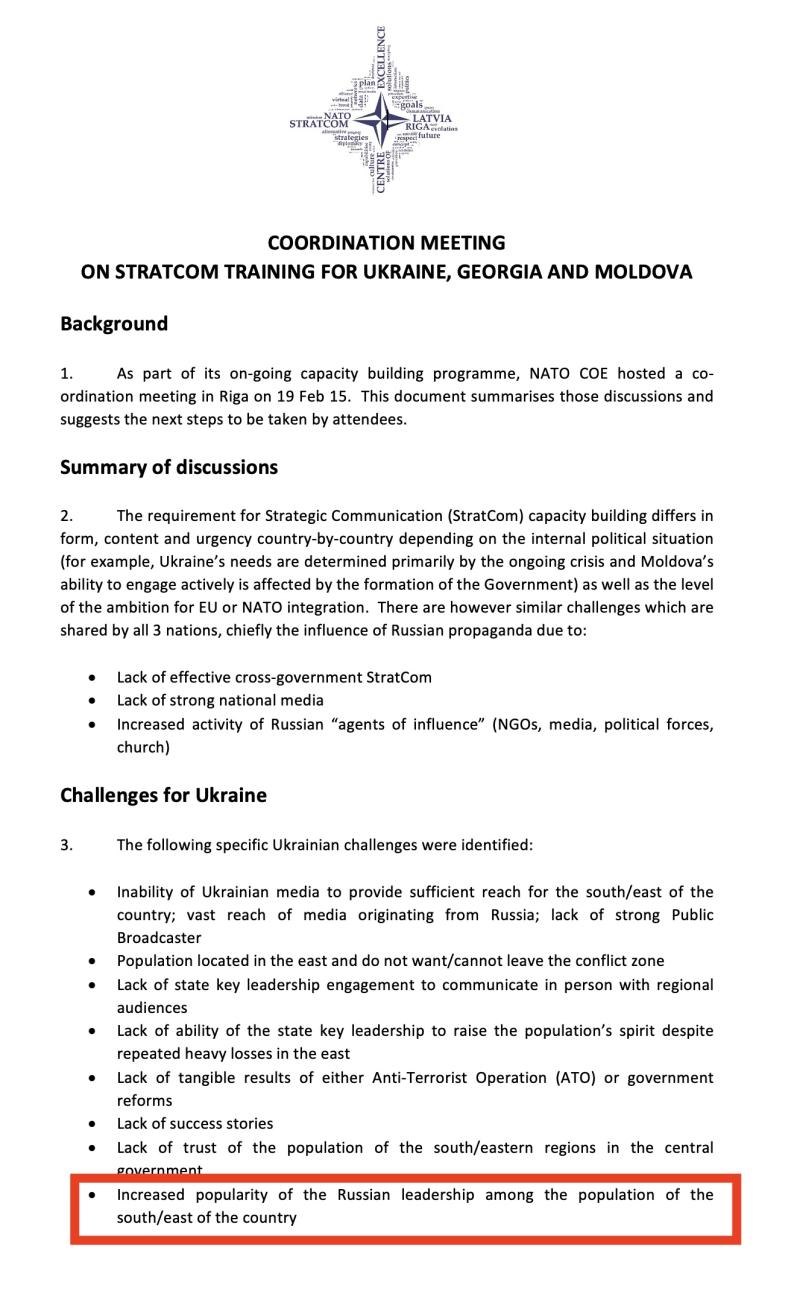
The leaked document with the allegedly added bullet point at the bottom. It is probably sensible to be sceptical of Tatham’s claims on this.
Amongst his work with NATO was a series of meetings to examine the challenges faced in strategic communications.
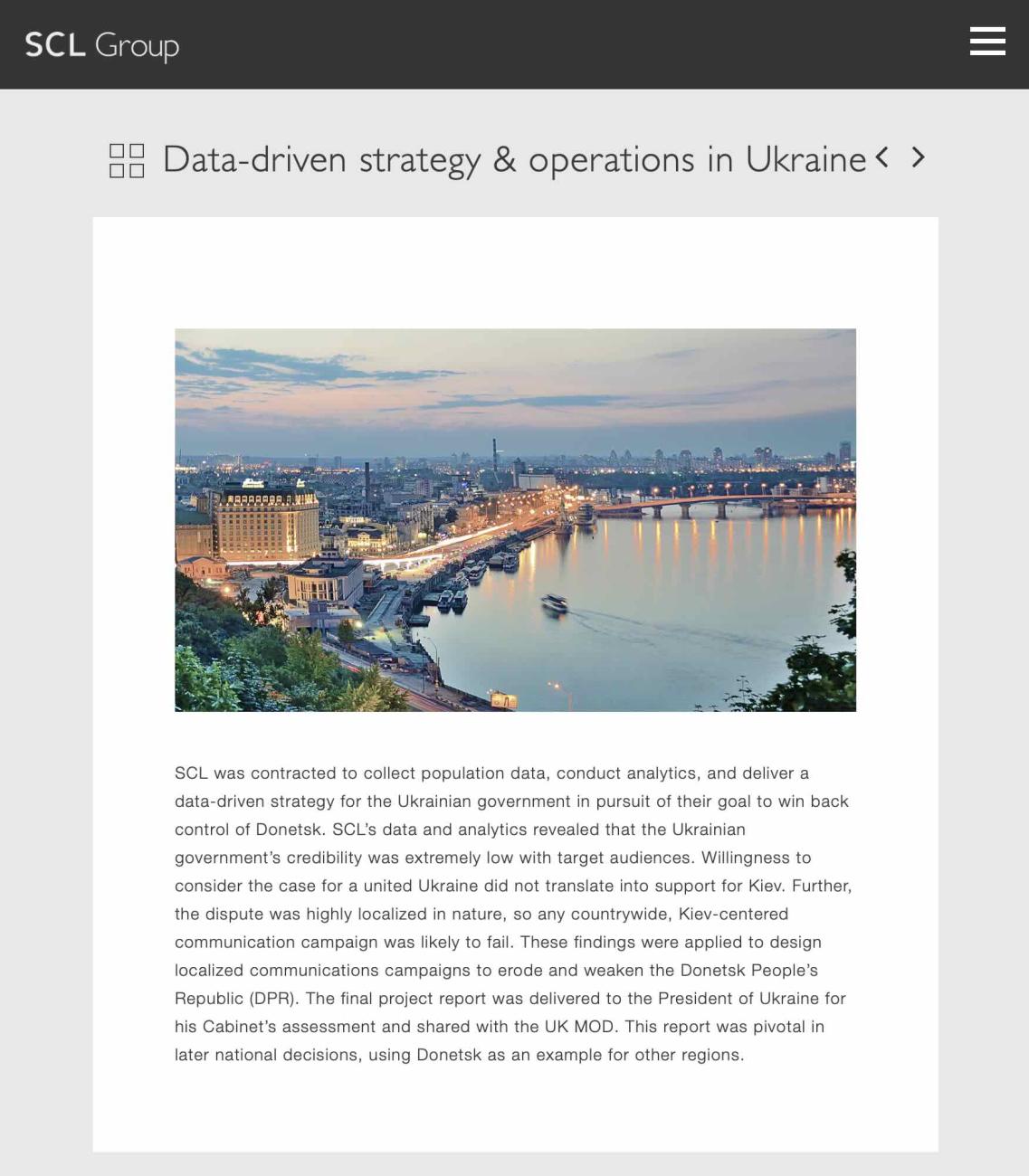
Now-deleted post on the SCL Group website on Ukraine. This makes it perfectly clear that the company was working against Russia and for the Nazi-infested government of Ukraine. Source
As the Cambridge Analytica story developed, Briant's relationship with Tatham did as well. He moved from being a colleague and co-conference attender to a person of research interest. In this process, Briant would sometimes email me with information about Tatham, which she affected to believe would be of interest to me, always making sure to ask that I keep her messages confidential, as in this example from 18 November 2015: “FYI - as usual, not from me”.
Scrutinising Tatham and SCL Defence?Tatham, SCL Defence, and IOTA-Global were thus regarded as part of the Cambridge Analytica Scandal. But of course, in reality, Tatham and the old Etonian Nigel Oakes, who ran SCL, were heavily implicated in conducting strategic communications against Russia for all of this period. This is of course the opposite of the charges implied against them by the journalist Carole Cadwalladr (and less directly Briant) and other partisans of the British intelligence-inspired ‘Russiagate’ narrative. Just as a reminder, it is worth citing Craig Murray’s extraordinary debunking post on the Cadwalladr cult amongst British liberals from 2022.
The most important piece of information to come out of Carole Cadwalladr’s current libel trial is perhaps the least reported: that she received material alleging links between Arron Banks, Vote Leave, and Russia from “a contractor to the UK security services”. The information came to light because, under discovery rules, she had to disclose a great deal of relevant material to Banks.
Here is something else I am pretty confident you did not know about Cadwalladr. Her great story for which she won the Pulitzer Prize was simply a lie. There was in fact no connection between Vote Leave or UKIP and the Brexit campaign and Cambridge Analytica. This is what the official investigation by the UK Information Commissioner uncovered. The entire glorious campaign of huge Guardian articles by Cadwalladr on how Cambridge Analytica, aided by Russia, won the Brexit vote, was in fact found to be entirely untrue.
Briant was a kind of junior Cadwalladr wannabe. When Briant wrote specifically about Tatham and SCL Defence (briefly mentioning IOTA-Global), she had nothing much to say about what they might be doing that was problematic. Let’s look briefly at the piece she wrote about the need to scrutinise SCL Defence on the SCL Group subsidiaries. Titled ‘Amid Shocking Revelations about Cambridge Analytica Unethical Activities, SCL Group’s Defence Work Needs Real Scrutiny’, it was published in Open Democracy in 2018.
She refers to SCL, Cambridge Analytica, SCL Defence, and IOTA-Global, and there is a fleeting reference to their work against Russia for NATO. But the real issue with SCL Defence, and with SCL/CA in general, is that their involvement in propaganda against the West’s official enemies disappears in the ideological requirement to focus on the wrong things: bad Russians and whether Cambridge Analytica was related to the rest of the SCL Group. She became increasingly propagandistic in her condemnations of alleged Russian influence, though like other purveyors of this narrative, she was never able to produce any evidence. Here is the introductory paragraph of a briefing she prepared for the Public Administration and Constitutional Affairs Committee of UK Parliament in 2021:
Since Russian efforts to influence the results in the UK’s Referendum on Membership of the European Union and the US Election of Donald Trump in 2016, concern about the role of ‘strategic leaks’ and truthful information algorithmically propelled within misleading influence campaigns with disinformation, as well as foreign intelligence operations, have all increasingly dominated national security concerns.
This is a farrago of speculation and falsehood.
In 2019, Briant contributed to the making of a documentary on the affair called The Great Hack. This also failed to provide the evidence in which its promoters blindly believed. The Economist noticed that the film’s focus on Cambridge Analytica meant that The Great Hack is too narrow but that when “it does, eventually, broaden out, it does so using innuendo and conflating different things, spookily intoning about Russians or populists”. The magazine of the capitalist class concluded that the film “is a misinformed documentary about misinformation”. However, we are now in a position to go further and suggest that it is a film about disinformation that was itself disinformation, sponsored, in this case, by the secret state.
Relations with Alicia Kearns MPBriant also appears to have been in contact with Alicia Kearns, another interesting intelligence-linked person in the propaganda world. Both Kearns and Briant contributed chapters to a book which came from the event at the University of Lund, titled Countering Online Propaganda and Extremism: The Dark Side of Digital Diplomacy, which was published in December 2018. This appears to have been the product of a conference, held in Lund by the editors of the book, which Kearns attended in October 2016. She may well have known Briant prior to this, given the fact that she tagged her in a tweet on attendance.
Kearns is, at the time of writing, Conservative MP for Rutland in the UK, as well as being the chair of the powerful Foreign Affairs Committee in Parliament. In that role, attained only months after being elected to the House of Commons, Kearns has started to make a name for herself as a bellicose cold warrior in calling for a declaration that Iran’s IRGC be declared a terrorist organisation. In the course of this, she has even called for the closure of a mosque in London. This is on the spurious fantasy grounds whipped up by the ultra-Zionist Jewish Chronicle that the Islamic Centre of England in Maida Vale, which is a community centre and mosque, is actually the “London office” of the IRGC.
A glance at Kearns’ LinkedIn page reveals an entirely blank career between her university days and her November 2019 election to Parliament. What on earth was she up to? Probably her first role in intelligence connected activities was in August 2014, when she joined the Counter-Daesh Coalition Communications Cell as its director. Here is a review of her ‘blank’ period from Kit Klarenberg:
Kearns’ work for the Cell variously included devising a “Prime Minister-approved communications strategy to defeat Daesh and support Syria,” leading the Foreign Office’s psychological warfare response to “Russian military activity” in Damascus, and representing London “at one-to-one meetings with Foreign Ministers, the most senior religious leaders of countries, NGOs, and foreign militaries for 15 countries.” Accordingly, her team delivered “overt and discreet communications campaigns” within Britain, and West Asia.
During this time, Kearns received three bonuses for “exceptional” work, and was nominated for the Foreign Office’s “exceptional policy delivery award.” A scathing internal review of the Cell’s activities, not intended for public consumption, was much less flattering. It concluded that these covert propaganda programs “were poorly planned, probably illegal and cost lives.”
The contractors Kearns supervised typically consisted of high-ranking military and intelligence veterans. Whether the spooks within these firms ever resigned their formal agency posts is unknown. Take for example InCoStrat, a shadowy cutout founded by former members of the British Army and Emma Le Mesurier, the wife of the late Syrian White Helmets founder and ex-military-intelligence officer James Le Mesurier. Emma Le Mesurier has admitted to being an MI6 officer, and acknowledged that her company conducted “covert influence ops.”
As head of the Cell, Kearns would meet with “former” MI6 representatives posted at these front groups every week, and “had the last say in everything.” It would be highly unusual for a civilian to be entrusted by British intelligence agencies to oversee the work of its operatives. This alone strongly suggests she was no ordinary Foreign Office employee during this time, but in fact, an MI6 officer.
After presiding over the spook-infested anti-ISIS Cell, Kearns moved on to Torchlight Group – yet another British intelligence front. From 2017 to 2019, Kearns held a position with Torchlight as a “freelance consultant” on “violent extremism, counter-disinformation, hybrid warfare and behaviour change programmes for governments, militaries and NGOs.”
Unsurprisingly, the company was and remains staffed by former high ranking spies and soldiers specialized in tasks such as training repressive governments in GCHQ’s dirty tricks, spying on Palestinian refugees, and infiltrating foreign security and intelligence services on London’s behalf.
Whatever the precise relationship in the past between Kearns and the intelligence agencies, it seems clear that she is devoting herself to being an asset of MI6 in her parliamentary career so far.
The Russian “Hack and Leak” TropeBy 2021, Briant was advising the Home Office in response to a call for evidence on the issue of alleged “hack and leak” attacks in recent years, “where documents have been obtained and then released in Russian propaganda and ideological blogs accompanied by analysis that is both ill-informed and often ill-motivated”. Typically, she does not provide evidence or examples of such activities. Her pursuit of this line of argument puts her very much in the same camp as others denouncing alleged “hack and leak” operations such as Steve Tatham, Paul Mason, and his handler Andy Pryce, with all of whom Briant has been in touch (even if only indirectly in the case of Andy Pryce).
More recently, the pro-NATO (and now former) SNP MP Stewart McDonald has resorted to this trope. McDonald told the BBC:
If it is indeed a malicious state-backed group, then, in line with what I’ve seen elsewhere, I expect them to dump some of the information online. And I can expect them to manipulate and fake some of that content and I want to get out ahead of that to ensure any disinformation attack against me is discredited before it’s even published.
Unsurprisingly, Briant is in the same territory when it comes to Ukraine, which we will examine in Part 2 of this article.
ConclusionThis article has examined the trajectory of Emma Briant, a minor British academic who became ensnared in UK and US intelligence networks. The extent to which she knew what she was doing may be open to some doubt. However, the evidence cited in this article to my mind suggests a process whereby Briant became socialised into the worldviews of her interlocutors, but in part probably because she shared some of their assumptions and this helped to bring her on board, especially in relation to Russia, and, as we will see in the next part of this article, on the question of Ukraine.